
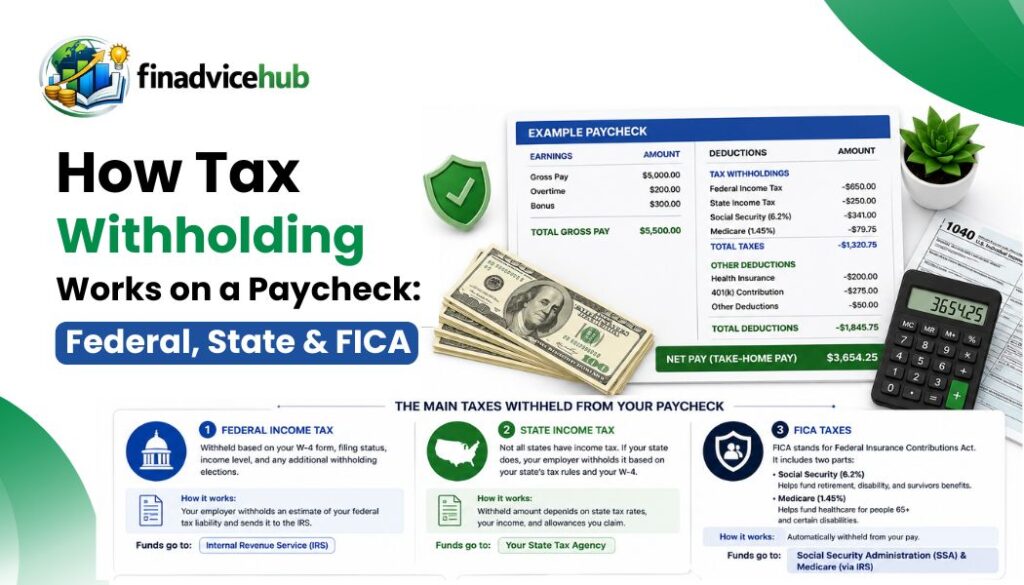
Seeing your paycheck amount after taxes can be confusing. Many employees look at their gross salary and wonder why the amount deposited into their bank account is lower. The difference comes from several deductions that happen before you receive your wages, including federal income tax, state taxes, Social Security, and Medicare.
How tax withholding works on a paycheck is important for knowing exactly where your money goes, why deductions change from one paycheck to another, and how to avoid surprises during tax season. A simple paycheck tax withholding explained guide can help you understand how payroll deductions are calculated and why your take-home pay may differ from your gross salary.
Whether you are starting your first job, receiving a pay rise, changing employers, or reviewing your annual tax return, knowing how paycheck tax withholding works gives you better control over your finances.
This guide explains the complete paycheck tax process, including how taxes are deducted from salary, how employers calculate withholding, how the W-4 form affects deductions, and how federal, state, and FICA taxes work together. You will also learn how to estimate your paycheck tax calculation and adjust your withholding when needed.
What Is Tax Withholding in Payroll
Definition of withholding
Tax withholding is the amount of money an employer removes from an employee’s paycheck to cover expected tax obligations. Instead of receiving your full salary and paying taxes later, a portion of your earnings is automatically sent to government agencies throughout the year.
Knowing how tax withholding works paycheck helps employees understand why their gross salary is different from the amount they actually receive. When you receive a paycheck, you usually see several lines under deductions. These may include federal income tax withholding, state income tax, Social Security tax, Medicare tax, retirement contributions, health insurance premiums, and other deductions.
The purpose of withholding is to spread tax payments throughout the year rather than requiring employees to pay one large tax bill after the year ends. This system makes tax collection more predictable for both workers and the government.
For example, if an employee earns $60,000 per year, they typically do not receive the entire $60,000. Each paycheck includes deductions calculated based on expected taxes and employee choices.
Why employers withhold taxes
Employers are responsible for collecting and submitting certain payroll taxes on behalf of their employees. Federal law requires employers to withhold specific taxes from wages and send those payments to government agencies.
The employer does not keep the withheld money. Instead, the company acts as a middleman between employees and tax authorities. The payroll department calculates deductions, records them, and transfers the required amounts.
Without payroll withholding, employees would need to calculate and pay their own taxes throughout the year. While some workers do make estimated tax payments separately, most employees rely on the employer withholding system.
The withholding process also helps employees avoid forgetting tax payments or facing a large tax balance at the end of the year.
Pay-as-you-earn system
The U.S. uses a pay-as-you-earn withholding tax system. This means employees generally pay taxes gradually as they earn income rather than waiting until tax filing season.
Each paycheck represents a small payment toward your annual tax responsibility. The employer estimates your tax amount using information from your tax forms, payroll records, and government withholding rules.
However, withholding is only an estimate. The final amount of tax you owe is determined when you file your annual tax return. If too much was withheld, you may receive a refund. If too little was withheld, you may owe additional taxes.
Overview of payroll taxes
Payroll taxes are taxes connected to employee wages. Some are deducted directly from employee paychecks, while others are paid separately by employers.
The most common paycheck taxes include:
- Federal income tax
- State income tax (where applicable)
- Local income taxes (in certain areas)
- Social Security tax
- Medicare tax
Employees may also see other paycheck deductions that are not technically payroll taxes, such as retirement contributions, insurance premiums, or flexible spending accounts.
The following table provides a simple payroll taxes breakdown:
| Tax Type | Who Pays | Purpose | How Calculated |
| Federal Income Tax | Employee | Funds federal government programs | Based on income, filing status, and tax brackets |
| Social Security Tax | Employee + Employer | Retirement and disability benefits | Percentage of wages up to annual limit |
| Medicare Tax | Employee + Employer | Healthcare funding | Percentage of wages |
| State Income Tax | Employee | State government funding | Depends on state rules |
| Local Tax | Employee (where applicable) | City or local services | Depends on local regulations |
Types of Taxes Taken From a Paycheck
Many employees ask, “What taxes are taken out of paycheck USA?” The answer depends on where you live, how much you earn, and your personal tax situation. However, most workers see federal income tax and FICA taxes on every paycheck, while state and local taxes depend on location.
Your paycheck tax deductions are not calculated as one single percentage. Each tax follows different rules, rates, and calculation methods.
Federal income tax
Federal income tax is usually the largest income-based deduction on an employee’s paycheck. This money goes to the federal government and helps fund national programs, services, and government operations.
Unlike FICA taxes, federal income tax is not calculated using one fixed percentage. The United States uses a progressive tax system, meaning higher portions of income may be taxed at higher rates.
Employers calculate federal withholding based on several factors, including:
- Employee wages
- Pay frequency
- Filing status
- Information entered on Form W-4
- Additional withholding requests
For example, an employee earning $50,000 annually may not pay the same percentage of federal tax as someone earning $150,000 because their income falls into different tax brackets.
State income tax
State income tax works similarly to federal income tax, but the rules depend on the employee’s state.
Some states use progressive tax brackets, while others have flat income tax rates. A few states do not charge personal income tax at all.
Because state laws vary, two employees with identical salaries can have different paycheck deductions simply because they live in different locations.
A worker in a state with a 5% income tax rate may see regular state withholding, while someone living in a state without income tax may not have that deduction.
Social Security tax
Social Security tax is one part of FICA taxes. It helps fund retirement benefits, disability benefits, and survivor benefits provided through the Social Security program.
Employees contribute a percentage of their wages toward Social Security through automatic paycheck deductions. Employers contribute an equal amount separately.
Unlike federal income tax, Social Security tax is generally calculated using a fixed percentage rather than tax brackets.
The deduction continues until an employee reaches the annual Social Security wage limit. After reaching that limit, additional wages are not subject to Social Security tax for that year.
Medicare tax
Medicare tax is the second major part of FICA taxes. It helps fund Medicare healthcare benefits.
Employees and employers each contribute a percentage of wages toward Medicare. Unlike Social Security tax, Medicare tax does not have an annual wage limit.
Higher-income employees may also pay an additional Medicare tax on earnings above a certain threshold.
As Medicare calculations are separate from income tax calculations, to understand FICA taxes, you need to look at Social Security and Medicare independently.
How Federal Income Tax Withholding Works
Federal income tax withholding is often the most confusing part of a paycheck because it does not follow a simple fixed percentage. The amount removed from your wages depends on your earnings, filing status, information reported on your W-4 form, and IRS withholding rules.
Understanding how federal tax withholding is calculated paycheck requires looking at several factors working together. Your employer does not decide your final tax amount. Instead, payroll systems estimate your annual tax responsibility and divide that amount across your pay periods.
For example, an employee paid every two weeks has 26 paychecks per year. The payroll system calculates an estimated withholding amount for each paycheck so taxes are collected gradually throughout the year.
Role of tax brackets
Tax brackets determine how different portions of your income are taxed. The United States uses a progressive tax system, meaning income is divided into levels, and each level may have a different tax rate.
A common misunderstanding is that moving into a higher tax bracket means all your income is taxed at the higher rate. In reality, only the income within that specific bracket is taxed at that rate.
For example, imagine an employee earns enough income to enter a higher tax bracket. The first portion of income is still taxed at lower rates, while only the additional income above the threshold is taxed at the higher rate.
This progressive system is why federal withholding cannot be calculated simply by multiplying your salary by one tax percentage.
W-4 form impact
The W-4 form is one of the most important documents affecting your paycheck tax deductions. Employees complete this form when starting a new job or whenever they want to update their withholding information.
The information on your W-4 tells your employer how much federal income tax should be withheld from each paycheck.
The form considers factors such as:
- Filing status
- Multiple jobs
- Spouse income
- Dependents
- Additional income
- Extra withholding amounts
A better sense of how the W4 form affects tax withholding can help employees avoid any major surprises during tax season.
For example, an employee who claims eligible credits or deductions may need less tax withheld. Another employee with additional income from freelance work may choose extra withholding to cover future tax obligations.
A W-4 does not determine how much tax you owe. It only helps your employer estimate how much should be paid throughout the year.
IRS withholding tables
Employers use IRS withholding tables and payroll calculation methods to determine federal tax deductions.
Payroll software applies government formulas based on:
- Employee wages
- Pay period frequency
- W-4 information
- Current tax rules
The payroll system then calculates the amount to remove from each paycheck.
For example, an employee earning $4,000 per month does not simply have a fixed percentage removed. The payroll system estimates annual income, applies withholding rules, accounts for W-4 information, and determines the monthly deduction.
Because tax laws and withholding tables can change, paycheck deductions may change from year to year even if your salary stays the same.
Example calculation
Consider an employee earning $60,000 annually and receiving monthly paychecks.
The employee earns:
Annual salary: $60,000
Monthly gross pay: $5,000
The employee completes a W-4 indicating their filing status and applicable adjustments. Based on IRS withholding calculations, the employer estimates a federal income tax deduction.
A simplified example might look like:
| Item | Amount |
| Monthly gross pay | $5,000 |
| Estimated federal withholding | $450 |
| Social Security tax | $310 |
| Medicare tax | $72.50 |
| Remaining pay before other deductions | $4,167.50 |
This is only an illustration. Actual withholding depends on the employee’s complete tax situation.
How FICA Taxes Are Calculated
FICA taxes are separate from federal and state income taxes. The Federal Insurance Contributions Act (FICA) requires employees and employers to contribute toward Social Security and Medicare programs.
A complete paycheck tax calculation USA requires including FICA because these deductions apply to most employees.
Unlike income taxes, FICA taxes generally use fixed rates, making them easier to estimate.
Social Security rate
Social Security tax is calculated as a percentage of employee wages.
The employee contribution rate is currently:
Social Security tax: 6.2% of wages
Employers contribute an additional 6.2%, creating a combined contribution toward the Social Security program.
For example:
An employee earns $3,000 in one paycheck.
Social Security calculation:
$3,000 × 6.2% = $186
The employee would see approximately $186 deducted for Social Security tax.
The actual calculation may vary depending on wage limits and current tax rules.
Medicare rate
Medicare tax is calculated separately from Social Security tax.
The standard employee Medicare contribution is:
Medicare tax: 1.45% of wages
Example:
Employee paycheck:
$3,000
Medicare calculation:
$3,000 × 1.45% = $43.50
The employee would have approximately $43.50 deducted for Medicare tax.
Higher-income employees may also pay an additional Medicare tax once their earnings exceed the applicable threshold.
Wage limits
Social Security tax has an annual wage limit. This means only wages up to a certain amount are subject to Social Security tax each year.
Once an employee reaches that limit, Social Security deductions stop for the remainder of the year.
Medicare works differently. Medicare tax applies to all covered wages, meaning there is no equivalent wage cap.
This difference is important when reviewing a paycheck late in the year. Some high-income employees notice that their Social Security deduction disappears after reaching the wage limit while Medicare deductions continue.
Employer vs employee share
Both employees and employers contribute to FICA taxes.
The responsibility is divided as follows:
| Tax | Employee Pays | Employer Pays |
| Social Security | 6.2% | 6.2% |
| Medicare | 1.45% | 1.45% |
The employee portion appears directly on the paycheck. The employer portion does not reduce the employee’s take-home pay because it is paid separately by the company.
How State & Local Taxes Work
Federal taxes apply across the United States, but state and local taxes depend on where an employee lives and works.
This is why employees often see different paycheck deductions even when they earn identical salaries. A worker in California, New York, or another state with income tax may have state withholding, while someone in a state without income tax may not.
State and local withholding rules create another layer in the full withholding system breakdown.
States with income tax
Most states collect personal income taxes from residents and workers earning income within the state.
State income tax systems vary widely. Some states use progressive tax brackets, while others use flat tax rates.
For example, one state may apply different rates depending on income level, while another may charge the same percentage for all taxable income.
Employers generally calculate state withholding using:
- Employee wages
- State tax rules
- State withholding forms
- Filing status information
Employees who move between states may notice major changes in paycheck deductions even if their salary remains unchanged.
States without income tax
Some states do not impose a personal income tax on wages.
Employees living in these states generally do not see state income tax deductions from their paychecks.
However, residents may still pay other types of taxes, such as:
- Sales taxes
- Property taxes
- Other state fees
A paycheck without state income tax does not necessarily mean the employee pays fewer taxes overall.
Local tax rules
Some cities and local governments impose additional income taxes. These local payroll taxes may apply based on where employees live or where they work.
For example, an employee working in a city with a local wage tax may see an additional deduction listed separately on their paycheck.
Local tax rules are usually smaller than federal or FICA deductions, but they can still affect take-home pay.
Example calculation
Suppose an employee earns $4,000 monthly and works in a state with a 4% income tax rate.
A simplified state tax withholding example paycheck:
| Description | Amount |
| Monthly gross pay | $4,000 |
| State income tax rate | 4% |
| Estimated state withholding | $160 |
Actual state withholding may differ because many states use deductions, credits, and withholding tables rather than a simple percentage.
Step-by-Step Paycheck Tax Calculation Example
Examining a full pay slip makes the entire process easier to visualise. The following example illustrates how gross wages are converted into take-home pay after common deductions are made.
Gross pay setup
Assume an employee earns:
Annual salary: $72,000
Pay schedule: Monthly
Monthly gross pay: $6,000
The employee lives in a state with income tax and has standard W-4 information.
Before taxes are removed, the employee’s paycheck starts with the full gross amount:
Gross pay: $6,000
This is the amount earned before deductions.
Applying withholding
The employer calculates different taxes separately.
Example:
| Deduction | Amount |
| Federal income tax | $650 |
| State income tax | $240 |
| Social Security tax | $372 |
| Medicare tax | $87 |
| Total taxes | $1,349 |
The employee does not receive the entire $6,000 because taxes are collected before payment.
Calculating FICA
FICA calculations:
Social Security:
$6,000 × 6.2% = $372
Medicare:
$6,000 × 1.45% = $87
Total FICA:
$372 + $87 = $459
These deductions are separate from income tax withholding.
Final tax deduction
Complete paycheck tax deduction breakdown example:
| Category | Amount |
| Gross pay | $6,000 |
| Federal income tax | -$650 |
| State income tax | -$240 |
| Social Security | -$372 |
| Medicare | -$87 |
| Total taxes deducted | -$1,349 |
| Estimated take-home pay | $4,651 |
Additional deductions such as health insurance or retirement contributions could further reduce the final paycheck amount.
Why Tax Withholding Varies Between Employees
Many employees are surprised when they compare paychecks with coworkers and notice that people earning similar salaries may have different tax deductions. This happens because paycheck withholding is not based only on income.
Factors such as filing status, dependents, additional income, benefits, retirement contributions, and W-4 information can all change the amount withheld.
Understanding why paycheck tax withholding varies helps employees avoid assuming that a different deduction amount means someone is paying more or less tax unfairly. The withholding system is designed to reflect each employee’s individual tax situation.
Filing status differences
Filing status is one of the biggest factors affecting federal income tax withholding.
Employees typically select a filing status such as:
- Single
- Married filing jointly
- Head of household
Each status has different tax rules, deductions, and withholding calculations.
For example, two employees may both earn $70,000 per year. One employee may file as single, while another may be married filing jointly with a spouse who has little or no income. Their federal withholding amounts may look very different because their expected annual tax liabilities are different.
This is why payroll systems use W-4 information instead of applying the same tax percentage to every employee.
Number of dependents
Dependents can affect withholding because they may qualify an employee for certain tax credits.
An employee with eligible children or other dependents may adjust their W-4 information to reflect those credits. This can reduce the amount of federal tax withheld from each paycheck.
For example, an employee supporting two qualifying children may have lower federal withholding than another employee with the same salary and no dependents.
However, employees should enter dependent information carefully. Incorrect estimates can result in either too much withholding or an unexpected tax bill.
Income level impact
Income level directly affects several paycheck tax calculations.
Higher-income employees may experience:
- Higher federal income tax withholding
- Additional Medicare tax
- Different tax bracket effects
- Changes in available deductions and credits
A person earning $40,000 annually and someone earning $200,000 annually may both pay payroll taxes, but their overall tax calculations will not look the same.
The progressive tax system means income increases can affect the percentage of income paid toward federal taxes.
Benefits and deductions
Employee benefits can also change taxable income and paycheck deductions.
Common examples include:
- Retirement plan contributions
- Health savings accounts
- Flexible spending accounts
- Certain employer benefits
Some deductions reduce taxable wages, which can lower income tax withholding.
For example, an employee contributing money to a traditional retirement plan may have a lower taxable income than someone earning the same salary without retirement contributions.
This is another reason why a paycheck tax breakdown must be reviewed as a complete picture rather than focusing on one deduction line.
How to Adjust Your Tax Withholding
Tax withholding is not permanent. Employees can update their information and change how much tax is removed from each paycheck.
Adjusting withholding can help employees better match their paycheck deductions with their expected annual tax bill.
Some employees prefer receiving larger paychecks throughout the year, while others prefer receiving a larger refund after filing taxes. The goal is to find a withholding amount that works for your financial situation.
Updating W-4 form
The main way employees adjust federal withholding is by submitting an updated Form W-4 to their employer.
You may consider updating your W-4 after major life changes, including:
- Getting married
- Having a child
- Starting a second job
- Receiving a large salary increase
- Changing retirement contributions
- Experiencing significant changes in deductions
A W-4 update does not change your tax rate. It changes the estimated amount your employer removes from each paycheck.
Employees can usually submit a new W-4 through their company payroll system or human resources department.
Increasing or decreasing withholding
Employees can request additional withholding if they expect to owe more taxes than their current paycheck deductions cover.
For example, someone with freelance income may ask their employer to withhold extra federal tax from each paycheck to reduce the chance of a tax bill later.
On the other hand, some employees may have too much withheld and choose to reduce withholding.
Learning how to reduce tax withholding can increase take-home pay during the year. However, reducing withholding too much may create an underpayment problem.
The best approach is to estimate your annual tax responsibility before making changes.
Avoiding underpayment penalties
Under-withholding happens when not enough tax is removed from paychecks during the year.
This may occur when:
- Income increases significantly
- A person starts additional work
- W-4 information is outdated
- Tax credits or deductions change
If withholding is too low, the employee may owe taxes when filing their return and may face penalties in certain situations.
Employees with changing financial situations should review their withholding periodically instead of waiting until tax season.
Planning for refunds
A tax refund means you paid more during the year than your final tax bill required.
While many people enjoy receiving refunds, a large refund also means they gave the government more money throughout the year than necessary.
Some employees prefer adjusting withholding so they receive more money in each paycheck instead of waiting for a refund.
Effective withholding optimization strategies focus on creating a balance: enough withholding to avoid tax problems while keeping unnecessary overpayments low.
Common Mistakes With Paycheck Tax Withholding
Paycheck withholding mistakes are common because tax rules change and personal situations evolve.
A small mistake on your withholding information can affect every paycheck throughout the year. Regularly reviewing your paystub and W-4 information can help prevent problems.
Incorrect W-4 information
One of the most common mistakes is providing outdated or incorrect W-4 information.
Examples include:
- Forgetting to update marital status
- Not adjusting for a second job
- Incorrectly entering dependent information
- Ignoring additional income
An inaccurate W-4 can cause too much or too little federal tax to be withheld.
Employees should review their W-4 whenever their financial situation changes.
Ignoring tax changes
Tax rules, tax brackets, and deduction limits can change over time.
Employees who never review their withholding may discover that their paycheck deductions no longer match their actual tax situation.
Changes that may affect withholding include:
- New tax laws
- Salary changes
- Bonus payments
- Benefit changes
A yearly paycheck review can help employees stay prepared.
Over-withholding
Over-withholding occurs when an employee pays more tax through paychecks than they ultimately owe.
The result is usually a larger refund after filing taxes.
While receiving a refund can feel positive, over-withholding means less money was available during the year for savings, investing, or everyday expenses.
Employees who consistently receive very large refunds may want to review their withholding settings.
Under-withholding risks
Under-withholding creates the opposite problem.
If too little tax is withheld, employees may owe money when filing their tax return.
Common causes include:
- Significant income increases
- Multiple jobs
- Side income
- Incorrect W-4 details
Employees can use their understanding of the full tax sequence to identify whether their deductions seem reasonable.
How to Estimate Taxes on Your Paycheck
Employees often ask, “How much tax is taken from paycheck?” While the exact amount requires payroll calculations, you can estimate deductions using basic methods.
A paycheck tax calculation does not need to be complicated. Understanding the major categories allows you to create a reasonable estimate.
Using percentages
The simplest approach is estimating fixed payroll taxes using percentages.
For example:
Social Security:
Gross pay × 6.2%
Medicare:
Gross pay × 1.45%
If your paycheck is $5,000:
Social Security:
$5,000 × 0.062 = $310
Medicare:
$5,000 × 0.0145 = $72.50
Income taxes require additional information because they depend on brackets, filing status, and withholding rules.
Using calculators
Online paycheck calculators can provide a more detailed estimate by considering:
- Salary
- Location
- Filing status
- Pay frequency
- Benefits
- Retirement contributions
These tools are useful for planning but should be treated as estimates rather than exact tax bills.
Manual estimation method
For employees who want to know how to calculate payroll taxes manually, the process involves several steps:
- Determine gross paycheck amount.
- Calculate Social Security tax.
- Calculate Medicare tax.
- Estimate federal income tax withholding.
- Add state and local taxes if applicable.
- Subtract deductions from gross pay.
For example:
Gross paycheck: $4,500
Social Security:
$4,500 × 6.2% = $279
Medicare:
$4,500 × 1.45% = $65.25
Income taxes would then be calculated separately using withholding rules.
Improving accuracy
The most accurate paycheck estimates come from reviewing your actual paystub and comparing it with your expected annual tax situation.
Helpful steps include:
- Review each paycheck deduction
- Update your W-4 after major changes
- Check retirement and benefit deductions
- Compare withholding with your expected tax return
A regular review helps ensure your paycheck reflects your current financial situation.
Conclusion
Your paycheck tells the story of how your earnings move through the tax system before reaching your bank account. Knowing how tax withholding works on a paycheck helps you learn about differences between gross pay and take-home pay, including why federal income tax, state deductions, and payroll taxes reduce your final amount.
Reviewing your deductions also makes it easier to spot changes and make informed decisions about your W-4. Whether you are checking how FICA taxes are calculated step by step or comparing your own deductions with a real paycheck tax calculation example, understanding the details gives you better control over your finances.
Tax withholding should not be something you only think about during tax season. Regularly reviewing your paycheck breakdown helps ensure your deductions continue to match your current income and personal situation.
FAQs
How much tax is taken from paycheck?
The amount of tax taken from a paycheck depends on income, location, filing status, W-4 details, and other deductions. There is no fixed percentage for every employee. A typical paycheck may include federal income tax, Social Security, Medicare, and state taxes. The paycheck tax sequence explained shows how each deduction is calculated before you receive your final take-home pay.
What taxes are taken out of paycheck USA?
Most employees in the U.S. have federal income tax, Social Security tax, and Medicare tax deducted from their paychecks. Some employees also pay state and local taxes. If you are wondering what are payroll taxes, they are taxes related to employee wages, including FICA contributions that support Social Security and Medicare programs.
How federal tax withholding is calculated paycheck?
Federal tax withholding paycheck calculations depend on wages, pay frequency, filing status, W-4 information, and IRS withholding tables. Employers estimate how much federal income tax should be withheld from each paycheck. Because tax brackets are progressive, employees with the same salary may have different withholding amounts based on their personal tax details.
Why paycheck tax withholding varies?
Why paycheck tax withholding varies depends on factors such as income, filing status, dependents, benefits, retirement contributions, and additional earnings. Two employees with identical salaries may have different deductions because their tax situations are different. Changes in income or personal circumstances can also affect withholding amounts.
How does W-4 affect tax withholding?
Knowing how W4 affects tax withholding helps employees manage their paycheck deductions. The W-4 provides information about filing status, dependents, multiple jobs, and extra withholding requests. Employers use this information to calculate federal tax deductions. Updating your W-4 after major life changes can help prevent overpaying or underpaying taxes.
How are FICA taxes calculated step by step?
FICA taxes explained paycheck calculations involve two main deductions: Social Security and Medicare taxes. First, employers determine gross wages. Then they apply the required Social Security and Medicare rates. Unlike federal income tax, FICA taxes are generally based on fixed percentages, making them easier to estimate.
Why is my paycheck tax withholding high?
Many employees ask why tax withholding is high when their take-home pay is lower than expected. Higher withholding may happen because of increased income, bonuses, W-4 changes, fewer credits, or updated tax rules. Reviewing your paycheck deductions and W-4 information can help determine whether your withholding is accurate.
How can I reduce tax withholding?
You can reduce tax withholding by updating your W-4 information with your employer. Adjusting dependent details, deductions, or additional withholding amounts may increase your take-home pay. However, changes should be made carefully because reducing withholding too much can result in a tax bill when filing your return.
What is the difference between federal and FICA taxes?
The federal vs FICA calculation clarity comes from understanding that these taxes serve different purposes. Federal income tax depends on income, tax brackets, and W-4 details. FICA taxes include Social Security and Medicare taxes and are calculated mainly using fixed wage percentages. Both appear as separate deductions on employee paychecks.
What is the difference between federal and state taxes?
The federal vs state taxes difference is that federal taxes are collected by the U.S. government, while state taxes are collected by individual states. Federal withholding follows national tax rules, while state withholding depends on local laws. Some states have income taxes, while others do not.
Real paycheck tax calculation example
A real paycheck tax calculation example starts with gross pay and subtracts each required deduction. For a $5,000 monthly salary, an employee may have federal income tax, Social Security, Medicare, and state taxes removed before receiving their final paycheck. The exact amounts depend on personal tax information and location.