
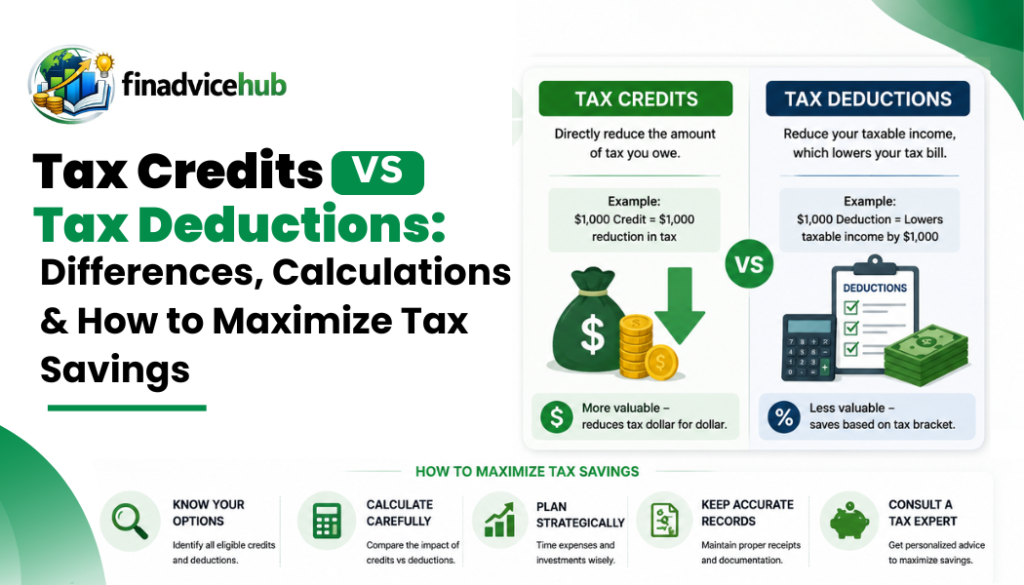
Every taxpayer wants to pay only what they legally owe, nothing more and nothing less. One of the best ways to achieve that is by understanding how tax credits and tax deductions work. Although these terms are often used together, they are not the same. Deductions reduce your taxable income, while tax credits lower your tax bill dollar for dollar. Knowing how each works can make a noticeable difference in your final tax bill.
Every year, millions of Americans save billions of dollars through federal tax credits and deductions. However, many taxpayers miss valuable opportunities simply because they don’t understand the rules or assume they don’t qualify. In some cases, a missed tax credit can cost hundreds or even thousands of dollars, while choosing the wrong deduction method can leave money on the table.
Whether you’re filing your first tax return, supporting a family, running a small business, or planning for retirement, understanding tax credits vs tax deductions is an important part of smart financial planning.
This guide explains both tax benefits in simple language, shows how they’re calculated, compares their impact using real-life examples, and shares practical strategies to help you maximize your tax savings while avoiding common filing mistakes.
What Is the Core Difference Between Tax Credits and Tax Deductions?
Many taxpayers believe tax credits vs tax deductions are interchangeable because they both lower the amount of tax they pay. While they share the same goal, they reduce your taxes at completely different stages of the tax calculation process. A tax deduction lowers the amount of income that is subject to tax, while a tax credit reduces the amount of tax you owe after your tax has already been calculated. Understanding this distinction is one of the most important steps toward making better tax decisions and keeping more of your income. It’s also helpful when learning self-employment tax basics, as self-employed individuals often need to understand both deductions and credits to manage their overall tax liability effectively.
Another way to think about it is that a deduction works “before” your tax bill is calculated, while a credit works “after.” Because of this difference, a tax credit often provides greater savings than a deduction of the same dollar amount. This explains which reduces tax liability more in many situations. However, deductions still play an essential role in reducing taxable income and can significantly lower your overall tax liability when used effectively.
Definition of Tax Credits
A tax credit is a dollar-for-dollar reduction of your tax liability. If your federal income tax is $4,000 and you qualify for a $1,500 tax credit, your final tax bill falls to $2,500. Unlike deductions, which only reduce taxable income, credits directly reduce the amount you owe the IRS.
The federal government offers tax credits to encourage certain activities that benefit individuals and the economy. Families may qualify for child-related credits, students may receive education credits, homeowners can benefit from clean energy credits, and lower-income workers may qualify for the Earned Income Tax Credit. These incentives are part of the IRS tax benefits available to eligible taxpayers. If you’re looking for a tax credits list in the USA, the IRS provides a complete list of available federal tax credits based on your income, filing status, and qualifying expenses.
Some tax credits are even more valuable because they can produce a tax refund. If a refundable credit is larger than your remaining tax liability, the IRS may send you the difference as a refund, provided you meet all credit eligibility rules. Understanding how tax credits work step by step can help you determine whether you qualify for valuable tax-saving opportunities.
Definition of Tax Deductions
A tax deduction reduces your taxable income instead of directly lowering your tax bill. The IRS subtracts eligible deductions from your total income before calculating how much tax you owe. Since taxes are calculated on a smaller amount of income, your final tax bill also decreases.
For example, suppose your annual income is $90,000 and you qualify for a $10,000 deduction. Instead of paying taxes on the full $90,000, you’ll only pay taxes on $80,000. The amount you save depends on your federal tax bracket because deductions reduce taxable income rather than the final amount of tax due.
Tax deductions are available for many common expenses, including mortgage interest, retirement contributions, certain business expenses, charitable donations, student loan interest, and qualifying medical expenses. Depending on your financial situation, deductions can significantly reduce the amount of income subject to taxation. Understanding how tax deductions work with examples makes it easier to estimate your potential savings before filing.
Key Structural Difference in Tax Calculation
The biggest difference between tax credits and tax deductions is where they fit into the tax calculation process. Deductions reduce taxable income before taxes are calculated, while credits reduce your final tax bill after the calculation is complete.
Imagine two taxpayers each receive a $2,000 tax benefit. One qualifies for a $2,000 deduction, while the other qualifies for a $2,000 tax credit. The taxpayer with the deduction only saves the taxes associated with that $2,000 based on their tax bracket. If they are in the 22% tax bracket, the deduction saves about $440. The taxpayer with the credit, however, reduces their tax bill by the full $2,000.
This real life example of tax credits vs deductions clearly demonstrates how much tax can credits reduce compared to deductions. In most situations, credits provide greater direct savings because they reduce the tax owed dollar for dollar.
That doesn’t mean deductions are less important. Multiple deductions combined can substantially reduce taxable income, especially for homeowners, self-employed individuals, and taxpayers who contribute regularly to retirement accounts.
Where Each Applies in the Tax Formula
Understanding the order of tax calculations makes it easier to see how deductions and credits work together.
| Tax Calculation Step | Tax Deduction | Tax Credit |
| Calculate total income | No | No |
| Subtract eligible deductions | Yes | No |
| Determine taxable income | Yes | No |
| Calculate tax using tax brackets | Yes | No |
| Apply eligible tax credits | No | Yes |
| Calculate final tax owed or refund | No | Yes |
This tax deductions vs credits step by step calculation explains why many financial professionals recommend claiming every deduction and tax credit you’re eligible for. Learning how to use tax credits and deductions together can significantly increase your overall tax savings. Deductions reduce the income being taxed, while credits lower the tax itself. Together, they provide some of the most effective tax savings strategies available to taxpayers.
How Tax Deductions Reduce Your Taxable Income
Tax deductions are one of the most effective ways to lower the amount of income subject to federal tax. Although they don’t reduce your tax bill directly, they reduce the portion of your income that the IRS uses to calculate your taxes. As your taxable income decreases, your total tax liability usually decreases as well.
Many taxpayers focus only on the deduction amount without understanding its actual value. A $5,000 deduction doesn’t mean you’ll save $5,000 in taxes. Instead, the deduction lowers your taxable income, and your actual savings depend on your tax bracket. Understanding how to calculate tax savings from deductions helps taxpayers estimate the real financial benefit before filing.
Step-by-Step Deduction Calculation
Suppose Emily earns $75,000 during the tax year and qualifies for $8,000 in deductions. Instead of paying taxes on the full $75,000, the IRS calculates her taxes using a taxable income of $67,000.
Assume Emily falls into the 22% federal tax bracket. Her estimated tax savings would look like this:
- Annual income: $75,000
- Eligible deductions: $8,000
- Taxable income: $67,000
- Estimated tax savings: $8,000 × 22% = $1,760
Although Emily claimed an $8,000 deduction, she didn’t receive $8,000 back. Instead, she reduced the amount of income being taxed, saving approximately $1,760 based on her tax rate. This example demonstrates why deductions are valuable but don’t provide dollar-for-dollar savings like tax credits.
Standard vs. Itemized Deductions
Most taxpayers choose between claiming the standard deduction or itemizing their deductions. The standard deduction is a fixed amount set annually by the IRS based on your filing status. It requires minimal paperwork and is the simplest option for many taxpayers.
Itemized deductions allow you to deduct actual qualifying expenses instead of taking the standard amount. These expenses may include mortgage interest, charitable contributions, certain medical expenses, and state and local taxes. Itemizing only makes financial sense when the total of your eligible expenses exceeds the standard deduction available for your filing status.
Before filing your return, compare both methods carefully. Choosing the larger deduction can lower your taxable income and increase your overall tax savings without requiring any additional financial risk.
Above-the-Line vs. Below-the-Line Deductions
Not all deductions affect your taxes in the same way. Above-the-line deductions reduce your Adjusted Gross Income (AGI), one of the most important income adjustments used to determine eligibility for many other tax benefits. Examples include Health Savings Account (HSA) contributions, certain retirement account contributions, educator expenses, and qualifying student loan interest.
Lowering your AGI may also increase your eligibility for additional tax credits or deductions that phase out at higher income levels. Because of this, above-the-line deductions can create savings beyond simply reducing taxable income.
Below-the-line deductions are generally itemized deductions claimed after your AGI has been calculated. These include mortgage interest, charitable donations, and certain medical expenses. While they don’t reduce AGI, they still play an important role in lowering taxable income for taxpayers who itemize their deductions.
Example: Deduction Impact on Taxable Income
Let’s compare two taxpayers with the same annual income to see how deductions can affect their taxes.
Michael and Sarah each earn $80,000 during the year. Michael qualifies for $5,000 in deductions, while Sarah qualifies for $15,000 because she has higher eligible business expenses and charitable contributions.
| Taxpayer | Annual Income | Total Deductions | Taxable Income |
| Michael | $80,000 | $5,000 | $75,000 |
| Sarah | $80,000 | $15,000 | $65,000 |
Although both taxpayers earned the same salary, Sarah pays taxes on $10,000 less income. Depending on her tax bracket, that difference could save her several thousand dollars over the course of the year. This example shows how tax deductions work with examples and highlights why keeping accurate financial records and tracking deductible expenses throughout the year can make a meaningful difference when it’s time to file your tax return.
It’s also important to remember that claiming deductions you’re not eligible for can lead to penalties or additional taxes if your return is reviewed. Always keep receipts, invoices, and other supporting documents for any deduction you claim.
Common Deduction Categories
The U.S. tax code includes many deductions that can reduce taxable income. Some apply to nearly every taxpayer, while others depend on your job, family situation, or financial decisions.
Some of the most common deductions include:
- Standard deduction
- Mortgage interest
- Traditional IRA contributions
- Health Savings Account (HSA) contributions
- Qualified business expenses
- Student loan interest
- Charitable donations
- State and local taxes (SALT), subject to IRS limits
- Certain medical and dental expenses
Not every deduction applies to every taxpayer, so it’s important to review your situation carefully before filing. Even small deductions can add up over time and reduce your taxable income more than you might expect. When combined with eligible tax credits, they become an important part of tax planning using credits and deductions and can help maximize tax savings using both benefits effectively.
How Tax Credits Reduce Your Final Tax Liability
While deductions reduce the amount of income that’s taxed, tax credits reduce the amount of tax you actually owe. Because credits are applied after your tax liability has been calculated, they often produce greater savings than deductions of the same dollar amount.
For many taxpayers, tax credits represent the most valuable part of their tax return. A single credit can reduce a tax bill by hundreds or even thousands of dollars, and some credits can increase your refund if they exceed the amount of tax you owe.
Understanding how different tax credits work can help you claim every benefit you’re entitled to and avoid leaving money behind when filing your return.
Direct Tax Reduction Explained
Tax credits provide a direct reduction in your tax liability. If your calculated federal income tax is $3,500 and you qualify for a $2,000 tax credit, your remaining tax bill falls to $1,500.
This dollar-for-dollar reduction is what makes credits so valuable. Unlike deductions, which only reduce taxable income, credits immediately lower the final amount you owe the IRS.
Many taxpayers mistakenly focus only on deductions because they’re more familiar with them. However, identifying available tax credits is often the fastest way to reduce your overall tax bill.
Refundable vs. Nonrefundable Credits
Not all tax credits work the same way. The IRS divides them into refundable and nonrefundable credits, and understanding the difference is essential when estimating your tax savings.
A refundable tax credit allows you to receive money back even if the credit reduces your tax liability to zero. For example, if you owe $600 in federal income tax but qualify for a refundable credit worth $1,200, the credit first eliminates your $600 tax bill. The remaining $600 may be paid to you as a refund, provided you meet all IRS eligibility requirements.
A nonrefundable tax credit, on the other hand, can reduce your tax bill only to zero. If you owe $600 and qualify for a nonrefundable credit worth $1,200, your tax bill becomes zero, but you generally won’t receive the remaining $600.
Knowing which credits are refundable can help you estimate your refund more accurately and avoid surprises when your return is processed.
Partially Refundable Credits Explained
Some tax credits combine features of both refundable and nonrefundable credits. These are known as partially refundable credits.
With a partially refundable credit, one portion reduces your tax liability, while another portion may be refunded if the credit exceeds the tax you owe. The refundable amount usually depends on IRS rules, income limits, and other eligibility requirements.
Because partially refundable credits have additional conditions, many taxpayers misunderstand how much they can actually receive. Carefully reviewing IRS guidance or using reliable tax software can help ensure the credit is calculated correctly.
Example: Credit Reducing Your Tax Bill
Consider the following example.
David’s federal income tax liability is $4,200 before credits. He qualifies for a $2,000 Child Tax Credit.
| Tax Liability Before Credit | Tax Credit | Final Tax Liability |
| $4,200 | $2,000 | $2,200 |
Unlike a deduction, which would simply reduce David’s taxable income, the credit lowers his tax bill by the full $2,000. This direct reduction illustrates why tax credits are often considered the most powerful tax-saving tool available to eligible taxpayers.
In some situations, additional refundable credits may reduce David’s remaining tax liability even further or increase his refund, depending on his income and filing status.
Popular IRS Tax Credits
The IRS offers several tax credits designed to help families, workers, students, and homeowners. Some of the most commonly claimed credits include the Child Tax Credit, Earned Income Tax Credit (EITC), American Opportunity Tax Credit, Lifetime Learning Credit, Child and Dependent Care Credit, and residential clean energy credits.
Each credit has its own eligibility rules, income limits, and documentation requirements. Before filing your return, review the qualifications carefully to make sure you don’t overlook benefits you may be entitled to receive.
Calculation Comparison: Credits vs. Deductions
Understanding the numbers makes the difference between tax credits and deductions much easier to see. Although both reduce your overall tax burden, they do so in different ways, and the savings can vary significantly depending on your income and tax bracket.
When comparing two tax benefits with the same dollar amount, tax credits usually produce larger savings because they reduce your tax bill directly rather than reducing taxable income first.
Example 1: Deduction Impact on Tax
Suppose Jennifer earns $85,000 and qualifies for a $5,000 tax deduction. If she falls into the 22% federal tax bracket, her estimated savings would be:
$5,000 × 22% = $1,100
Her taxable income decreases, but she doesn’t receive the full $5,000 as a reduction in taxes.
Example 2: Credit Impact on Tax
Now imagine Jennifer qualifies for a $5,000 tax credit instead.
If her calculated federal income tax is at least $5,000, the entire credit reduces her tax bill by the full $5,000.
This comparison clearly demonstrates why credits generally provide greater tax savings than deductions of the same amount.
Side-by-Side Comparison
| Feature | Tax Deduction | Tax Credit |
| Reduces taxable income | Yes | No |
| Reduces final tax bill | No | Yes |
| Depends on tax bracket | Yes | No |
| Dollar-for-dollar savings | No | Yes |
| Can increase the refund | Sometimes | Yes, if refundable |
Which Saves More at Different Income Levels?
Whether a tax credit or a tax deduction provides greater savings depends on your income, tax bracket, and the specific benefit you’re claiming. In general, tax credits deliver more immediate savings because they reduce your tax bill dollar for dollar. However, deductions can still provide substantial value, particularly for taxpayers in higher tax brackets or those with significant deductible expenses.
For lower-income taxpayers, refundable tax credits often provide the greatest financial benefit because they can reduce taxes to zero and may even result in a refund. Credits such as the Earned Income Tax Credit (EITC) and portions of the Child Tax Credit can make a meaningful difference for eligible households.
Middle-income taxpayers usually benefit from a combination of deductions and credits. Retirement contributions, Health Savings Account (HSA) contributions, and mortgage interest deductions can reduce taxable income, while education and child-related credits further reduce the final tax bill.
Higher-income taxpayers may receive greater value from certain deductions because each dollar deducted avoids tax at a higher marginal rate. However, it’s important to remember that some deductions and credits begin to phase out once income exceeds IRS thresholds, making careful tax planning even more important.
Visualization of Tax Savings Difference
The following example illustrates how a tax deduction and a tax credit of the same amount affect your taxes differently.
| Scenario | Tax Deduction | Tax Credit |
| Annual Income | $80,000 | $80,000 |
| Tax Benefit | $3,000 Deduction | $3,000 Credit |
| Tax Bracket | 22% | 22% |
| Estimated Tax Savings | $660 | $3,000 |
Although both taxpayers received a tax benefit worth $3,000 on paper, the taxpayer with the tax credit saved significantly more because the credit directly reduced the final tax bill. This simple comparison demonstrates why taxpayers should always explore available credits before assuming deductions will provide the greatest benefit.
Real-Life Scenarios: Which One Saves More Money?
Looking at real-world situations makes it easier to understand how tax credits and deductions work in practice. Every taxpayer has a unique financial situation, so the most valuable tax-saving strategy often depends on income, family size, employment status, and eligible expenses.
Low-Income Taxpayer Scenario
Consider Maria, who works full-time and earns $28,000 per year. She qualifies for the Earned Income Tax Credit and also claims the standard deduction. Because the EITC is refundable, it not only reduces her tax liability but may also increase her refund.
In Maria’s case, the tax credit provides a much greater financial benefit than additional deductions because her taxable income is already relatively low. Refundable credits are designed to support workers with modest incomes, making them one of the most valuable tax benefits available.
Middle-Income Taxpayer Scenario
James and his spouse earn a combined income of $95,000. They own a home, contribute to retirement accounts, and have one child attending college. Their tax savings come from several different sources.
Mortgage interest and retirement contributions reduce their taxable income, while education credits lower their final tax bill. Instead of relying on one tax benefit, they combine deductions and credits to maximize their overall savings. This balanced approach is common among middle-income households and often produces the best results.
High-Income Taxpayer Scenario
Sophia earns $240,000 annually and owns a small consulting business. Many tax credits begin to phase out at higher income levels, limiting her eligibility for some benefits. However, she still benefits from legitimate business expense deductions, retirement contributions, and other tax-planning strategies that reduce taxable income.
Although deductions may provide greater overall savings for taxpayers in higher tax brackets, careful planning remains essential because income limits and deduction restrictions can affect the final outcome.
Families vs. Single Filers
Families often qualify for more tax credits than single taxpayers because several federal tax benefits are designed to support children and dependent care expenses. Credits such as the Child Tax Credit and Child and Dependent Care Credit can significantly reduce a family’s tax bill.
Single filers, on the other hand, may rely more heavily on deductions related to retirement contributions, education expenses, or business costs if they are self-employed. While they may not qualify for as many family-related credits, they can still reduce their tax burden through thoughtful financial planning.
Freelancers vs. Employees
Self-employed individuals and freelancers typically have access to more business-related deductions than traditional employees. Expenses such as office supplies, professional software, business travel, equipment purchases, and a qualifying home office may reduce taxable income when they meet IRS requirements.
Employees generally have fewer deductible work-related expenses under current federal tax rules. However, they may still benefit from retirement contributions, Health Savings Accounts, education credits, and other tax-saving opportunities. For freelancers, maintaining detailed records throughout the year is especially important because accurate documentation supports every deduction claimed.
Can You Use Tax Credits and Deductions Together?
Many taxpayers wonder whether they must choose between claiming tax credits or tax deductions. In most situations, the answer is no. If you qualify for both, you can generally claim eligible deductions and tax credits on the same tax return. In fact, using both together is often the most effective way to reduce your overall tax liability.
Tax deductions reduce your taxable income first. Once your taxable income has been determined and your tax liability calculated, eligible tax credits are applied to lower the amount of tax you owe. Since they affect different stages of the tax calculation, they work together rather than compete against each other.
How They Stack in Your Tax Calculation
Think of your tax return as a series of steps. First, you report your income from wages, investments, self-employment, and other sources. If you’re self-employed, you’ll also need to calculate any Self-Employment Tax you owe on your business earnings. Next, eligible deductions reduce that income to determine your taxable income. After the IRS calculates your tax based on the applicable tax brackets, any qualifying tax credits reduce the final amount you owe.
Because deductions and credits serve different purposes, claiming both can produce greater savings than relying on either one alone.
Common Combinations Used by Taxpayers
Many taxpayers naturally combine deductions and credits without realizing it. For example, a married couple might claim the standard deduction, contribute to a traditional IRA, and qualify for the Child Tax Credit. A college student may deduct eligible student loan interest while also claiming an education credit for qualified tuition expenses, provided the same expense is not used for both benefits.
Small business owners often combine deductible business expenses with energy-related tax credits or retirement contribution deductions. These combinations help reduce both taxable income and final tax liability.
Mistakes When Combining Both
One of the most common mistakes is assuming that the same expense can be used to claim multiple tax benefits. In many cases, the IRS prohibits “double dipping,” meaning you cannot claim both a deduction and a credit for the same qualifying expense if the law doesn’t allow it.
Another frequent mistake is overlooking income limits or filing without supporting documentation. Missing receipts, inaccurate records, or claiming benefits you’re not eligible for can delay your refund or lead to additional taxes and penalties.
Optimization Strategy
The best approach is to review all available deductions first, determine your taxable income, and then identify every tax credit you qualify for. Maintaining organized financial records throughout the year makes this process much easier and reduces the risk of missing valuable tax benefits.
Tax planning should not begin a few days before the filing deadline. Reviewing your financial situation throughout the year allows you to make informed decisions about retirement contributions, business purchases, charitable donations, and other activities that may improve your tax outcome. By combining deductions and credits strategically, many taxpayers can legally reduce their tax liability while remaining fully compliant with IRS rules.
Common Tax Credits in the USA (With Use Cases)
Tax credits are among the most valuable tax benefits available because they reduce your tax bill directly. However, each credit has its own eligibility requirements, income limits, and filing rules. Understanding the purpose of each credit can help you determine whether you qualify and avoid overlooking valuable savings.
Child Tax Credit
The Child Tax Credit helps families offset the cost of raising children. Eligible taxpayers may receive a credit for each qualifying child who meets the IRS age, relationship, residency, and support requirements. Depending on current tax laws and income limits, part of the credit may also be refundable.
For example, a married couple with two qualifying children may significantly reduce their federal tax liability through this credit. Families should review eligibility carefully each year because income thresholds and credit amounts can change with tax legislation.
Earned Income Tax Credit (EITC)
The Earned Income Tax Credit (EITC) is designed to help low- and moderate-income workers. It is one of the most valuable refundable tax credits available because eligible taxpayers may receive a refund even if they owe little or no federal income tax.
The amount of the credit depends on several factors, including earned income, filing status, and the number of qualifying children. Even taxpayers without children may qualify if they meet specific IRS requirements. Unfortunately, many eligible individuals fail to claim this credit each year because they assume they earn too much or believe the application process is too complicated.
Education Credits
The federal government offers education credits to help offset the cost of higher education. Two of the most common are the American Opportunity Tax Credit and the Lifetime Learning Credit.
These credits may help reduce the cost of tuition, enrollment fees, and other qualified educational expenses. However, taxpayers generally cannot claim both credits for the same student during the same tax year. Reviewing the eligibility requirements before filing can help determine which option provides the greatest tax benefit.
Energy Tax Credits
Homeowners who invest in qualifying energy-efficient improvements may be eligible for federal energy tax credits. These improvements can include solar panels, certain battery storage systems, energy-efficient windows, insulation, heat pumps, and other approved upgrades.
In addition to lowering your tax bill, these improvements may reduce monthly utility costs and increase your home’s long-term value. Before beginning a project, verify that both the product and installation qualify under current IRS rules.
Healthcare-Related Credits
Some taxpayers may qualify for healthcare-related tax credits that help reduce the cost of health insurance purchased through approved marketplaces. Eligibility generally depends on household income, family size, and other factors established under federal law.
Because healthcare rules can change, taxpayers should review the latest IRS guidance each year to ensure they claim every credit available to them.
Common Tax Deductions in the USA (With Use Cases)
Tax deductions remain an important part of tax planning because they reduce taxable income, helping lower your overall tax liability reduction before your tax bill is calculated. Understanding how tax deductions reduce taxable income makes it easier to compare tax credits vs tax deductions and choose the best tax-saving approach. When comparing tax credits vs deductions difference, it’s important to remember that deductions may not provide the same dollar-for-dollar savings as credits. However, they can still generate significant tax reductions, particularly for taxpayers with substantial qualifying expenses.
Mortgage Interest Deduction
Many homeowners can deduct interest paid on qualifying home loans, making the mortgage interest deduction one of the most widely used itemized deductions.
For taxpayers who recently purchased a home or have a large mortgage balance, this deduction can substantially reduce taxable income. However, not all mortgage interest qualifies, so it’s important to understand the IRS limitations before claiming the deduction.
Medical Expenses Deduction
Certain medical and dental expenses may be deductible if they exceed the IRS threshold based on your adjusted gross income. Eligible expenses can include hospital bills, prescription medications, medical equipment, and some long-term care costs.
Because only qualifying expenses above the applicable threshold may be deducted, taxpayers should keep detailed medical records throughout the year to support their claims if needed. These deductions are among the many IRS tax benefits available to eligible taxpayers, provided they meet the applicable requirements and maintain proper documentation.
Business Expense Deductions
Self-employed individuals and business owners often qualify for a wide range of business expense deductions. Common examples include office supplies, business travel, advertising, software subscriptions, equipment purchases, internet service used for business, and professional insurance.
The key requirement is that each expense must be both ordinary and necessary for operating the business. Maintaining organized receipts and accounting records throughout the year makes claiming these deductions much easier and helps support them during an IRS review. Good recordkeeping also supports effective tax planning using credits and deductions, allowing business owners to maximize available tax benefits.
State and Local Tax Deduction (SALT)
The State and Local Tax (SALT) deduction allows eligible taxpayers to deduct certain state and local income, property, or sales taxes, subject to current federal limits.
Although this deduction is valuable for many homeowners, taxpayers should be aware that federal law currently places limits on the amount that can be claimed. Reviewing the latest IRS guidance each tax year helps ensure accurate reporting.
Charitable Contributions
Taxpayers who donate money or qualifying property to eligible charitable organizations may be able to deduct those contributions if they itemize deductions.
Proper documentation is essential. Receipts, bank records, and written acknowledgments from charitable organizations help verify donations and support deduction claims if requested by the IRS. Donating appreciated assets instead of cash may also provide additional tax advantages in some situations, making charitable giving a valuable part of long-term tax planning.
Mistakes to Avoid When Using Credits and Deductions
Even experienced taxpayers make mistakes that reduce their tax savings. Understanding the tax credits vs deductions difference can help you file a more accurate return and maximize every tax benefit available.
Confusing Credits with Deductions
One of the biggest misconceptions is believing that tax credits and tax deductions provide the same type of savings. Deductions reduce taxable income, while credits directly reduce your tax liability. Understanding how tax credits reduce your tax bill vs deductions and reviewing a real life example of tax credits vs deductions can help you estimate your taxes more accurately and avoid unrealistic expectations.
Missing Refundable Credits
Many eligible taxpayers fail to claim refundable vs nonrefundable tax credits, especially refundable credits like the Earned Income Tax Credit and certain child-related credits, because they assume they don’t qualify.
Reviewing IRS eligibility requirements each year can help prevent missed opportunities and ensure you receive every benefit available under current tax law. Always review the latest tax credits list in the USA to determine which credits may apply to your situation.
Overestimating Deduction Impact
Some taxpayers believe that a $5,000 deduction automatically reduces their taxes by $5,000. In reality, the deduction only reduces the amount of income that’s taxed. The actual tax savings depend on your federal tax bracket and other factors affecting your return.
A simple tax credit vs tax deduction example shows the difference clearly. It also demonstrates how tax credits work step by step: a tax credit directly reduces the amount of tax you owe, while a deduction lowers the income subject to tax. Understanding this distinction makes it easier to estimate your potential tax savings.
Ignoring Eligibility Rules
Every deduction and credit has specific qualification requirements. Income limits, filing status, age, dependency rules, and documentation requirements all affect eligibility.
Claiming benefits without meeting these credit eligibility rules may result in delayed refunds, additional taxes, penalties, or interest. Carefully reviewing IRS guidance before filing helps avoid unnecessary problems.
Filing Errors That Reduce Savings
Simple filing mistakes can prevent taxpayers from receiving valuable tax benefits. Common errors include entering incorrect Social Security numbers, reporting inaccurate income, failing to attach required forms, or forgetting to claim available credits.
Using reliable tax software or consulting a qualified tax professional can reduce these errors and improve the accuracy of your return.
Tax Planning Strategy: How to Maximize Savings
Effective tax planning is not something you do only during tax season. The most successful taxpayers make financial decisions throughout the year with taxes in mind. Planning ahead provides more opportunities to reduce taxable income, qualify for valuable credits, and improve your overall tax savings credits vs deductions strategy using proven tax savings strategies.
Choosing Between Deduction vs. Credit Focus
If you’re eligible for both deductions and credits, don’t assume you must choose one over the other. Instead, focus on claiming every deduction and tax credit available to you under IRS rules. Since they reduce taxes at different stages of the calculation process, using both often produces the greatest overall savings.
Learning how to use tax credits and deductions together is usually more beneficial than asking which is better tax credit or deduction, because both reduce taxes in different ways and can work together to maximize savings.
Income-Level Optimization Strategy
Your income affects which deductions and credits you qualify for. Some tax benefits phase out once income exceeds certain limits, while others become more valuable as income increases.
Monitoring your taxable income throughout the year may allow you to make strategic decisions, such as increasing retirement contributions or delaying certain income, to remain eligible for valuable tax benefits. This approach is especially useful when comparing credits vs deductions for different income levels.
Timing Income and Expenses
The timing of income and deductible expenses can influence your tax liability. For example, making charitable contributions, purchasing business equipment, or contributing to retirement accounts before the end of the tax year may increase your deductions.
Business owners, freelancers, and investors often have greater flexibility when planning the timing of income and expenses, making year-round tax planning especially valuable.
Using Credits Strategically
Tax credits should never be viewed as an afterthought. Before filing your return, review every credit that may apply to your situation, including child-related credits, education credits, clean energy incentives, and healthcare-related benefits.
Even if you qualified for a credit in previous years, review the current rules because income limits, eligibility requirements, and credit amounts may change over time.
Long-Term Tax Planning Approach
The best tax strategy is one that supports your long-term financial goals. Regular retirement contributions, organized recordkeeping, thoughtful charitable giving, and careful investment planning can all improve your tax position over time.
Rather than making tax decisions only when filing your return, consider taxes as part of your overall financial plan. Reviewing your deductions and credits annually creates a practical tax credits vs deductions decision framework that helps maximize savings year after year.
Conclusion
Understanding tax credits vs tax deductions is one of the smartest ways to reduce your federal tax bill legally. Tax deductions provide taxable income reduction, while tax credits offer direct tax liability reduction. Because they work at different stages of your tax return, using both can often produce the greatest overall savings.
Whether you’re filing your first return, managing a business, or planning for retirement, knowing how tax benefits apply in filing can help you avoid costly mistakes and keep more of your hard-earned money. Staying organized throughout the year, reviewing your eligibility regularly, and using trusted tax software, digital tax planning tools USA, or professional guidance are simple ways to maximize tax savings using both deductions and credits.
As smart tax saving strategies 2026 continue to evolve, many taxpayers are also exploring AI tax optimization strategies USA and automated tax planning tools credits vs deductions to identify eligible tax benefits more efficiently and simplify the filing process.
FAQs
What is the main difference between tax credits and deductions?
The biggest difference is how they affect your taxes. Tax deductions reduce your taxable income before your taxes are calculated, while tax credits directly reduce the amount of tax you owe. Looking at tax credit vs deduction calculation examples, the USA can make this distinction much easier to understand.
Which is better: a tax credit or a deduction?
It depends on your financial situation. If you’re comparing the standard deduction vs tax credits which saves more money, remember that they serve different purposes. The standard deduction lowers your taxable income, while tax credits directly reduce your tax bill. Reviewing a tax savings comparison of credits vs deductions can help determine which option provides greater savings, and many taxpayers benefit from claiming both whenever they’re eligible.
Do tax credits reduce taxable income?
No. Tax credits do not reduce taxable income. Instead, they lower your final tax bill after your taxes have been calculated. Tax deductions work earlier in the process by reducing taxable income.
Can you claim both credits and deductions?
Yes. In most cases, eligible taxpayers can claim both deductions and credits on the same tax return. Combining both is often the best strategy for achieving greater tax liability reduction and lowering your overall tax bill.
What are refundable tax credits?
Understanding refundable vs nonrefundable tax credits explained with examples can help you estimate your refund more accurately. Refundable credits may generate a refund even if they reduce your tax bill to zero, while nonrefundable credits can only reduce the amount of tax you owe.
How do tax deductions affect tax brackets?
Tax deductions reduce taxable income, which may lower the amount of income taxed at higher rates. Some deductions are also treated differently depending on whether they are above-the-line or below-the-line deductions, so it’s helpful to understand the difference between above the line and below the line deductions when planning your taxes.
Are tax credits available for all income levels?
Some credits are available to a broad range of taxpayers, while others have income limits or phase out at higher earnings. Your eligibility depends on factors such as income, filing status, and family circumstances.
How do I know which tax benefits I qualify for?
Review the latest IRS guidance, use reputable tax preparation software, or speak with a qualified tax professional. These resources can help you identify the deductions and credits you’re eligible for and ensure your return is accurate.