
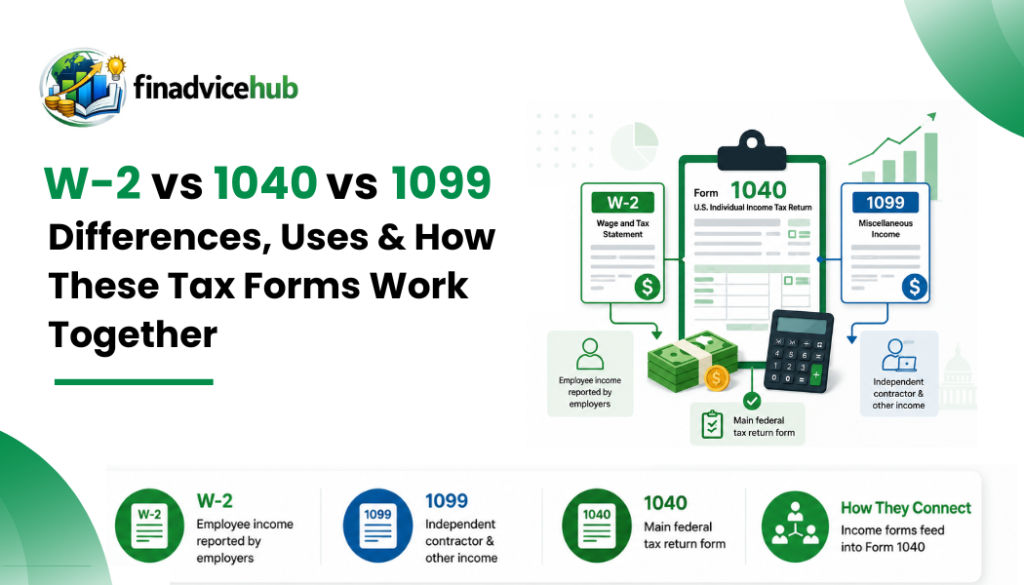
Tax season can feel confusing because people often hear about W-2, 1099, and 1040 forms as if they are competing documents. In reality, these forms serve different purposes. The W-2 and 1099 report income, while the 1040 is the main tax return form used to calculate and file your federal income taxes.
Understanding W-2 vs 1099 vs 1040 helps employees, freelancers, contractors, and business owners know which forms they receive, which forms they complete, and how each document fits into the tax filing process.
A simple way to remember it:
- W-2 = reports employee wages
- 1099 = reports certain non-employee income
- 1040 = files your personal income tax return
This guide explains the difference between W2 1099 and 1040 explained simply, including how these forms connect, who uses them, and how to avoid common filing mistakes.
Tax Forms Ecosystem Explained Visually
Think of the tax process as a workflow:
Employer → W-2 → Taxpayer → Form 1040 → IRS
Example:
A company pays an employee $60,000.
- The employer reports wages and taxes withheld on a W-2.
- The employee receives the W-2.
- The employee enters that information on Form 1040.
- The IRS matches the reported income with the tax return.
For freelancers:
Client → 1099 → Freelancer → Schedule C/Self-employment reporting → Form 1040 → IRS
Example:
A freelancer earns $20,000 from clients.
- Clients may issue 1099 forms.
- The freelancer reports income.
- Business expenses may be deducted.
- The income flows into Form 1040.
This is the basic tax form workflow behind IRS filing.
What Are W-2, 1099, and 1040 Forms?
What Is a W-2 Form?
A W-2 is an income reporting form used by employers to report wages paid to employees.
Employers send W-2 forms to:
- Employees
- The IRS
- State tax agencies (when required)
A W-2 usually includes:
- Total wages earned
- Federal income tax withheld
- Social Security taxes
- Medicare taxes
- Retirement contributions
- Benefits information
How W2 Works
When you work as an employee, your employer typically handles payroll taxes throughout the year.
Example:
Sarah works full-time for a company.
Her paycheck shows:
- Salary income
- Federal tax withholding
- Social Security withholding
- Medicare withholding
At the end of the year, her employer sends a W-2 showing her total earnings and taxes already paid.
The W-2 helps Sarah complete her tax return.
What Is a 1099 Form?
A 1099 is used to report many types of income that are not traditional employee wages.
Common 1099 recipients include:
- Freelancers
- Independent contractors
- Self-employed workers
- Investors
- People receiving certain payments
Common types include:
- 1099-NEC for contractor payments
- 1099-INT for interest income
- 1099-DIV for dividends
- 1099-MISC for certain payments
How 1099 Works
A freelancer usually does not have an employer withholding payroll taxes.
Example:
Mike designs websites as an independent contractor.
During the year:
- Client A pays $5,000
- Client B pays $8,000
- Client C pays $7,000
Each client may provide a 1099-NEC.
Mike reports that income when filing taxes.
This is the main W2 vs 1099 difference:
- W-2 workers have an employer relationship.
- 1099 workers are usually independent contractors responsible for reporting income and handling self-employment taxes.
What Is Form 1040 Used For?
Many beginners ask: what is form 1040 used for?
Form 1040 is the main U.S. individual income tax return.
It is the form taxpayers use to:
- Report income
- Claim deductions
- Claim tax credits
- Calculate tax owed
- Request a refund
Unlike a W-2 or 1099, the 1040 does not report income from an employer or client. Instead, it collects information from different income reporting forms.
In simple terms:
- W-2 and 1099 tell you what income you received.
- 1040 tells the IRS how much tax you owe.
W2 vs 1099 vs 1040: Main Differences
| Feature | W-2 | 1099 | 1040 |
| Purpose | Reports employee wages | Reports non-employee income | Files personal tax return |
| Used by | Employees | Freelancers, contractors, investors | Individual taxpayers |
| Created by | Employer | Client, payer, financial institution | Taxpayer |
| Reports income? | Yes | Yes | Yes, using reported information |
| Files taxes? | No | No | Yes |
W2 vs 1099 Difference: Employee vs Contractor Taxes Forms
The biggest confusion comes from tax forms for employees vs freelancers.
Employee Tax Situation
Employees usually receive:
- W-2 form
- Payroll tax withholding
- Employer-paid payroll contributions
Their employer manages much of the wage reporting.
Contractor Tax Situation
Contractors usually receive:
- 1099 forms
- Business income records
- Self-employment tax responsibilities
They often track:
- Business expenses
- Payments received
- Estimated tax payments
The employee vs contractor taxes forms difference affects how income is reported and how taxes are paid.
How W-2 and 1099 Connect to 1040
A common question is: how W2 and 1099 connect to 1040?
The connection works like this:
- Income is reported on W-2 or 1099 forms.
- The taxpayer collects those documents.
- Information is entered into Form 1040.
- Additional schedules may be added depending on income type.
- The final return is submitted to the IRS.
Example:
A person has:
- One W-2 job: $50,000
- Freelance income: $10,000
- Bank interest: $500
Their 1040 may include information from:
- W-2
- 1099-NEC
- 1099-INT
This explains why some taxpayers need multiple forms.
How to File Taxes With W-2 and 1099 Together
Many people have both employee and freelance income, affecting their freelance taxes.
Example:
Jessica works full-time and earns:
- $70,000 from her employer
- $12,000 from freelance consulting
She receives:
- W-2 from employer
- 1099 forms from clients
Her filing process:
Step 1: Gather tax documents
Collect:
- W-2 forms
- 1099 forms
- Expense records
- Previous tax returns
- Tax deduction documents
Step 2: Report income
Enter:
- W-2 wages
- 1099 income
- Other taxable income
Step 3: Complete additional sections
Freelancers may need self-employment reporting forms.
Step 4: Review deductions and credits
Check eligibility for:
- Business expenses
- Retirement contributions
- Tax credits
Step 5: Submit Form 1040
The completed tax return is filed with the IRS.
Which Tax Form Should I Use Employee vs Freelancer?
The answer depends on how you earn income.
If You Are an Employee
You usually need:
- W-2 from employer
- Form 1040 for filing taxes
If You Are a Freelancer
You may need:
- 1099 forms from clients
- Income records
- Self-employment forms
- Form 1040
If You Are Both
You may need:
- W-2
- Multiple 1099 forms
- Additional schedules
- Form 1040
The question “which tax form do I need” depends on your income sources, not just your job title.
How to Read W2 and 1099 Forms
Reading a W-2
Look for:
- Box 1: taxable wages
- Box 2: federal income tax withheld
- Social Security wages
- Medicare wages
Reading a 1099
Look for:
- Type of income reported
- Amount paid
- Payer information
- Recipient information
Accurate reading prevents mistakes when preparing tax return documentation.
Common Tax Filing Mistakes Explained
Tax filing mistakes often happen because taxpayers do not understand how income reporting forms and tax return forms work together. W-2 and 1099 forms show income information, while Form 1040 is used to file the actual tax return. Knowing where each form belongs helps prevent missing income, incorrect reporting, and filing delays.
Forgetting a 1099
One of the most common mistakes is forgetting to report income from a 1099 form.
A taxpayer may receive multiple 1099 forms from different sources, including:
- Freelance clients
- Banks
- Investment companies
- Other businesses
The IRS also receives copies of many 1099 forms. If a taxpayer reports less income than the IRS has on record, the IRS may send a notice asking for clarification.
Example:
Emma works as a freelance writer and receives payments from three clients:
- Client A pays $4,000
- Client B pays $6,000
- Client C pays $5,000
She receives only two 1099 forms and forgets the third payment.
When filing Form 1040, she reports $10,000 instead of $15,000. The IRS may later identify the missing income because the third client reported the payment.
How to avoid this mistake:
- Keep a record of all income received.
- Review bank statements and invoices.
- Compare all 1099 forms with your records before filing.
Confusing 1099 Income With Wages
A major source of confusion is treating 1099 income like employee wages.
A W-2 employee and a 1099 contractor may earn the same amount, but their tax responsibilities are different.
W-2 Employee
A W-2 employee usually:
- Works for an employer
- Receives a regular paycheck
- Has taxes withheld automatically
- Receives a W-2 at the end of the year
The employer handles wage reporting and payroll tax withholding.
1099 Contractor
A 1099 contractor usually:
- Works independently
- Receives payments from clients
- Does not have payroll tax withholding
- Reports business income separately
Example:
Sarah works for a company and earns $55,000. She receives a W-2.
Mike works as a freelance designer and earns $55,000. He receives 1099 forms.
Both earned the same amount, but Mike may need to handle self-employment taxes and track business expenses.
This difference affects the overall W2 vs 1099 tax implications.
Filing Without Checking Documents
Some taxpayers file quickly without reviewing their tax documents.
This can lead to mistakes such as:
- Entering the wrong income amount
- Missing a form
- Reporting duplicate income
- Using incorrect personal information
Before submitting your tax return, compare:
- W-2 forms
- 1099 forms
- Income records
- Expense records
Example:
An employer sends a corrected W-2 after an earlier mistake. If the taxpayer files using the old form, the income reported may not match IRS records.
A careful document review helps prevent processing delays.
Ignoring Self-Employment Taxes
Freelancers and independent contractors often make the mistake of thinking their 1099 income is treated exactly like wages.
Employees usually have Social Security and Medicare taxes withheld from each paycheck.
Freelancers generally handle these taxes themselves.
Example:
A photographer earns $45,000 from clients during the year.
Clients pay the full amount because they are not the photographer’s employer.
The photographer may need to plan for:
- Income taxes
- Self-employment taxes
- Estimated tax payments
Keeping accurate income and expense records makes the filing process easier.
Using the Wrong Filing Information
Incorrect information can create problems with your tax return.
Common errors include:
- Incorrect Social Security number
- Wrong income amounts
- Missing deductions
- Incorrect bank details
- Wrong personal information
The IRS compares information on your tax return with documents submitted by employers, banks, and other organizations.
Accurate tax return documentation helps ensure your filing matches IRS records.
Step-by-Step Form Usage Guide
Understanding the tax form workflow makes filing easier. W-2 and 1099 forms provide income details, and Form 1040 brings everything together.
Step 1: Identify Your Income Type
Before collecting forms, determine how you earned income.
Ask:
Did I work as an employee?
If yes:
- You likely receive a W-2.
- Your employer reports your wages.
Example:
You work full-time for a company, receive paychecks, and taxes are withheld from your earnings.
Did I provide services independently?
If yes:
- You may receive 1099 forms.
- You may need self-employment reporting.
Example:
You provide consulting, design, writing, repair, or other services directly to clients.
Did I receive other taxable income?
Other income may include:
- Interest
- Investment earnings
- Rental income
- Other IRS-reported payments
Different income sources may require different IRS forms.
Step 2: Collect Income Reporting Forms
Gather all forms before starting your tax return.
W-2 Forms
A W-2 shows:
- Employee wages
- Taxes withheld
- Employer information
1099 Forms
A 1099 may show:
- Contractor payments
- Interest income
- Investment income
Other IRS Forms
Depending on your situation, you may need additional documents for specific income or deductions.
Collecting everything first makes filing more accurate.
Step 3: Organize Tax Return Documentation
Tax forms alone may not tell the full story.
Keep:
Income Records
Examples:
- Payment records
- Invoices
- Bank statements
Receipts
Useful for tracking:
- Business expenses
- Potential deductions
Expense Information
Freelancers should track costs related to earning income.
Examples:
- Equipment
- Software
- Supplies
Previous Tax Returns
Past returns can help compare changes and maintain records.
Step 4: Complete Your Tax Return
Form 1040 is where your tax information comes together.
The general process:
- Enter personal information.
- Report income from W-2 and 1099 forms.
- Add deductions and credits.
- Calculate taxes.
- Submit the return.
Some taxpayers may need additional schedules depending on their income sources.
Step 5: Review Before Filing
Before submitting your return, check:
- Name spelling
- Social Security number
- Income amounts
- W-2 and 1099 entries
- Deductions
- Bank information
A final review can help prevent mistakes and reduce delays.
W2 vs 1099 Tax Implications Example
Consider two people who each earn $50,000.
Worker A: Employee
Worker A receives:
- W-2 form
- Regular paycheck
- Payroll tax withholding
During the year:
- Employer withholds certain taxes.
- Employee receives a W-2.
- Employee uses the W-2 information when filing Form 1040.
Worker B: Contractor
Worker B receives:
- 1099 forms
- Payments from clients
- No regular payroll withholding
During the year:
- Clients pay the full amount.
- Worker tracks income and expenses.
- Worker reports earnings through Form 1040.
Why the Difference Matters
Both workers earned $50,000, but their tax situations are different.
The employee usually has taxes handled through payroll.
The contractor manages more of the tax process independently.
- W-2 reports employee wages.
- 1099 reports many types of non-employee income.
- 1040 is the form used to file the final tax return.
Knowing where each form goes in tax filing helps taxpayers avoid common mistakes and complete their filing requirements correctly.
Final Takeaway
Understanding W-2 vs 1099 vs 1040 makes tax filing much easier.
Remember:
- W-2 shows employee wages.
- 1099 shows many types of non-employee income.
- 1040 is the tax return you file.
The best approach is to collect every income document, understand where each form goes in tax filing, and complete your return carefully. Tax situations vary based on income sources, deductions, and personal circumstances, so reviewing IRS requirements or working with a qualified tax professional may be helpful for complex situations.
FAQs
What is the difference between W-2 and 1099?
A W-2 reports income from an employer relationship. A 1099 reports certain non-employee income, such as freelance payments or other types of earnings.
What is Form 1040 used for?
Form 1040 is used to file an individual federal income tax return. It combines information from income reporting forms and calculates your tax result.
Do I need both W-2 and 1099?
Yes, you may need both if you have employee wages and additional income such as freelance work.
Can I file taxes without a W-2?
If you were an employee and did not receive your W-2, you should contact your employer and follow IRS procedures for missing wage documents.
How do I report multiple 1099 forms?
Add together your applicable income sources and report them correctly on your tax return. Keep copies of all forms and records.
What happens if I don’t file Form 1040?
If you are required to file and do not, you may face penalties, interest, and collection actions.
Which tax form is for freelancers?
Freelancers commonly receive 1099 forms and report income through Form 1040 with applicable self-employment reporting.
How do these forms connect in filing taxes?
W-2 and 1099 forms report income. Form 1040 uses that information to complete your tax filing.