
Getting paid is one of the most important parts of any job, but when you receive your paycheck can be just as important as how much you earn. If you’ve ever wondered about biweekly vs monthly pay, you’re not alone. Many employees compare different payroll schedules before accepting a job, while employers choose pay frequencies based on payroll costs and business needs.
According to the U.S. Bureau of Labor Statistics, biweekly is the most common payroll schedule in the United States, used by about 43% of private businesses, while only around 10% pay employees monthly.
The truth is that your pay frequency doesn’t change your annual salary, but it can affect your budgeting, bill payments, savings habits, and overall financial planning. Understanding the biweekly vs monthly paycheck difference helps you make smarter financial decisions and avoid cash flow problems.
This guide explains the differences, compares real examples, and answers common questions so you can decide which pay schedule works best for your lifestyle.
What Is Pay Frequency in Payroll
Definition of pay frequency
Pay frequency refers to how often employees receive wages during a year. It determines the length of each pay period and how salary distribution happens throughout the year. Every payroll system follows a specific schedule, often called a payroll cycle or compensation timing.
Common payroll schedules
The most common payroll schedules include:
- Weekly (52 paychecks per year)
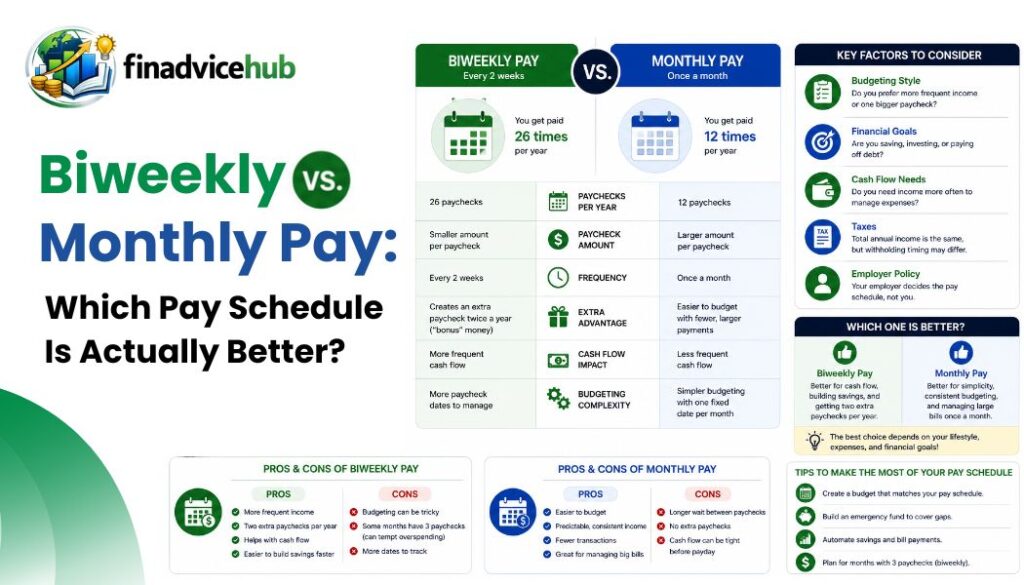
- Biweekly (26 paychecks per year)
- Semi-monthly (24 paychecks per year)
- Monthly (12 paychecks per year)
When comparing weekly vs biweekly vs monthly salary, each option offers different advantages depending on budgeting needs and employer preferences.
Why pay schedules matter
Pay schedules influence much more than payday. They affect income scheduling, cash flow, budgeting, savings, and payroll administration. Understanding how pay frequency affects paycheck timing helps employees plan expenses more effectively.
Overview of differences
The biggest distinction in biweekly vs monthly pay is the number of pay periods. Biweekly employees receive smaller but more frequent paychecks, while monthly employees receive one larger paycheck each month. This difference creates noticeable changes in spending habits and financial planning.
What Is Biweekly Pay
Definition and structure
Biweekly pay means employees are paid once every two weeks, usually on the same weekday, such as every other Friday. This payroll schedule is widely used across the United States because it balances payroll efficiency with employee convenience.
- Fixed Schedule: Payday always lands on the exact same day of the week (e.g., every second Friday).
- Work Period: Each paycheck covers a 14-consecutive-day period (typically 10 working days for standard full-time schedules).
- Biweekly vs. Semi-Monthly: While biweekly means 26 paychecks tied to a day of the week, semi-monthly means 24 paychecks tied to calendar dates (like the 1st and 15th of every month).
How many paychecks per year
Biweekly employees receive 26 paychecks per year. In some years, depending on the payroll calendar, employees may experience three paychecks in a single month.
- Why the 3rd Paycheck Happens: A standard year has 52 weeks. Since 10 out of 12 months are longer than 28 days (4 full weeks), those extra days accumulate over the course of the year.
- The “Bonus” Months: Exactly 2 months out of the year will contain 3 paydays instead of the standard 2.
- Financial Advantage: Because standard bills (rent, utilities, insurance) are structured monthly, you can build your baseline budget around 2 paychecks per month. The 3rd paycheck in those two special months can act as an “extra” check to aggressively pay down high-interest debt, build emergency savings, or fund annual expenses.
How biweekly pay works
Each paycheck covers two weeks of work. Since there are 52 weeks in a year, dividing them into two-week periods results in 26 payroll cycles.
Many people ask how biweekly pay affects take home pay. Although each paycheck is smaller than a monthly paycheck, your total annual earnings remain the same. Taxes and deductions are simply spread across more pay periods.
- Impact on Deductions: Mandatory taxes (income tax, Medicare, Social Security) scale directly with your earnings on each check. However, fixed voluntary deductions (like health insurance or retirement contributions) are usually spread thinner across 26 paychecks, resulting in slightly less taken out per check compared to a 24-paycheck schedule.
- Budgeting Strategy: Aligning bill due dates is critical. A popular approach is paying first-half-of-the-month bills (like rent) with your first paycheck and second-half bills (like utilities and credit cards) with your second paycheck.
Example breakdown
Suppose an employee earns $78,000 annually.
Biweekly gross pay:
[$78,000 \div 26 = \$3,000 \text{ per paycheck}]
Every two weeks, the employee receives approximately $3,000 before deductions.
To see how biweekly compares directly to other common payment frequencies for the same $78,000 salary:
| Pay Schedule | Paychecks per Year | Gross Pay per Check | Key Feature |
| Biweekly | 26 | $3,000 | Paid every 2 weeks (2 months have 3 paychecks) |
| Semi-Monthly | 24 | $3,250 | Paid twice a month (e.g., 1st & 15th) |
| Monthly | 12 | $6,500 | Paid once a month |
What Is Monthly Pay
Definition and structure
Monthly pay means employees receive one paycheck every month, typically on the last business day or a fixed calendar date like the first of the month. Under this structure, the calendar year is divided into twelve distinct pay periods, each covering a full month of work regardless of whether the month contains twenty-eight or thirty-one days. This salary payment schedule is common in government agencies, universities, and international companies because it streamlines payroll administration, minimizes processing fees, and aligns perfectly with standard monthly corporate accounting cycles and benefit provider billings.
Monthly salary payments
Employees receive exactly 12 paychecks each year, with each check representing one full month of gross salary earnings. Unlike biweekly schedules, there are no “extra” paycheck months, meaning your cash flow remains entirely fixed and predictable from month to month. Fixed payroll deductions, such as health, vision, and dental insurance premiums, as well as monthly retirement contributions, are deducted in full from this single check rather than being split into fractions across multiple pay periods throughout the month.
How it works
Instead of multiple smaller payments, monthly payroll combines the month’s full earnings into one larger payment delivered at predictable, recurring intervals. This simplifies payroll processing for employers and provides employees with immediate access to their entire monthly earnings at once, making it easy to clear major monthly expenses like rent or mortgage right away. However, because thirty to thirty-one days pass between direct deposits, this schedule requires employees to practice strict budgeting discipline and careful cash-flow management to ensure funds last through the final week of the month.
Example breakdown
Using the same annual salary of $78,000, your monthly gross pay calculation is straight and predictable.
[$78,000 \div 12 = \$6,500 \text{ per month}]
This $6,500 monthly gross amount is more than double a $3,000 biweekly paycheck, but it arrives only once each month instead of every two weeks. To maintain financial stability on this schedule, employees typically pay all fixed monthly bills immediately upon receipt of the paycheck, set aside savings, and then divide the remaining cash into four weekly allowances to prevent running short before the next pay date.
Key Differences Between Biweekly and Monthly Pay
Number of pay periods
Feature Biweekly Pay Monthly Pay
Paychecks per year 26 12
Typical pay cycle Every 2 weeks Once per month
Payroll cycles More frequent Less frequent
Cash flow differences
The biggest real income flow comparison comes from timing. Biweekly employees receive money more regularly, making it easier to cover recurring expenses. Monthly employees must stretch one paycheck across several weeks.
Budgeting impact
The pay frequency impact on budgeting can be significant. More frequent income helps reduce financial pressure between paydays, while monthly income requires stronger planning and expense tracking.
Example comparison
This monthly salary vs biweekly paycheck comparison shows that although annual income stays identical, paycheck timing changes spending behavior. That’s why a proper pay frequency comparison should focus on cash flow rather than salary alone.
More frequent income
Receiving pay every two weeks helps many employees feel financially secure because they wait less time between paydays.
Easier budgeting
Many recurring expenses, such as groceries and transportation, occur weekly or biweekly. Matching income with these expenses often simplifies budgeting with different pay schedules.
“Extra paycheck” months
One unique advantage in biweekly vs monthly pay is that two months each year usually include three paychecks instead of two.
Many people use these “extra paycheck” months to:
- Build emergency savings
- Pay off debt
- Invest for retirement
- Cover large annual expenses
Potential downsides
Biweekly payroll isn’t perfect. Some monthly bills, including rent and mortgages, don’t align with biweekly income. Employers also process payroll more often, increasing administrative work.
Pros and Cons of Monthly Pay
Simplicity
Monthly payroll offers significant operational advantages for employers because payroll processing occurs only twelve times per calendar year. This low frequency dramatically reduces administrative overhead, third-party processing fees, and direct deposit transaction costs for the business. From an accounting perspective, a monthly cycle perfectly aligns payroll expenses with standard monthly financial reporting, profit-and-loss statements, and tax filings. Additionally, employee benefits administration becomes much simpler because deductions for health insurance, retirement contributions, and public transit passes are billed monthly, eliminating the need to calculate split deductions across multiple paychecks.
Larger paycheck amount
Receiving a single larger paycheck provides employees with a substantial lump sum at the start of each pay period, making it straightforward to cover major fixed expenses immediately. With a full month of earnings delivered at once, employees can immediately pay off large recurring bills such as rent, mortgage payments, auto loans, and tuition without waiting for subsequent paychecks. This eliminates the hassle of setting aside funds across multiple weeks to cover a single large bill, while also providing an immediate opportunity to make significant single payments toward debt to minimize interest accrual.
Budgeting challenges
The primary drawback of a monthly pay schedule is the long duration between paychecks, which requires precise financial management over thirty to thirty-one days. Navigating such a long period can create severe cash-flow gaps, particularly if unexpected expenses like medical bills or auto repairs occur early in the month. Furthermore, receiving a large lump sum often triggers a false sense of financial abundance during the first week, tempting individuals to overspend on discretionary items and leaving them financially strained by the fourth week.
Financial discipline required
Managing a monthly income successfully demands exceptional financial discipline, structured planning, and proactive tracking of routine spending. Employees must adopt zero-based budgeting or automated allocation strategies on payday, immediately directing funds into bill payments, savings accounts, and weekly allowance pools. Automating transfers to savings right when the paycheck arrives prevents impulse spending, while maintaining a dedicated checking account buffer ensures that late-month living expenses remain covered even when unpredicted costs arise.
Real-Life Paycheck Comparison Example
Salary setup
Annual salary: $78,000
Biweekly calculation
Gross paycheck: $78,000 ÷ 26 = $3,000
Monthly calculation
Gross paycheck: $78,000 ÷ 12 = $6,500
Results comparison
Annual Salary Biweekly Pay Monthly Pay
$78,000 $3,000 × 26 $6,500 × 12
This biweekly paycheck vs monthly salary example clearly shows that annual earnings stay the same. Only the difference between pay periods explained changes how frequently you receive your money.
How Pay Frequency Affects Budgeting
Managing expenses
A major part of pay frequency financial impact analysis involves matching income to expenses. Frequent paychecks reduce the need to hold large cash balances between paydays.
Paying bills
Many bills arrive monthly regardless of payroll cycles. Employees paid biweekly should set aside part of each paycheck so rent, utilities, and insurance are covered when due.
Saving money
People often ask, which pay schedule saves more money?
Neither schedule automatically increases savings. However, biweekly pay can encourage more consistent saving because deposits happen more often. Monthly pay works equally well if automatic transfers are scheduled after payday.
Cash flow stability
A good paycheck timing vs. budgeting strategy focuses on cash flow rather than paycheck size. Stable cash flow usually makes financial planning easier and reduces reliance on credit cards.
Which Pay Schedule Is Better for You
Based on spending habits
If you prefer regular income and shorter gaps between paydays, biweekly vs monthly pay which is better often favors biweekly pay.
If you’re comfortable planning expenses weeks ahead, monthly pay may suit you well.
Based on financial goals
Employees focused on debt reduction or building savings often benefit from more frequent paychecks because they can automate payments more regularly.
Based on job type
Certain industries traditionally use specific payroll schedules. Corporate offices commonly use biweekly payroll, while universities, government employers, and some international organizations often use monthly payroll. A payroll schedule example USA may vary by employer and state regulations.
Decision framework
Choose biweekly pay if you value:
- Regular cash flow
- Easier budgeting
- More frequent savings opportunities
Choose monthly pay if you prefer:
- Larger single paychecks
- Simple monthly budgeting
- Fewer payroll transactions
Common Mistakes When Choosing Pay Frequency
Ignoring your budgeting needs
Many people focus only on the size of each paycheck instead of how often they get paid. A larger paycheck can seem more appealing, but if you struggle to make it last until the next payday, a more frequent pay schedule may be easier to manage.
Misunderstanding when you receive your income
It’s common to think that monthly pay means you earn more because each paycheck is larger. However, your total annual salary stays the same regardless of whether you’re paid weekly, biweekly, semimonthly, or monthly. The only difference is how your earnings are divided and when you receive them.
Not planning for monthly expenses
Your rent, mortgage, utilities, insurance, and other recurring bills are usually due every month, no matter how often you’re paid. Creating a monthly budget helps ensure you have enough money set aside for these expenses, regardless of your payroll schedule.
Overestimating your available income
Employees who are paid biweekly receive 26 paychecks per year, which means two months will include three paychecks instead of two. While these “extra” paychecks can feel like a bonus, they aren’t additional income; they’re simply part of your normal annual salary. Using these paychecks for savings, debt repayment, or other financial goals can be more beneficial than treating them as unexpected spending money.
Conclusion
When comparing biweekly vs monthly pay, neither option changes your annual earnings, but each creates a different financial experience. Biweekly pay provides 26 paychecks, steadier cash flow, and easier day-to-day budgeting. Monthly pay offers larger paychecks and a simpler payroll process but requires stronger money management between paydays.
The best choice depends on your spending habits, financial goals, and employer’s payroll system. By understanding payroll schedule comparison, paycheck frequency pros and cons, and the impact of different payroll cycles, you can build a budgeting strategy that keeps your finances organized regardless of when payday arrives.
FAQs
Is biweekly pay better than monthly pay?
It depends on your financial habits. Biweekly pay usually offers better cash flow and simpler budgeting, while monthly pay provides larger individual paychecks and simpler payroll administration.
How many paychecks do you get biweekly?
Employees paid biweekly receive 26 paychecks per year, with two months typically including three paychecks.
Does pay frequency affect taxes?
No. Taxes are based on your total taxable income, not how often you’re paid. Payroll systems calculate withholding differently for each pay period, but your annual tax obligation stays the same.
Which pay schedule is best for budgeting?
Many people find biweekly pay easier because income arrives more frequently. However, disciplined budgeting works well with either schedule.
What is the difference between biweekly and semi-monthly?
The biweekly vs semi monthly pay difference is that biweekly pay occurs every two weeks (26 paychecks), while semi-monthly pay occurs twice per month (24 paychecks), often on fixed dates such as the 15th and 30th.
Why do some jobs pay monthly?
Monthly payroll reduces administrative work and payroll processing costs. It is also common in government, education, and many international organizations.
Can you choose your pay schedule?
Usually, no. Employers decide the payroll schedule based on company policy, payroll systems, and local labor laws, although some organizations offer limited flexibility.
How does pay frequency affect savings?
More frequent paychecks can make automatic saving easier because contributions happen throughout the year. Regardless of pay frequency, consistent budgeting and automatic transfers are the keys to long-term savings.