
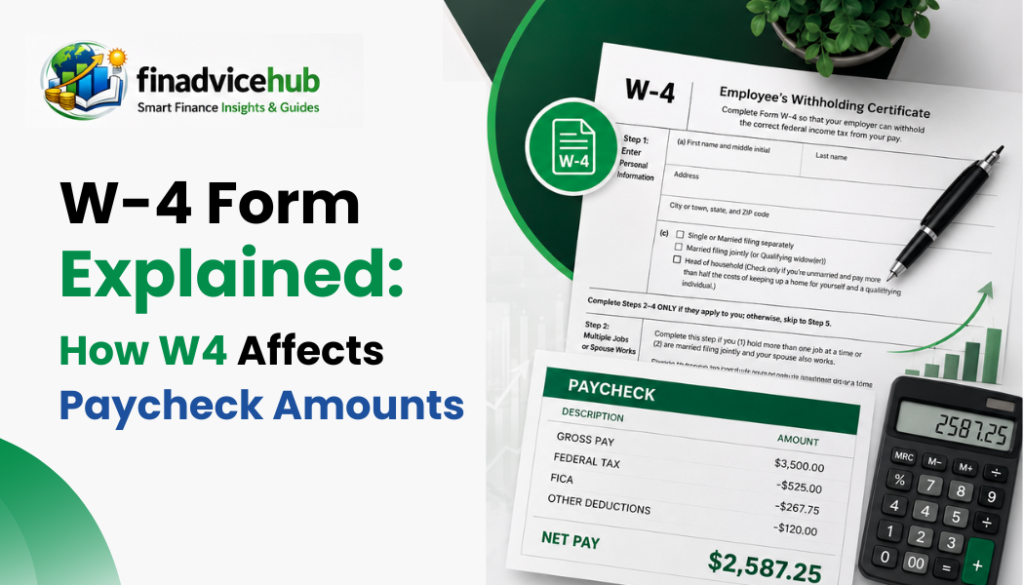
Your paycheck is not just the amount your employer agrees to pay you it is the result of several calculations, and your W-4 plays one of the most important roles in determining your final take-home amount. When you start a new job or review your pay stub, you will come across IRS Form W-4, also known as the Employee’s Withholding Certificate. While many employees treat it as simple onboarding paperwork, the choices you make on this form directly influence how much federal income tax is withheld from every paycheck and how much money you actually receive.
The timing of these paycheck calculations also depends on how frequently you are paid. According to the U.S. Bureau of Labor Statistics, biweekly pay periods were the most common among U.S. private establishments, with 43% paying employees every two weeks in February 2023. This means W-4 decisions can impact the amount of money workers receive in their bank accounts multiple times each month.
Understanding how W4 affects paycheck amounts gives you better control over your income throughout the year. Your W-4 determines whether you are withholding the right amount of tax, helping you avoid unnecessarily smaller paychecks or an unexpected tax balance when filing your return. Whether you are starting a new job, updating your tax information, or simply reviewing your pay stub, understanding W-4 withholding can help you make more informed decisions about your finances.
In this guide, we will explain everything you need to know about the W-4 form, including how withholding is calculated, what each section means, common mistakes to avoid, and how to adjust your W-4 to better match your financial situation.
What Is the W-4 Form
Definition and purpose
The Form W-4, officially titled the Employee’s Withholding Certificate, is a critical tax form provided by theInternal Revenue Service (IRS). Its core purpose is to inform your employer how much federal income tax to deduct from your gross wages each pay period. Your employer sends those withheld funds directly to the government throughout the year as advance payments toward your annual income tax liability.
Why employees must fill it
The United States operates on a pay-as-you-go income tax system. The government requires taxpayers to pay income taxes continuously as earnings are received, rather than paying one large lump sum at tax time. Completing this tax withholding form USA document is essential because payroll systems rely on it to calculate your exact payroll tax settings. Without a completed W-4, your employer is legally required to withhold taxes at the highest standard rate, significantly reducing your net earnings.
When to update W-4
While you must fill out a W-4 whenever you start working for a new employer, it is far from a one-time form. You can update your paycheck tax adjustments and W-4 options whenever your personal or financial circumstances change. Key triggers for an update include getting married, getting divorced, welcoming a new child, buying a home, taking on a second job, or experiencing a major shift in household income.
Overview of impact
The choices you make on your W-4 form directly dictate your take-home pay. Selecting the right options ensures you withhold enough tax to satisfy the IRS while keeping as much of your hard-earned money in your pocket every pay period. Mastering how W-4 affects paycheck outcomes ensures you stay in full command of your cash flow.
How the W-4 Form Affects Your Paycheck
Withholding adjustments
The IRS uses the parameters you enter on Form W-4 to calculate taxable wages for each pay period. When you request extra withholding, your employer subtracts more money from your gross pay. Conversely, when you claim tax credits or deductions, your employer subtracts fewer dollars, leaving you with larger payments in each pay cycle.
Impact on take-home pay
There is a direct inverse relationship between federal tax withholding and your take-home pay. Increasing your withholding adjustments lowers your net pay, while decreasing tax withholding increases your take-home amount. Understanding how W-4 changes your paycheck amount helps you avoid surprising fluctuations in your personal bank account.
Over-withholding vs under-withholding
Balancing your tax form options comes down to managing over-withholding versus under-withholding:
- Over-withholding: Occurs when you have more federal tax deducted than your actual tax liability requires. This results in smaller paychecks throughout the year and a large refund when you file your annual tax return.
- Under-withholding: Occurs when you withhold less than you owe. This provides larger paychecks, but you risk owing a tax balance and potential IRS penalties when filing taxes.
Real paycheck changes
Even minor edits to your tax paperwork create noticeable changes in net pay. Adjusting your filing status or claiming an extra child tax credit can alter your take-home amount by hundreds of dollars each month. Evaluating paycheck difference after W-4 changes allows you to see the tangible financial benefits of proper tax setup.
Key Sections of the W-4 Form Explained
Filing status
Step 1 of the Form W-4 collects personal identification details and requires you to select your filing status. You must choose between Single, Married Filing Separately, Married Filing Jointly, or Head of Household. Your selection establishes the baseline standard deduction and tax brackets applied to your pay cycle.
| Filing Status | Standard Deduction Baseline | Relative Tax Withholding Impact |
| Single / Married Filing Separately | Standard single baseline deduction | Higher rate of tax withheld per dollar earned |
| Married Filing Jointly | Double the single baseline deduction | Lower withholding rate (assumes single income household) |
| Head of Household | Expanded baseline deduction | Lower withholding rate for qualifying single heads of household |
Multiple jobs section
Step 2 is designed for households with multiple streams of income. If you work two jobs at once or are married filing jointly with an employed spouse, completing this step prevents under-withholding. It adjusts payroll calculations so standard deductions are not counted twice across separate income sources.
Dependents section
Step 3 allows you to account for dependents by claiming the Child Tax Credit and credits for other qualifying relatives. Entering your eligible dollar credits reduces federal tax withholding directly, providing immediate cash flow benefits. Understanding how dependents affect W-4 withholding is one of the easiest ways to optimize monthly cash flow.
Additional withholding
Step 4 offers advanced paycheck tax control for complex financial situations:
- Step 4(a): Enter non-job income (such as investment returns or interest) so tax is withheld directly from your pay.
- Step 4(b): Enter custom deductions exceeding the standard deduction to reduce tax withholding.
- Step 4(c): Specify an exact additional dollar amount you want withheld from each paycheck.
Step-by-Step Example of W-4 Impact
Scenario setup
To clearly illustrate a W-4 paycheck impact breakdown, let’s analyze a real-world scenario. Meet Alex, a full-time employee earning $78,000 annually ($3,000 gross per biweekly paycheck). Alex is a single parent with one qualifying child under age 17. Let’s see how different setup choices change this W-4 withholding example paycheck.
Original paycheck
If Alex fills out Step 1 as Single but leaves Steps 2 through 4 completely blank, payroll software calculates federal tax withholding based solely on the standard single baseline:
- Gross Biweekly Pay: $3,000.00
- Estimated Federal Tax Withheld: ~$310.00
- Estimated Net Pay (before state/FICA): $2,690.00
Adjusted withholding
Now, Alex reviews the W-4 form step by step guide USA rules and completes Step 3 by claiming the $2,000 Child Tax Credit. This credit reduces annual federal tax withholding by exactly $2,000, which divides to roughly $76.92 less tax withheld per biweekly pay period ($2,000 divided by 26 paychecks).
Final paycheck comparison
Here is the step-by-step real W-4 adjustment examples comparison showing the paycheck change after W-4 update:
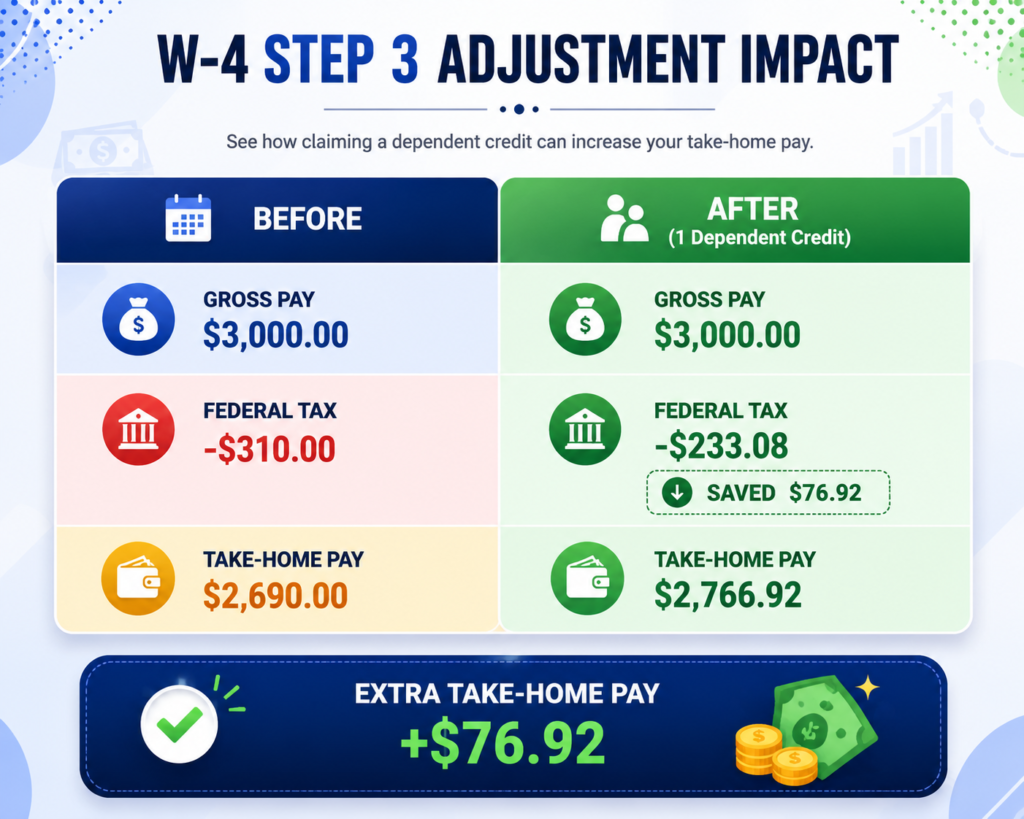
By completing Step 3, Alex gains an extra $76.92 in net pay every two weeks, generating roughly $166 in additional monthly take-home income.
How to Fill Out W-4 Correctly
Step-by-step instructions
Following this structured process helps you understand how to fill W-4 correctly:
- Step 1: Complete personal details and select your official tax filing status.
- Step 2: Fill out this section if you hold multiple jobs or file jointly with a working spouse.
- Step 3: Calculate eligible child and dependent tax credits and enter the total dollar amount.
- Step 4: Account for additional non-job income, itemized deductions, or extra voluntary withholding.
- Step 5: Sign and date the form. Unsigned forms cannot be processed by payroll.
Choosing filing status
Always choose the exact status you intend to use when filing your annual income tax return. Selecting Married Filing Jointly on your W-4 when you file as Single on your tax return will lead to severe under-withholding and an unexpected tax bill.
Claiming dependents
Multiply your number of qualifying children under 17 by the current credit amount, add credits for other dependents, and enter the total dollar figure in Step 3.
Understanding Tax Allowances: Before major tax revisions, the IRS relied on tax allowances to adjust withholding. Today, W-4 allowances explained guides clarify that the allowance system has been eliminated. The modern W-4 uses direct dollar amounts for credits, income, and deductions to deliver far greater precision.
Avoiding mistakes
Common filing errors include forgetting to sign the form, double-counting dependent credits across working spouses, or failing to report secondary job income in Step 2.
How to Adjust W-4 to Increase Take-Home Pay
Reducing withholding
If you regularly receive a large refund check each spring, you are sending too much tax to the IRS during the year. Learning how to adjust W-4 for less tax or how to fill out W-4 for maximum take-home pay involves accurately claiming all eligible credits in Step 3 and deductions in Step 4(b) to reduce tax deductions per pay period.
Risks involved
While learning how to increase take-home pay W-4 options is beneficial, reducing withholding too aggressively creates financial risks. If your total withholding falls below IRS requirements, you may face a tax bill and late-payment penalties when filing taxes.
Tax balance considerations
The goal of an effective withholding optimization strategy is to reach a neutral tax position. Ideally, your total annual tax withholding should closely match your W-4 vs actual tax liability, leaving you with near-zero balance owed and minimal refund.
Strategy examples
If you receive an annual tax refund of $2,600, you are overpaying taxes by $100 every biweekly pay period. Adjusting your W-4 entries to reflect your real tax position puts that $100 back into your paycheck every two weeks, helping you pay down debt or build savings immediately.
How W-4 Affects Your Tax Refund
Overpayment of taxes
A tax refund is not free money or a bonus from the government. It is simply a return of your own overpaid earnings that you loaned to the federal government interest-free throughout the tax year.
Underpayment risks
If your paycheck withholding is set too low, your total payments will fail to cover your tax obligation. When considering what happens if W-4 is wrong, underpayment requires you to pay the remaining balance directly out of pocket by the April filing deadline.
Refund expectations
Understanding tax refund vs withholding dynamics allows you to set clear financial expectations. If you prefer receiving a lump sum once a year for large planned purchases, keep your withholding higher. If you prefer ongoing cash flow, keep your withholding lower.
Balancing strategy
Balancing your tax form setup ensures you keep control of your earnings throughout the year, maximizing net income while maintaining tax compliance.
Common W-4 Mistakes to Avoid
Incorrect filing status
Selecting an incorrect status corrupts baseline tax calculations. Single individuals who mistakenly check Married Filing Jointly will experience severe under-withholding across all pay periods.
Ignoring multiple jobs
When working two jobs, leaving Step 2 blank on both W-4 forms causes both employers to apply full standard deductions. This results in significant under-withholding across your combined earnings.
Not updating after life changes
Failing to update your paperwork after major life events leads to inaccurate withholding. Marriage, divorce, having a baby, or a child aging out of dependent status all require an updated form.
Overestimating dependents
Claiming tax credits for individuals who do not meet IRS dependent definitions artificially lowers your withholding, resulting in an unexpected tax balance at year-end.
When You Should Update Your W-4
Job change
Starting a new position or adding part-time work requires submitting a fresh W-4 that accurately reflects your updated total household income.
Marriage or divorce
A change in marital status fundamentally alters your filing status, standard deduction, and applicable tax brackets, making an immediate W-4 review essential.
Birth of child
Welcoming a child makes you eligible for dependent tax credits. Updating Step 3 allows you to reduce tax withholding and increase your take-home pay right away.
Income changes
Significant shifts in side-gig income, investment gains, or secondary earnings should prompt a W-4 review to add extra withholding via Step 4(a) or Step 4(c) and avoid end-of-year tax surprises.
W-4 Optimization Strategy for Better Paycheck Control
Balancing taxes vs take-home
An effective tax strategy focuses on finding the middle ground between maximizing take-home pay and fulfilling your tax obligations. Aligning your W-4 with your actual financial situation prevents unwanted tax day surprises.
Using IRS calculator
The IRS offers a free online tool called the IRS Tax Withholding Estimator. By inputting details from your recent pay stubs and prior tax returns, this tool calculates exact line-by-line recommendations for your Form W-4.
Planning ahead
Review your tax settings mid-year or whenever major financial changes occur. Proactive management ensures your withholding stays aligned with your annual tax goals.
Annual review strategy
Establish a routine of reviewing your payroll settings every January. Regular updates keep your W-4 form-explained paycheck strategy accurate, predictable, and fully aligned with your financial goals.
Conclusion
Once you understand how W4 affects paycheck amounts, it becomes easier to make informed decisions about your tax withholding instead of leaving your paycheck results to chance. A properly completed W-4 helps ensure that the amount withheld from each paycheck matches your actual tax situation, whether your goal is increasing take-home pay or avoiding an unexpected balance when you file your return.
Because your financial situation can change over time, your W-4 should be reviewed and updated when needed. Taking a few minutes to adjust it after starting a new job, receiving a pay increase, getting married, or experiencing another major life change can help keep your withholding accurate and your finances more predictable.
FAQs
How does W-4 affect your paycheck?
How W-4 affects paycheck amounts depends on the information you provide on your W-4. Your employer uses the form to calculate how much federal income tax to withhold from each paycheck. Claiming eligible credits or deductions generally reduces withholding and increases your take-home pay, while requesting additional withholding results in more tax being deducted and a smaller paycheck.
Can changing W-4 increase take-home pay?
Yes. If you’re having more tax withheld than necessary, updating your W-4 to reflect your current filing status, eligible credits, or deductions can reduce federal tax withholding. As a result, you’ll receive more of your earnings in each paycheck, provided your withholding still covers your expected tax liability.
What happens if W-4 is filled incorrectly?
An incorrect W-4 can lead to either too much or too little tax being withheld. Over-withholding means smaller paychecks and a larger tax refund, while under-withholding may leave you with a tax bill, and potentially penalties, when you file your return.
How often should I update my W-4?
You can update your W-4 whenever your financial or personal circumstances change. It’s a good idea to review it at least once a year, especially after events such as starting a new job, getting married or divorced, having a child, or experiencing a significant change in income.