

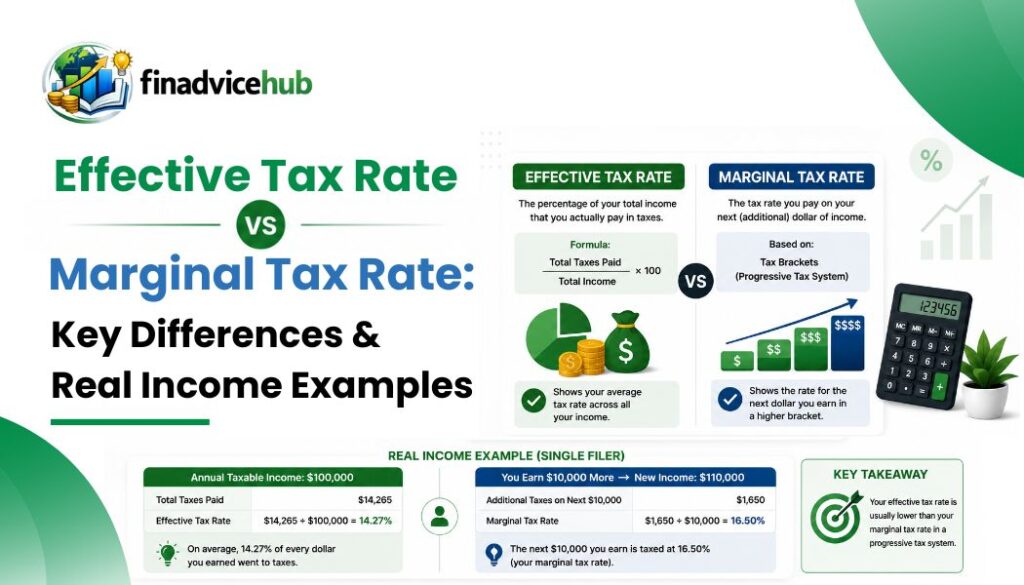
You look at your tax bracket and think you’re handing over 24% of your paycheck to the IRS. Then you do the real math, and the number is way lower. What happened?
This is the most common source of tax rate confusion, explained simply: people mix up the rate on their last dollar with the rate on their whole income. Once you see the numbers side by side, it clicks fast.
What Is a Marginal Tax Rate?
Definition of marginal tax rate
Your marginal tax rate is the tax rate applied to your next dollar of income. It’s tied to the highest tax bracket your income reaches, not your entire paycheck.
How tax brackets create marginal rates
The US uses a progressive tax system. Income is split into chunks, called brackets, and each chunk gets taxed at its own rate. This is the basic tax bracket structure behind marginal rates.
How only part of the income is taxed at each rate
This is the part most people miss. If you’re in the 22% bracket, that doesn’t mean all your income is taxed at 22%. Only the income inside that bracket is. Everything below it is taxed at lower rates first.
Example of marginal tax calculation
Say you earn $50,000 as a single filer in 2024. Using simplified brackets:
- 10% on income up to $11,600
- 12% on income from $11,600 to $47,150
- 22% on income from $47,150 to $50,000
Your marginal rate is 22%, because that’s the rate on your top slice of income. But most of your $50,000 was taxed at 10% and 12%.
Common misconceptions
A lot of people believe moving into a higher bracket means their whole salary gets taxed at that rate. That’s false. This single misunderstanding causes more tax bracket vs tax rate confusion than anything else.
What Is an Effective Tax Rate?
Definition of effective tax rate
Your effective tax rate is the percentage of your total income that actually goes to taxes. It blends every bracket you passed through into one simple number.
Why it is called “average tax rate”
Because it reflects the average tax rate across your entire income, not just the top slice. This is why some people call it your blended tax rate.
Formula for effective tax rate
Effective tax rate = Total tax paid ÷ Total taxable income
Example calculation
Using the $50,000 example above, suppose total federal tax owed comes out to $6,053.
$6,053 ÷ $50,000 = 12.1% effective tax rate
That’s far lower than the 22% marginal rate.
Real-world interpretation
This 12.1% is the number that actually reflects your tax burden. It’s a more honest answer to “how much of my income goes to taxes.”
Key Differences Between Marginal and Effective Tax Rates
Understanding the effective tax rate vs. the marginal tax rate is essential for making sense of how your income is actually taxed in the United States. Many people confuse the two, which leads to misunderstandings about their real tax burden.
Tax calculation method differences
The core marginal tax rate explained the USA concept is simple: it applies only to the next dollar you earn. Think of it as looking at one slice of your income.
In contrast, the effective tax rate calculation looks at your entire income and total tax paid, giving you a full-picture average.
This is why in how tax rates work USA, different parts of your income are taxed at different levels under a progressive tax system.
Bracket-based vs blended rate
A tax bracket vs tax rate difference comes down to structure versus outcome.
- Marginal tax rate = bracket-based system tied to income taxation tiers
- Effective tax rate = a blended or “blended tax rate” across all brackets you’ve entered
So while marginal tax is step-based, effective tax rate smooths everything into a single average number.
Impact on total tax paid
Your marginal rate affects decisions like raises or bonuses; this is where how the marginal tax rate applies to income brackets becomes important. Meanwhile, your effective rate reflects your true yearly tax burden and helps with estimating the total tax burden more accurately.
This also explains why the effective tax rate is lower than the marginal tax rate for most taxpayers.
Psychological misunderstanding of tax rates
People often say “I’m in the 24% tax bracket,” but that refers to their marginal rate, not what they actually pay. This confusion leads to the difference between the average and marginal tax rate being explained issue in personal finance discussions.
It can even distort decisions about extra income, because the marginal tax rate, meaning with real income example, shows that only additional dollars are taxed at the higher rate, not all income.
Comparison table explanation
| Feature | Marginal Tax Rate | Effective Tax Rate |
| What it measures | Rate on your last dollar | Average rate on all income |
| Based on | Highest bracket reached | Total tax ÷ total income |
| Used for | Planning raises, bonuses | Understanding real tax burden |
| Typical value | Higher | Lower |
This tax bracket system explained with example USA style breakdown helps clarify how tax brackets affect total tax paid in real life.
A marginal vs effective tax examples visualization like this makes the gap easy to see at a glance and highlights the income tax rate breakdown across brackets.
How the US Progressive Tax System Works
Tax bracket structure explained
Tax brackets are income ranges, each with its own rate. As your income rises, only the new income above each threshold gets taxed at the next rate.
Income layering system
Think of your income as layers stacked in a jar. The bottom layer gets taxed first, at the lowest rate. Each layer above it gets taxed a little higher. This income layering tax system USA approach is the backbone of federal income tax.
Step-by-step taxation across brackets
- The first layer of income is taxed at the lowest rate.
- The next layer is taxed at the next rate up.
- This continues until you reach your top layer, taxed at your marginal rate.
Why rates increase with income
The system is designed so higher earners pay a larger share, while everyone benefits from the lower rates on their first dollars earned.
Real-life progressive tax example
A person earning $30,000 and a person earning $300,000 both pay 10% on their first $11,600. The higher earner just keeps climbing into more brackets above that.
Step-by-Step Example: Marginal vs Effective Tax Rate
Income breakdown example
Let’s use a single filer earning $90,000 in taxable income for 2024.
Applying multiple tax brackets
- 10% on $0 to $11,600 = $1,160
- 12% on $11,600 to $47,150 = $4,266
- 22% on $47,150 to $90,000 = $9,427
Calculating total tax paid
$1,160 + $4,266 + $9,427 = $14,853 total federal tax
Calculating effective rate
$14,853 ÷ $90,000 = 16.5% effective tax rate
Final comparison result
Marginal rate: 22% Effective tax rate: 16.5%
This effective tax rate vs marginal tax rate example calculation shows almost a 6-point gap between the two numbers, even though they describe the same paycheck.
Why the Effective Tax Rate Is Lower Than the Marginal Rate
The difference between effective tax rate vs marginal tax rate comes down to how income is split, taxed, and averaged under the U.S. system. Once the structure is clear, the lower effective rate becomes easy to explain.
Bracket layering effect
Income is taxed in layers, not as one lump sum. Under the progressive tax system, earnings move through income taxation tiers, where each portion is taxed at different rates.
Only the highest layer of income reaches your marginal tax rate explained USA. All earlier layers are taxed at lower brackets, which naturally reduces the overall average rate. This is a core tax bracket vs tax rate difference that shapes the entire system.
Partial income taxation logic
The U.S. system applies taxes step by step across brackets instead of using one flat percentage. This structure explains how tax rates work USA in practice.
When all bracket portions are combined, the result is a blended outcome known as the effective tax rate calculation. It averages the different rates applied across your income, which is why it is always lower than the top bracket rate in most cases.
Deduction impact
Deductions reduce the amount of income that is subject to tax before brackets are applied. This affects where your income falls within the federal income tax structure.
By lowering taxable income, deductions shift more of your earnings into lower brackets. This influences how tax brackets apply step by step and plays a direct role in how to calculate your effective tax rate step by step, since the base amount being taxed is reduced.
Credits impact
Tax credits reduce your final tax bill directly instead of adjusting income. This makes them more powerful than deductions in many cases.
Because credits cut the actual tax owed, they further reduce your blended tax rate, especially when looking at how income is taxed at different rates. The result is a noticeable drop in the overall effective rate even if income stays the same.
Common confusion explained
A frequent misunderstanding in how the marginal tax rate applies to income brackets is assuming the tax bracket equals the total tax paid.
In reality, the bracket only applies to your highest portion of income. Your total tax comes from a combination of all brackets, deductions, and credits, shown in the full income tax rate breakdown.
That’s why marginal vs effective tax examples are important for showing real outcomes under the tax bracket system explained with example USA, where the average rate is always lower than the top marginal rate.
How Tax Brackets Affect Real Tax Liability
The way tax bracket system explained with example USA works is based on splitting income into layers rather than applying one flat rate. This structure directly shapes your real tax liability and explains how tax brackets affect total tax paid in practice.
Income segmentation across brackets
Income is divided into segments that sit inside different income taxation tiers. Each tier works like a separate mini-calculation stacked on the previous one.
This layered setup is central to how income is taxed at different rates, where lower portions of income stay in lower brackets and only higher portions move upward.
Incremental tax calculation
As income crosses a bracket threshold, only the amount above that line is taxed at the new rate. This is the core of how marginal tax rate applies to income brackets.
So instead of your entire income shifting into a higher rate, only the additional dollars are affected. This incremental logic is key to how tax rates work USA in a progressive system.
High-income example
A single filer earning $250,000 may fall into a 35% marginal bracket. However, their effective tax rate calculation is much lower, often around 25–28%.
This gap appears because earlier portions of income are taxed at lower rates, creating a strong blended tax rate effect. It’s a clear case of effective tax rate for high-income earners, for example, where layering significantly reduces the average rate.
Low-income example
A taxpayer earning $20,000 might sit in a 12% marginal bracket, but their effective rate could be closer to 6–8%.
Most of their income remains in the lowest taxable income levels, which lowers the overall average. This shows a simple marginal vs effective tax example pattern where lower incomes face a smaller spread between rates.
Tax cliff misconceptions
There is no point where earning one extra dollar suddenly changes the tax rate on your entire income. This misconception comes from a misunderstanding of the tax bracket vs tax rate difference.
Only the income above the threshold gets taxed at the higher rate, which is why fears about a “tax cliff” are incorrect in a progressive tax system.
Real-Life Scenarios for Tax Rate Differences
Single-filer example
A single filer earning $60,000 may fall into a 22% marginal bracket, but their effective rate is closer to 14% after applying the full income tax rate breakdown across brackets.
Married couple example
Married couples filing jointly benefit from wider brackets in the federal income tax structure. This often increases the gap between the average tax rate vs marginal tax rate, since more income stays in lower tiers.
Freelancer income example
Freelancers are taxed under the same bracket system but also pay self-employment tax. This raises their total liability and shifts their effective tax rate calculation higher than that of an employee earning the same gross income.
High-income earner scenario
A high earner in a 35% bracket often ends up with a mid-to-high 20s effective rate. Deductions, retirement contributions, and bracket layering all contribute to lowering the final outcome in how tax rates work USA.
Side income scenario
Side income is added on top of existing earnings, meaning it is usually taxed at the highest marginal tax rate explained by the USA taxpayer already reaches.
This is why additional income often feels heavily taxed; it sits entirely in the top layer of the income taxation tiers, even though earlier income remains taxed at lower rates.
Common Mistakes in Understanding Tax Rates
A lot of confusion around effective tax rate vs marginal tax rate comes from mixing up how brackets actually work with how people assume taxes are calculated. These misunderstandings often lead to poor financial decisions or overestimating tax liability.
Thinking the entire income is taxed at the highest rate
One of the most common errors in income tax rate breakdown discussions is assuming your entire income gets taxed at your top bracket.
In reality, a progressive tax system applies different income taxation tiers, where only the portion above each threshold is taxed at the higher rate. This step-by-step structure is central to how tax brackets apply correctly.
Misinterpreting marginal rate
Many people treat their marginal rate as their real-world tax burden. But the marginal tax rate explained USA only applies to the last slice of income, not the whole amount.
This is where the tax bracket vs tax rate difference becomes important your marginal rate is not your average rate, and it does not reflect total taxes paid.
Ignoring deductions and credits
Another frequent mistake is leaving out deductions and credits when estimating taxes.
Deductions reduce taxable income, while credits reduce tax owed directly. Ignoring them distorts your effective tax rate calculation and inflates perceived liability under the federal income tax structure.
Confusing average vs marginal
The average tax rate vs marginal tax rate comparison is often misunderstood because both sound similar but answer different questions.
- Marginal rate = tax on your next dollar
- Average (effective) rate = total tax ÷ total income
Mixing them leads to incorrect assumptions about how tax rates work in the USA and can skew financial planning decisions.
Misreading tax tables
Tax tables show bracket ranges and rates, not the total tax owed on your full income.
Without understanding how income is taxed at different rates, it’s easy to misinterpret these tables and overestimate liability. The confusion often disappears once you understand how tax brackets apply step by step.
Tax Planning Using Effective Tax Rate
Estimating the true tax burden
Your effective tax rate is the most useful number for budgeting. It reflects your actual yearly outcome after all brackets, deductions, and credits are applied.
This is the number used when calculating how to estimate the total tax burden more realistically.
Income planning strategies
If your income is close to a bracket threshold, timing bonuses or freelance payments can influence how much lands in a higher bracket.
This is a practical application of how the marginal tax rate applies to income brackets, especially for managing taxable income levels efficiently.
Bracket management techniques
When possible, spreading income across different tax years can reduce how much gets pushed into higher brackets.
This approach uses the structure of the progressive tax system to keep more earnings in lower-income taxation tiers, reducing overall tax pressure.
Retirement contribution impact
Contributions to retirement accounts like a 401(k) or IRA reduce taxable income before brackets are applied.
This lowers both marginal exposure and your overall blended tax rate, directly improving your effective tax rate calculation under the federal income tax structure.
Long-term tax optimization
Tracking your effective tax rate each year helps reveal trends in your income tax rate breakdown. Over time, it allows adjustments in withholding, deductions, and contributions.
This makes tax planning more proactive, helping you better manage how tax rates work USA instead of reacting only at tax season.
Conclusion
A tax bracket is not a flat price tag on your paycheck; it’s more like a staircase: your income climbs one step at a time. That’s the real story behind effective tax rate vs marginal tax rate.
Your marginal rate only touches the top slice of your income, while everything below it is taxed in earlier income taxation tiers under the progressive tax system. Once those layers stack up, the final number naturally settles lower than the headline bracket.
That gap is exactly where the reason why the effective tax rate is lower than the marginal tax rate becomes obvious. Lower brackets, deductions, and credits all quietly pull your total down inside the federal income tax structure, reshaping what you actually pay.
So when you see a tax bracket vs tax rate difference, remember: the bracket is just the edge you’ve reached, not the story of your entire income. The real picture is your blended outcome, not your top rate.
FAQs
What is the difference between the marginal and the effective tax rate?
The marginal tax rate is the rate on your last dollar of income. The effective tax rate is the average rate you pay across all your income combined.
Why is my effective tax rate lower than my tax bracket?
Because only the income inside your top bracket is taxed at that rate. Everything below it is taxed at lower rates, which pulls your average down.
How do I calculate my effective tax rate?
Divide your total tax paid by your total taxable income. The result is your effective tax rate.
Does the marginal tax rate apply to all income?
No. It only applies to the portion of your income that falls within your highest tax bracket.
Which tax rate matters more for planning?
Your marginal rate matters most for decisions about extra income, like bonuses or side jobs. Your effective rate matters most for understanding your overall tax burden.
Can my effective tax rate change yearly?
Yes. It shifts based on your income, deductions, credits, and any changes to tax brackets from year to year.
How do tax brackets affect the marginal tax rate?
Your marginal rate is simply the rate tied to the highest bracket your income reaches that year.
Is the marginal tax rate the same as the tax paid?
No. The marginal rate is just one rate on your top slice of income. Your actual tax paid comes from adding up tax owed across every bracket you passed through.