
Filing taxes can feel confusing, especially if you are doing it for the first time. The good news is that the process becomes much easier when you understand each step and prepare your documents in advance. Every year, millions of Americans file a tax return to report their income, claim deductions, and determine whether they owe additional taxes or qualify for a refund. In fact, the IRS reports that more than 90% of individual tax returns are now filed electronically, making online filing the preferred choice for most taxpayers. While tax forms may seem complicated at first, the overall process follows a straightforward sequence. Once you know what information you need and understand each step, filing your return becomes much more manageable.
This guide explains the tax filing process step by step USA in simple language. Whether you are an employee, freelancer, student, retiree, or small business owner, you will learn how to organize your records, calculate your income, choose the correct filing status, apply deductions and credits, submit your return, and track your refund. The guide is written for beginners but also includes practical tips that experienced taxpayers can use to improve accuracy and avoid costly mistakes.
Instead of rushing through tax season, take the process one step at a time. Careful preparation helps reduce errors, prevents delays, and makes it easier to meet IRS requirements. By the end of this guide, you will understand how to file taxes in USA step by step and feel more confident about completing your own return.
Overview of the US Tax Filing System
Before completing any tax forms, it is important to understand how the American tax system works. Knowing the basics helps you understand why certain documents are required, how taxes are calculated, and what happens after you submit your return. Having a clear understanding of the tax filing process step by step USA also makes it easier to prepare accurate information, avoid common mistakes, and follow the correct sequence when completing your tax obligations.
What is tax filing
Tax filing is the yearly process of reporting your income, deductions, tax credits, and taxes already paid to the Internal Revenue Service (IRS). The IRS uses this information to determine your final tax responsibility for the year.
Think of tax filing as balancing your tax account. During the year, taxes may already be taken from your paycheck or paid through estimated quarterly payments. When you file your return, the IRS compares the amount you already paid with the amount you actually owe.
There are two possible outcomes:
- You paid more than required and received a tax refund.
- You paid less than required and must pay the remaining balance.
Many people believe tax filing is only about reporting income. In reality, it is also about claiming deductions and tax credits that can lower your taxable income and reduce the amount of tax you owe. Learning the IRS tax filing process explained from start to finish helps you avoid errors and understand how every part of the return fits together.
Who needs to file taxes
Not everyone is required to file a federal tax return every year. Whether you must file depends on several factors, including your age, filing status, total income, and the type of income you receive.
For example, people who earn wages from an employer usually need to file once their income reaches the IRS filing threshold. Self-employed individuals often have different filing requirements because they must also pay self-employment tax. Retirees, students, and people receiving investment income may also need to file depending on their financial situation.
Even if you are not legally required to file, submitting a return can still be beneficial. Many taxpayers receive refunds because too much tax was withheld from their paychecks. Filing also allows you to claim valuable tax credits that could increase your refund.
Federal vs state tax filing
The United States has two different levels of income taxation. The federal government collects federal income tax through the IRS, while many individual states collect state income tax through their own tax agencies.
Federal tax rules apply across the country. State tax rules, however, vary depending on where you live. Some states have no state income tax, while others require residents to file a separate state return each year.
When preparing your taxes, always determine whether your state requires a separate filing. Missing a required state return can result in penalties even if your federal return is filed correctly.
Filing deadlines explained
Every tax return has a filing deadline. In most years, individual federal tax returns are due in April. Missing the deadline can lead to penalties, interest charges, and delays in processing refunds.
If you cannot finish your return before the deadline, you may request an extension. An extension gives you more time to file your paperwork, but it does not give you more time to pay taxes you owe. Any estimated balance should still be paid by the original due date to reduce penalties and interest.
Keeping track of IRS tax filing deadlines explained each year is one of the easiest ways to avoid unnecessary costs.
Overview of IRS system
The IRS is the federal agency responsible for collecting taxes and enforcing tax laws. Each year it processes millions of tax returns from individuals and businesses.
The IRS e-file system has made tax filing much faster than traditional paper returns. Electronic filing automatically checks many common mistakes, speeds up processing, and helps taxpayers receive refunds more quickly.
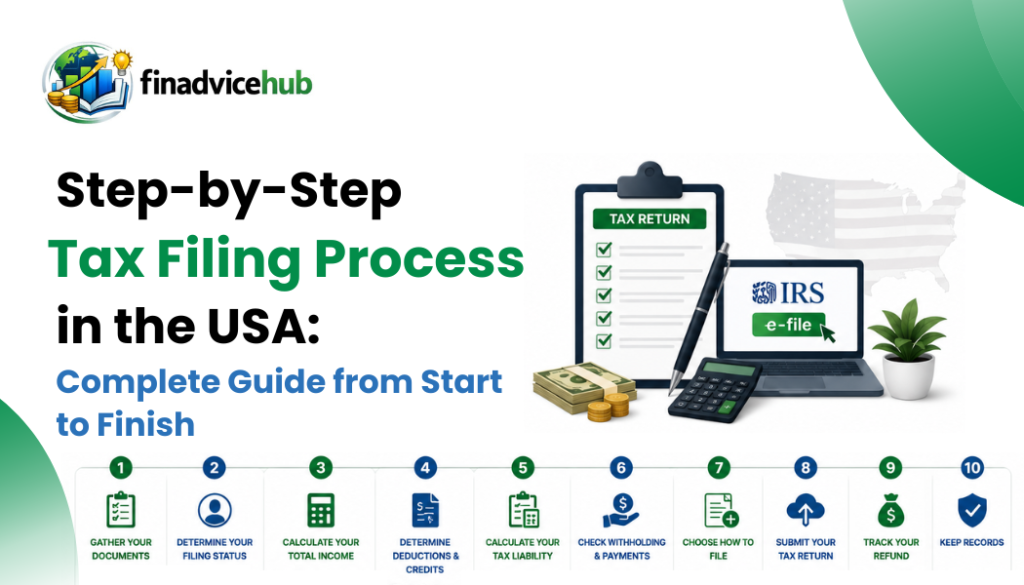
A simplified version of the tax preparation workflow looks like this:
| Step | Purpose |
| Collect documents | Gather income and deduction records |
| Prepare return | Complete tax forms accurately |
| Submit return | File electronically or by mail |
| IRS review | Verify information and calculate tax |
| Refund or payment | Receive a refund or pay any balance due |
Understanding this workflow helps explain how IRS processing moves from your completed return to your final refund or tax bill.
Documents Required for Tax Filing
Having the correct paperwork before starting your return saves time and reduces mistakes. Many delays happen because taxpayers forget an important form or fail to report all income.
Creating a complete tax documents checklist before you begin is one of the best ways to simplify the income reporting process.
Common documents include:
- W-2 forms from employers
- 1099 forms for freelance, contract, dividend, or interest income
- 1098 forms for mortgage interest or education expenses
- Bank statements
- Investment records
- Social Security statements, when applicable
- Receipts supporting deductions
- Records of estimated tax payments
W-2 forms
A W-2 is one of the most important tax documents for employees. Every employer sends this form after the end of the tax year. It reports your total wages, bonuses, tips, retirement contributions, and federal and state taxes already withheld from your paycheck.
When entering W-2 information, copy every number carefully. Even a small typing error can delay processing or trigger questions from the IRS. If you worked for more than one employer during the year, include every W-2 you receive.
1099 forms
Many taxpayers receive one or more 1099 forms instead of, or in addition to, a W-2. These forms report income from freelance work, consulting, dividends, bank interest, retirement distributions, investments, and other non-salary payments.
Anyone learning how to file taxes with W2 and 1099 should carefully compare each form with their own financial records. Sometimes payments are reported on multiple forms, while other income may need to be reported even if you never received a 1099.
1098 forms (education and mortgage)
A 1098 form reports expenses that may qualify for valuable tax benefits. Homeowners often receive a mortgage interest statement, while students may receive education-related forms showing tuition payments.
These documents help determine whether you qualify for education credits or mortgage interest deductions, both of which may reduce your overall tax bill.
Bank and income records
Your tax return should include every source of taxable income, not just the amounts shown on W-2 or 1099 forms. That is why keeping accurate financial records throughout the year is so important.
Review your bank statements, savings account interest reports, brokerage statements, retirement account distributions, rental income records, and any other documents that show money you received. These records help confirm that all income has been reported correctly.
If you own a small business or work as a freelancer, maintain organized records of every payment you receive. Accounting software, spreadsheets, or well-organized paper records can make tax season much easier. Good recordkeeping also helps if the IRS ever requests additional information.
Deduction receipts
Deductions lower your taxable income, which may reduce the amount of tax you owe. However, many deductions require supporting documents.
Keep receipts for charitable donations, medical expenses, business purchases, educational expenses, and other deductible costs. Store these records in one place throughout the year instead of searching for them at tax time.
Digital copies are usually easier to organize than paper files. Many taxpayers scan receipts or save electronic invoices in folders labeled by year and expense category.
The better your records are, the easier it becomes to complete your return accurately and support your deductions if questions arise later.
Step 1 – Determine Your Filing Status
One of the first decisions you must make is choosing the correct filing status selection. Your filing status affects your tax rates, standard deduction, eligibility for credits, and the amount of tax you may owe. Selecting the wrong status can result in errors, delayed processing, or even IRS notices.
The IRS recognizes five main filing statuses. Understanding each one helps you choose the option that best fits your situation.
Single
The Single filing status is generally for taxpayers who are unmarried, legally separated, or divorced as of the last day of the tax year.
Although this is the simplest filing status, it still requires careful reporting of all income, deductions, and tax credits. Single filers qualify for the standard deduction and may also be eligible for education credits, retirement savings credits, or other tax benefits, depending on their income.
Married Filing Jointly
Many married couples choose to file one joint tax return because it often provides the greatest tax advantages.
When filing jointly, both spouses report all income, deductions, and credits on the same return. This option usually offers a higher standard deduction and access to credits that may not be available when filing separately.
Before filing jointly, both spouses should review all tax documents carefully to make sure every source of income is included.
Married Filing Separately
Some married couples choose to file separate returns. This option may be useful when spouses want to keep their finances separate or when one spouse has certain deductions tied to individual income.
However, filing separately may reduce eligibility for several tax credits and deductions. Because of these limitations, taxpayers should compare both filing methods before making a final decision.
Head of Household
The Head of Household filing status is available to qualifying unmarried taxpayers who pay more than half the cost of maintaining a home for a qualifying child or dependent.
This status often provides a larger standard deduction and more favorable tax brackets than filing as Single. Many single parents qualify for this status, but specific IRS rules must be met.
Understanding these requirements before filing helps prevent mistakes that could delay your return.
Qualifying Widow(er)
A surviving spouse may qualify for this filing status for a limited period after the death of a spouse if they have a qualifying dependent child.
This option allows the taxpayer to receive many of the same tax benefits as Married Filing Jointly, making the financial transition easier during a difficult time.
Before selecting this status, review the IRS eligibility rules to ensure all requirements are met.
Step 2 – Gather and Report Income
After choosing your filing status, the next step is reporting every source of taxable income. This is one of the most important parts of the tax return filing guide USA because the IRS receives copies of many income forms directly from employers, banks, and financial institutions.
If your reported income does not match IRS records, your return may require additional review.
W-2 Income Reporting
Employees should begin by entering the information from every W-2 received during the year.
Each W-2 includes important details such as:
- Total wages earned
- Federal income tax withheld
- State income tax withheld
- Social Security wages
- Medicare wages
- Retirement contributions
Double-check every number before submitting your return. Even a simple typing mistake can delay refund processing.
1099 Income Reporting
The next step is reporting income from all 1099 forms.
Common examples include freelance payments, consulting income, interest earned from banks, stock dividends, retirement distributions, unemployment compensation, and investment earnings.
Do not assume that missing a 1099 means the income does not need to be reported. Tax law generally requires you to report all taxable income, even if a tax form was never issued.
Accurate reporting is an important part of the income reporting process and helps avoid future IRS notices.
Freelance Income Reporting
Freelancers, independent contractors, and small business owners have additional reporting responsibilities.
Instead of reporting only income shown on tax forms, they must report all business income received during the year. This includes payments made by cash, checks, electronic transfers, and online payment platforms.
Business owners should also keep records of deductible business expenses, such as office supplies, software subscriptions, advertising costs, travel expenses, and professional services. These expenses may reduce taxable business income when reported correctly.
Maintaining organized records throughout the year makes tax preparation much faster than trying to recreate financial information at the last minute.
Investment Income Reporting
Investment income may come from several different sources, including savings accounts, certificates of deposit, mutual funds, stocks, bonds, and real estate investments.
Some investments generate interest income, while others produce dividends or capital gains when assets are sold.
Because different types of investment income may be taxed differently, carefully review every investment statement before completing your return. Reporting investment earnings accurately helps ensure your tax calculation is correct.
Total Income Calculation
Once every source of taxable income has been entered, calculate your total income.
This amount represents the combined value of wages, self-employment income, investment earnings, retirement distributions, rental income, unemployment benefits, and other taxable income received during the year.
Your total income serves as the starting point for the next stage of the federal tax filing steps, where adjustments are applied to calculate your Adjusted Gross Income (AGI). AGI plays a major role in determining your eligibility for deductions, credits, and other valuable tax benefits.
Step 3 – Calculate Adjusted Gross Income (AGI)
After calculating your total income, the next step is finding your Adjusted Gross Income (AGI). Many taxpayers overlook this number, but it is one of the most important figures on a tax return. The IRS uses your AGI to determine whether you qualify for many deductions, tax credits, and financial assistance programs.
Think of AGI as your total income after certain approved adjustments have been subtracted. A lower AGI may reduce your tax bill and increase your eligibility for valuable tax benefits.
Income adjustments explained
Income adjustments are expenses the IRS allows you to subtract from your total income before calculating taxes. These adjustments are often called “above-the-line deductions” because they are claimed before deciding whether to take the standard deduction or itemize deductions.
Common adjustments include deductible contributions to certain retirement accounts, student loan interest, educator expenses for eligible teachers, health savings account (HSA) contributions, and part of the self-employment tax paid by freelancers.
These adjustments lower your AGI, which may also increase your eligibility for additional tax credits and deductions.
Above-the-line deductions
Above-the-line deductions are available whether you choose the standard deduction or itemize your expenses. That makes them especially valuable because almost every eligible taxpayer can claim them.
Some of the most common above-the-line deductions include:
| Adjustment | Possible Benefit |
| Student loan interest | Lowers AGI if you qualify |
| Traditional IRA contributions | May reduce taxable income |
| Health Savings Account contributions | Reduces AGI for eligible taxpayers |
| Self-employed health insurance | Available for many business owners |
| Half of the self-employment tax | Deductible for self-employed individuals |
Always review the IRS rules before claiming these deductions because eligibility depends on income limits and other factors.
AGI formula breakdown
The formula for calculating AGI is straightforward:
Total Income − Eligible Income Adjustments = Adjusted Gross Income (AGI)
For example, if your total income is $68,000 and you qualify for $3,000 in allowable adjustments, your AGI becomes $65,000.
Although the calculation is simple, accuracy is very important because many later tax calculations depend on this number.
Example AGI calculation
Suppose Emily earned:
- W-2 wages: $58,000
- Freelance income: $6,000
- Savings account interest: $500
Her total income equals $64,500.
She also qualifies for:
- $1,500 student loan interest deduction
- $2,000 traditional IRA contribution deduction
Her calculation would look like this:
| Description | Amount |
| Total income | $64,500 |
| Less adjustments | $3,500 |
| Adjusted Gross Income | $61,000 |
This AGI will be used during the next steps to calculate deductions and taxable income.
Importance of AGI
Your AGI affects much more than your final tax bill.
The IRS uses it to determine eligibility for many tax credits, education benefits, retirement contribution deductions, healthcare-related programs, and other tax advantages. Financial institutions and government agencies may also request your AGI when verifying information.
For these reasons, always review your AGI carefully before moving to the next step.
Step 4 – Apply Deductions
Once you know your AGI, you can reduce your taxable income by claiming deductions. Deductions lower the amount of income that is actually taxed, which can significantly reduce your final tax liability.
Most taxpayers choose either the standard deduction or itemized deductions, depending on which provides the greater benefit.
Standard deduction
The standard deduction is a fixed amount established by the IRS each year. Most taxpayers choose this option because it is simple, requires less paperwork, and often provides a substantial reduction in taxable income.
If you do not have enough deductible expenses to exceed the standard deduction, taking the standard deduction usually saves both time and effort.
Always use the standard deduction amount for the tax year you are filing, as it changes periodically.
Itemized deductions
Instead of taking the standard deduction, you may choose to itemize eligible expenses.
Common itemized deductions include qualified mortgage interest, certain state and local taxes, charitable donations, and some medical expenses that meet IRS requirements.
Itemizing requires more documentation, so keep organized records throughout the year. Receipts, bank statements, and official tax documents help support your claims if additional verification is needed.
Choosing the best option
You cannot claim both the standard deduction and itemized deductions on the same return.
The easiest approach is to calculate your total itemized deductions and compare that amount with the standard deduction available for your filing status. Choose whichever option results in the larger deduction because it generally produces the lower taxable income.
Many tax software programs automatically compare both methods and recommend the better choice.
Deduction impact on taxable income
Deductions reduce the amount of income that is subject to federal income tax.
For example:
- AGI: $70,000
- Standard deduction: $15,000
Your taxable income becomes:
$70,000 − $15,000 = $55,000
Although your total earnings remain $70,000, taxes are calculated only on the reduced taxable income.
Common deduction mistakes
Many taxpayers lose money because they misunderstand deduction rules.
Common mistakes include:
- Claiming deductions without supporting documents
- Forgetting charitable donations
- Mixing business and personal expenses
- Choosing the wrong deduction method
- Entering incorrect amounts from receipts
Review every deduction carefully before filing. Even small mistakes can delay processing or reduce your refund.
Step 5 – Calculate Taxable Income
After deductions have been applied, you can calculate your taxable income. This number determines how much income will actually be taxed under the federal tax system.
Taxable income formula
The basic formula is:
Adjusted Gross Income − Deductions = Taxable Income
This figure becomes the basis for calculating your federal income tax.
Applying deductions to AGI
Subtract your standard deduction or total itemized deductions from your AGI.
Suppose your AGI is $61,000 and your deduction is $15,000.
Your taxable income equals:
$61,000 − $15,000 = $46,000
This is the amount used during tax bracket calculations.
Example calculation
Consider another example.
Sarah has:
| Description | Amount |
| Total income | $72,000 |
| Adjustments | $2,000 |
| AGI | $70,000 |
| Standard deduction | $15,000 |
| Taxable income | $55,000 |
Notice that Sarah is not taxed on her entire salary. She pays tax only on her taxable income after approved adjustments and deductions have been applied.
Role in tax brackets
Many people believe earning more money automatically causes all of their income to be taxed at a higher rate. That is not how the federal tax system works.
The United States uses a progressive tax system. Different portions of your taxable income fall into different tax brackets. As your income increases, only the income within the higher bracket is taxed at the higher rate.
Understanding this concept helps taxpayers avoid one of the most common misunderstandings about federal taxes.
Final taxable income result
Once your taxable income has been calculated, you have completed one of the most important parts of the tax filing process, from income to refund explained.
The next step is applying federal tax rates and tax credits to determine your final tax liability and whether you will receive a refund or owe additional taxes.
Step 6 – Apply Tax Rates and Credits
After calculating your taxable income, the next step is determining how much tax you owe. The IRS applies federal tax rates to your taxable income, and then any eligible tax credits are used to reduce your final tax bill. This step completes your tax liability calculation and tells you whether you owe additional taxes or qualify for a refund.
Federal tax bracket application
The United States uses a progressive tax system. This means different portions of your taxable income are taxed at different rates instead of one single rate.
For example, if your taxable income moves into a higher tax bracket, only the income within that bracket is taxed at the higher percentage. The rest of your income continues to be taxed at the lower rates.
This system is designed so that taxpayers with higher incomes generally pay a higher average tax rate, while lower-income taxpayers pay less.
Marginal tax calculation
Your marginal tax rate is the highest tax rate that applies to your income. It does not mean your entire income is taxed at that percentage.
Suppose your taxable income places part of your earnings in a higher tax bracket. Only that portion is taxed at the higher rate. Understanding this rule helps prevent one of the most common tax misunderstandings.
Most tax software performs these calculations automatically, but knowing how the system works helps you better understand your completed return.
Tax credits impact
Tax credits are different from deductions. While deductions reduce your taxable income, tax credits directly reduce the amount of tax you owe.
Some common tax credits include:
- Child Tax Credit
- Earned Income Tax Credit
- American Opportunity Credit
- Lifetime Learning Credit
- Child and Dependent Care Credit
If you qualify for one or more of these credits, your final tax bill may decrease significantly.
Refundable vs nonrefundable credits
Tax credits fall into two main categories.
Refundable credits can reduce your tax to zero and may even result in a refund if the credit is larger than your tax liability.
Nonrefundable credits reduce your tax bill but cannot reduce it below zero. Any unused portion of a nonrefundable credit is generally lost unless IRS rules allow it to be carried forward.
Knowing which credits apply to your situation helps maximize your tax savings.
Final tax liability
After applying tax rates and subtracting all eligible credits, you arrive at your final tax liability.
Next, compare this amount with the taxes already paid through paycheck withholding or estimated tax payments.
- If you paid more than your tax liability, you receive a refund.
- If you paid less, you must pay the remaining balance.
At this point, your return is ready for submission.
Step 7 – Submit Tax Return
Once your calculations are complete, it is time for tax return submission. Before sending your return, review every form carefully to make sure names, Social Security numbers, bank account details, and income figures are correct.
Taking a few extra minutes to review your return can prevent delays and avoid IRS correction notices.
E-filing process
The e-filing process IRS recommends is the fastest and most secure way to file a tax return.
Electronic filing offers several advantages:
- Faster IRS processing
- Automatic error checking
- Immediate confirmation that your return was received
- Faster refunds through direct deposit
- Reduced paperwork
Most taxpayers now choose electronic filing because it is easier and more accurate than mailing paper forms.
Paper filing option
Although electronic filing is preferred, paper filing is still available.
If you mail your return, print all forms clearly, attach required schedules, sign the return, and send it to the correct IRS mailing address.
Paper returns usually take longer to process because they must be entered manually into IRS systems.
IRS submission confirmation
After an electronic return is submitted, the IRS sends a confirmation showing it has accepted or rejected the return.
If your return is rejected, carefully read the reason, correct the error, and submit it again. Many rejections are caused by simple mistakes such as incorrect Social Security numbers or missing information.
Common filing platforms
Several methods are available for taxpayers who want to how to submit tax return online.
Common options include:
- IRS Free File (for eligible taxpayers)
- Commercial tax preparation software
- Professional tax preparers
- Certified Public Accountants (CPAs)
- Enrolled Agents
Choose the option that best fits your financial situation and level of tax knowledge.
Filing confirmation receipt
Always save your filing confirmation after submitting your return.
Your confirmation should include:
- Filing date
- IRS acceptance notice
- Submission confirmation number
- Copy of your completed tax return
Keeping these records makes it easier to answer future questions or prepare next year’s taxes.
Step 8 – Receive Refund or Pay Taxes
After your return has been accepted, the IRS begins processing it. The time required depends on your filing method, return accuracy, and whether additional review is needed.
Refund process timeline
Most electronically filed returns with direct deposit are processed within a few weeks, although actual processing times vary.
Paper returns generally require additional processing time because they must be reviewed manually.
Understanding how long does tax filing process take helps set realistic expectations while waiting for your refund.
Direct deposit vs check
Direct deposit is usually the fastest and safest way to receive a refund.
Benefits include:
- Faster payment
- No risk of lost checks
- Automatic deposit into your bank account
- Greater convenience
Paper refund checks may take longer to arrive and can sometimes be delayed by mail.
Paying taxes owed
If your calculations show that you owe taxes, pay the balance as soon as possible to reduce interest and penalties.
The IRS provides several payment options that make paying taxes convenient and secure.
Payment methods IRS accepts
Taxpayers can pay using several methods, including:
- Direct bank transfer
- Debit card
- Credit card
- Electronic payment services
- Check or money order
- Monthly payment plans for eligible taxpayers
Choose the method that best fits your financial situation.
What happens after submission
After your return is processed, the IRS updates your account.
If you are receiving a refund, the money is issued through direct deposit or mailed as a paper check.
If additional information is needed, the IRS will contact you by mail with instructions explaining what is required.
You can also monitor refund processing using the IRS refund tracking tools to see the current status of your return.
Common Tax Filing Mistakes
A tax return is a combination of income records, personal details, deductions, and credits. An incorrect entry or missing document can change your refund amount, delay processing, or require you to submit corrections later. Knowing the common mistakes before starting your return can make the tax filing process step by step in the USA much clearer.
Forgetting to Report All Income
Taxpayers often report their main salary but overlook smaller sources of income. The IRS receives income information from employers, banks, investment companies, and other organizations, so missing income may create a mismatch between your return and IRS records.
Before filing, collect documents for every income source, including:
- W-2 forms from employers
- 1099 forms for freelance payments, interest, dividends, and other earnings
- Investment account statements
- Records of business or self-employment income
- Rental income records, if applicable
A complete income record is the foundation of an accurate return and is one of the first tasks covered in any step-by-step guide to filing taxes for beginners in the USA.
Choosing the Wrong Filing Status
Your filing status determines which tax rules apply to your return. It can affect your standard deduction, tax rate, and eligibility for certain credits.
When deciding how to choose filing status, consider:
- Your marital status on the last day of the tax year
- Whether you support qualifying dependents
- Whether you meet the requirements for head of household or other filing categories
A filing status mistake can result in paying more tax than necessary or claiming benefits that do not apply.
Making Errors in Calculations
A tax return involves several calculations, including income totals, deductions, credits, and payments already made. A small mistake in one section can affect the final result.
Tax software can calculate figures automatically and flag certain issues, but taxpayers should still compare the information entered with their original documents before submitting.
Missing Deductions and Credits
Many taxpayers focus only on income and overlook tax benefits they may qualify for. Deductions reduce taxable income, while credits directly reduce the amount of tax owed.
Possible tax benefits may relate to:
- Education expenses
- Retirement contributions
- Childcare costs
- Qualified home improvement expenses
- Charitable donations
- Business expenses
Keeping receipts and records during the year makes it easier to identify eligible deductions and credits when preparing your return.
Missing the Tax Deadline
A late return can create additional costs when taxes are unpaid. The IRS may apply penalties and interest depending on how late the payment or filing occurs.
Following a tax filing process checklist USA can help taxpayers track important tasks, including collecting documents, reviewing information, and submitting the return before the deadline.
How to Prepare for Tax Filing
A successful return starts before you open a tax filing website or software. The preparation stage involves collecting records, understanding your situation, and deciding whether you need professional assistance.
How to Prepare Tax Documents
Before starting your return, organize documents based on the type of information they contain.
Common records include:
- Employment income forms
- Bank interest statements
- Investment reports
- Mortgage interest documents
- Education expense records
- Donation receipts
- Business expense records
Having these documents available allows you to complete your return without stopping repeatedly to search for missing information.
Filing Taxes Online
Many taxpayers choose electronic filing because it guides them through the required sections and reduces manual calculations. Those learning how to file taxes online using IRS system resources should use approved IRS-supported options or reputable tax software providers.
Online filing platforms typically help users:
- Enter income information
- Apply deductions and credits
- Review possible mistakes
- Submit returns electronically
For taxpayers with straightforward income, online filing can often replace the need for an accountant.
Reviewing Your Return Before Submission
Before submitting your return, verify details that commonly cause processing problems:
- Social Security numbers and taxpayer information
- Bank account details for refunds
- Employer information
- Income amounts
- Dependent details
A final review can identify incorrect entries before the return reaches the IRS.
Filing Early and Tracking Refunds
Starting early gives you time to locate missing documents, compare records, and correct mistakes. After submission, taxpayers can learn how to check tax refund status through IRS refund tracking tools.
Electronic filing with direct deposit is generally the quickest way to receive a refund once the IRS completes processing.
Filing Without an Accountant
Many people complete their own returns by following step-by-step instructions on how to file taxes without an accountant. This approach may work well when income sources are limited and tax situations are simple.
Professional help may be worth considering for situations involving:
- Self-employment income
- Multiple businesses
- Rental properties
- Complex investments
- Major financial changes
Conclusion
Filing a tax return in the USA involves much more than simply entering information into a form. It requires proper preparation, accurate documentation, and careful review at every stage. From collecting income records and identifying eligible deductions to submitting the return and tracking IRS updates, each step affects the accuracy of the outcome.
Understanding the tax filing process step by step USA helps taxpayers complete their returns in an organized way instead of dealing with paperwork and calculations at the last moment. A tax filing process checklist USA can make the entire process easier by helping individuals keep track of important tasks, verify personal details, review available tax benefits, and confirm that all required information has been submitted correctly.
A well-managed filing process can reduce errors, prevent missed deductions, and make future tax preparation more efficient. Whether someone chooses to file independently or works with a tax professional, having a clear understanding of the overall workflow allows them to make better decisions throughout the filing journey.
FAQs
What is the tax filing process in USA?
The tax filing process is the yearly procedure taxpayers follow to report their income, claim applicable deductions and credits, and submit their tax return to the IRS. The tax filing process step by step USA usually involves preparing financial documents, entering accurate information, reviewing the return, submitting it, and tracking the final status. The purpose of this process is to determine whether a taxpayer owes additional taxes or is eligible for a refund.
How do I file taxes step by step?
To file taxes, taxpayers generally begin by gathering their income and expense records, selecting the correct filing status, entering income details, applying eligible deductions and credits, reviewing the completed return, and submitting it electronically or by mail. Following each stage carefully helps reduce mistakes and ensures the return is completed correctly.
What documents are needed for tax filing USA?
The documents required for tax filing depend on an individual’s income sources and financial activities. Common documents include W-2 forms, 1099 forms, investment statements, bank records, mortgage documents, education-related forms, and receipts for expenses that may qualify for deductions.
How does IRS process tax returns?
The IRS processes tax returns by reviewing submitted information through automated checks and additional verification procedures when necessary. The system examines reported details, completes calculations, and determines whether the taxpayer receives a refund or needs to make an additional payment.
Can beginners file their own taxes?
Yes, many beginners can complete their own tax returns by using online tax filing software and following the required steps carefully. A basic understanding of document preparation, income reporting, deductions, and final review can help first-time filers complete the process successfully.
How do I file an amended tax return?
An amended tax return is submitted when a taxpayer needs to correct information from an already filed return. This may happen because of incorrect income details, missing deductions, or overlooked tax credits. The amended return allows the taxpayer to update and correct the original submission.
What happens if I file taxes late?
Filing taxes after the deadline may result in penalties and interest charges, particularly when taxes are unpaid. Completing the filing as soon as possible can help reduce additional complications and keep tax records up to date.
How can I check my tax refund status?
After submitting a return, taxpayers can check their refund status through IRS tracking services. These tools provide updates on whether the return has been received, processed, or if the refund has been approved for payment.
What does a complete tax filing workflow look like?
A complete tax filing workflow usually starts with collecting documents, followed by entering income details, selecting the correct filing status, reviewing deductions and credits, checking the return for accuracy, submitting it to the IRS, and monitoring refund progress. Understanding this complete process helps taxpayers approach filing with better preparation and confidence.