
Opening your paycheck and seeing a smaller number than you expected? You’re not alone. Most workers know taxes get taken out, but few understand exactly how taxes are calculated on salary or where each dollar goes.
This guide breaks it down piece by piece. You’ll see real numbers, simple math, and practical tips you can use today.
Overview of Salary Taxation in the USA
Every paycheck goes through several rounds of deductions before it reaches your bank account. Understanding this process helps you plan your budget and avoid surprises at tax time.
Types of taxes on salary
Your salary is subject to a few different taxes:
- Federal income tax
- State income tax (in most states)
- Local or city tax (in some areas)
- Payroll taxes (Social Security and Medicare)
Each one is calculated differently, which is why paycheck math can feel confusing.
Federal vs payroll taxes
This is one of the most misunderstood parts of wage taxation. Federal income tax is based on how much you earn and your filing status. It uses tax brackets, so your rate increases as your income rises.
Payroll taxes are different. They are flat-rate taxes that fund Social Security and Medicare. Everyone pays the same percentage, no matter their income level (with one exception for high earners, covered later). Understanding federal vs payroll taxes is the foundation for understanding your full paycheck.
State taxes overview
Most states charge their own income tax on top of federal tax. Rates vary widely. Some states, like Texas and Florida, charge no state income tax at all. Others, like California, have higher rates for higher earners.
How salary taxes are deducted
Your employer handles all of this automatically through payroll software. Based on your W-4 form, the system calculates how much to withhold from each paycheck for federal tax, state tax, and payroll taxes. This is called the tax withholding system.
Why paycheck differs from salary
If your salary is $60,000 a year, your paycheck will never show that full amount divided by your pay periods. Taxes and deductions are taken out first. This is why your real take-home pay is always lower than your stated salary.
Gross Salary vs Net Salary Explained
Before you can understand how much tax is deducted from salary, you need to understand the difference between gross and net pay.
What is gross income
Gross income is your full salary before anything is taken out. If you earn $5,000 a month, that’s your gross pay.
What is net income
Net income is what actually lands in your bank account after taxes and deductions. This is your real spending money, also called take-home pay.
Pre-tax vs post-tax deductions
Some deductions come out before taxes are calculated. These lower your taxable income. Examples include:
- 401(k) contributions
- Health insurance premiums
- Health savings account (HSA) contributions
Other deductions happen after taxes, such as Roth 401(k) contributions or wage garnishments.
Example of salary breakdown
Here’s a quick look at net vs gross salary tax:
| Item | Amount |
| Gross monthly salary | $5,000 |
| Pre-tax deductions | $400 |
| Taxable income | $4,600 |
| Total taxes | $920 |
| Net pay | $3,680 |
Importance for tax planning
Knowing your gross-to-net breakdown helps you budget accurately and plan for tax season instead of guessing.
Federal Income Tax Calculation on Salary
This is the part most people ask about when they search how federal tax is calculated on wages.
Applying tax brackets
The U.S. uses a progressive tax system. This means different portions of your income are taxed at different rates. You don’t pay one flat rate on your entire salary.
Role of taxable income
Your federal tax is based on taxable income, not your full gross salary. Pre-tax deductions reduce this number before brackets are applied.
Example calculation
Say your taxable income is $50,000 and you file as single. Using simplified 2024 brackets:
- 10% on the first $11,600
- 12% on income from $11,600 to $47,150
- 22% on income above $47,150
This is how tax brackets affect salary. You’re never taxed at one flat rate on your whole paycheck.
Withholding based on W-4
Your employer uses the information on your W-4 form to estimate how much federal tax to withhold from each paycheck. This includes your filing status and any dependents you claim.
Impact of filing status
Single, married filing jointly, and head of household all have different tax brackets and standard deductions. This changes how much is withheld.
Payroll Taxes Explained (FICA Taxes)
Payroll taxes explained simply: they fund two federal programs, Social Security and Medicare. Together, they’re called FICA taxes.
Social Security tax
The rate is 6.2% of your gross wages, up to an annual wage limit ($168,600 in 2024).
Medicare tax
Medicare tax is 1.45% of all your wages, with no upper limit.
Employer vs employee contributions
You pay 6.2% for Social Security and 1.45% for Medicare. Your employer matches both amounts. This is why self-employed workers pay double through self-employment tax.
Wage limits and thresholds
Once your income passes the Social Security wage base, that portion stops being taxed for Social Security. Medicare keeps applying to all income, and an extra 0.9% Medicare tax kicks in for high earners above certain thresholds.
Example payroll tax calculation
On a $5,000 gross paycheck:
- Social Security: $5,000 × 6.2% = $310
- Medicare: $5,000 × 1.45% = $72.50
- Total payroll tax: $382.50
Other Deductions Taken from Your Paycheck
In addition to federal income taxes, several other deductions may be withheld from your paycheck before you receive your take-home pay. These deductions can be mandatory, employer-sponsored, or voluntary, and they all affect the amount of money you ultimately receive.
Health Insurance
If you participate in an employer-sponsored health insurance plan, your share of the insurance premium is typically deducted directly from your paycheck. In many cases, these premiums are taken out on a pre-tax basis, which lowers your taxable income and can reduce the amount of income tax you owe. Depending on your benefits package, deductions may also include coverage for dental insurance, vision insurance, or family members enrolled in the plan.
Retirement Contributions (401(k))
Many employers offer retirement savings plans, such as a 401(k), that allow employees to contribute a portion of their earnings toward retirement.
- Traditional 401(k) contributions are usually made with pre-tax dollars, reducing your current taxable income and potentially lowering your tax bill today.
- Roth 401(k) contributions are made with after-tax dollars, meaning they do not reduce your current taxable income. However, qualified withdrawals in retirement including investment earnings are generally tax-free.
Regular contributions to a retirement plan can help build long-term financial security while offering valuable tax advantages.
State and Local Taxes
In addition to federal taxes, many states and some local governments impose their own income taxes. The amount withheld depends on where you live and work, as well as your income level and filing status.
State and local tax systems often use their own tax rates, brackets, and withholding rules, which means these deductions can vary significantly from one location to another. Some states have no income tax at all, while others have progressive tax structures similar to the federal system.
Benefits and Voluntary Deductions
Employees may choose to participate in additional benefit programs offered by their employer. These voluntary deductions can include:
- Life insurance premiums
- Disability insurance coverage
- Flexible Spending Accounts (FSAs)
- Health Savings Accounts (HSAs)
- Union dues
- Employee assistance programs
- Charitable contributions through payroll deduction
Because these deductions are optional, employees generally decide whether to enroll and how much to contribute.
Garnishments and Other Required Deductions
Certain deductions may be required by law or court order. These are known as wage garnishments and can reduce your paycheck without your direct authorization. Common examples include:
- Child support payments
- Alimony obligations
- Unpaid taxes
- Student loan defaults
- Court-ordered debt repayments
Employers are legally required to withhold and remit these amounts according to the terms of the garnishment order.
Step-by-Step Paycheck Tax Calculation Example
Understanding how paycheck deductions work is easier when you see a complete example. The following walkthrough illustrates how a typical U.S. employee’s monthly paycheck may be calculated, starting with gross earnings and ending with net pay. Keep in mind that actual tax amounts vary based on filing status, location, benefits, and withholding elections.
1. Starting Salary Input
Assume an employee earns a gross monthly salary of $6,000. Gross pay is the total amount earned before any taxes or deductions are withheld.
Gross Monthly Salary: $6,000
2. Apply Pre-Tax Deductions
Before calculating taxes, certain deductions may be taken from the employee’s paycheck. These deductions are often made on a pre-tax basis, meaning they reduce the income subject to taxation.
In this example:
- 401(k) retirement contribution: $300
- Health insurance premium: $200
- Total Pre-Tax Deductions: $500
3. Calculate Taxable Income
Taxable income is the portion of earnings that remains after eligible pre-tax deductions have been subtracted from gross pay.
Formula:
Taxable Income=Gross Pay−Pre-Tax Deductions\text{Taxable Income} = \text{Gross Pay} – \text{Pre-Tax Deductions}Taxable Income=Gross Pay−Pre-Tax Deductions
Calculation:
$6,000−$500=$5,500\$6,000 – \$500 = \$5,500$6,000−$500=$5,500
Taxable Income: $5,500
This is the amount used to calculate most payroll taxes.
4. Calculate Federal, State, and Payroll Taxes
Next, taxes are applied to the taxable income.
Federal Income Tax
Based on the employee’s withholding information and applicable tax brackets, the estimated federal income tax withholding is:
Federal Income Tax: $650
State Income Tax
State income tax rates vary depending on where the employee lives and works. For this example:
State Income Tax: $200
Social Security Tax
Social Security tax is generally calculated at 6.2% of eligible wages up to the annual wage limit.
Calculation:
$5,500×6.2%=$341\$5,500 \times 6.2\% = \$341$5,500×6.2%=$341
Social Security Tax: $341
Medicare Tax
Medicare tax is generally withheld at 1.45% of eligible wages.
Calculation:
$5,500×1.45%=$79.75\$5,500 \times 1.45\% = \$79.75$5,500×1.45%=$79.75
Medicare Tax: $79.75
5. Determine Total Taxes
Add all taxes together to find the total amount withheld for taxes.
| Tax Type | Amount |
| Federal Income Tax | $650.00 |
| State Income Tax | $200.00 |
| Social Security Tax | $341.00 |
| Medicare Tax | $79.75 |
| Total Taxes | $1,270.75 |
6. Calculate Net Pay
Net pay, also known as take-home pay, is the amount the employee receives after all taxes have been deducted from taxable income.
Formula:
Net Pay=Taxable Income−Total Taxes\text{Net Pay} = \text{Taxable Income} – \text{Total Taxes}Net Pay=Taxable Income−Total Taxes
Calculation:
$5,500−$1,270.75=$4,229.25\$5,500 – \$1,270.75 = \$4,229.25$5,500−$1,270.75=$4,229.25
Final Net Pay: $4,229.25
Summary of the Calculation
| Item | Amount |
| Gross Monthly Salary | $6,000.00 |
| Less: Pre-Tax Deductions | ($500.00) |
| Taxable Income | $5,500.00 |
| Less: Total Taxes | ($1,270.75) |
| Net Pay (Take-Home Pay) | $4,229.25 |
How Bonuses and Overtime Are Taxed
Many employees are surprised when they receive a bonus or earn overtime pay and notice that a larger amount is withheld for taxes. While these earnings are generally taxed as income, the way taxes are withheld from bonuses can differ from regular wages. Understanding these rules can help you better estimate your take-home pay and avoid common misconceptions.
Supplemental Income Rules
Bonuses, commissions, awards, and certain other types of extra compensation are considered supplemental wages by the IRS. Because these payments are separate from an employee’s regular salary or hourly wages, employers may use special withholding methods when calculating federal income tax.
Although supplemental income may be withheld differently, it is still subject to federal income tax, Social Security tax, Medicare tax, and any applicable state or local taxes.
Flat-Rate vs. Aggregate Method
Employers generally have two options for withholding federal income tax on bonuses and other supplemental wages.
Flat-Rate Method
Under the flat-rate method, employers withhold federal income tax at a fixed rate of 22% on eligible supplemental wages. This approach is simple and commonly used for bonus payments issued separately from regular paychecks.
Aggregate Method
Under the aggregate method, the bonus is combined with the employee’s regular wages for the pay period. Taxes are then calculated on the total amount using the employee’s normal withholding information and applicable tax tables.
Because the combined earnings are higher, the withholding amount may appear larger than usual, even though the employee’s actual tax rate has not necessarily changed.
Bonus Tax Example
Suppose an employee receives a $2,000 bonus that is paid separately from their regular paycheck and is subject to the IRS flat-rate withholding method.
Calculation:
$2,000×22%=$440\$2,000 \times 22\% = \$440$2,000×22%=$440
Federal Income Tax Withholding: $440
In this example, $440 would be withheld for federal income tax immediately, leaving the employee with the remaining amount before other applicable taxes are deducted. This is one of the most common ways bonuses are taxed in salary-based compensation arrangements.
How Overtime Pay Is Taxed
A common misconception is that overtime earnings are taxed at a higher rate than regular wages. In reality, overtime pay is not subject to a special tax rate.
Instead, overtime earnings are simply added to your regular wages for that pay period. Because your total earnings for the paycheck are higher, payroll systems may withhold more federal income tax than usual. This can make it seem like overtime is taxed more heavily, even though the same tax rules apply.
For example, if an employee earns $1,000 in regular wages and $300 in overtime during a pay period, the payroll system generally calculates withholding based on total earnings of $1,300.
Why Bonuses and Overtime Sometimes Feel Over-Taxed
Employees often notice larger tax withholdings on bonus or overtime checks and assume they are paying a higher tax rate. In most cases, what changes is the withholding amount, not necessarily the actual tax liability.
Payroll withholding systems estimate taxes based on the income paid during a specific pay period. When earnings temporarily increase due to a bonus or overtime, the withholding calculation may also increase.
Common Misconceptions
“Bonuses Are Taxed More Than Regular Income”
Bonuses are not necessarily taxed more heavily than other income. While employers may withhold federal tax at a flat 22% rate, this is simply a withholding method not your final tax rate.
“Overtime Is Taxed at a Higher Rate”
Overtime earnings are taxed the same way as regular wages. Higher withholding often occurs because the larger paycheck results in a different withholding calculation, not because overtime income receives special tax treatment.
“The Amount Withheld Is the Amount I Owe”
The amount withheld from your paycheck is only an estimate of your tax obligation. When you file your annual tax return, all income including wages, bonuses, and overtime is combined to determine your actual tax liability. If too much tax was withheld, you may receive a refund. If too little was withheld, you may owe additional tax.
How to Estimate Your Take-Home Pay
Understanding how taxes are calculated on salary is essential if you want a clear picture of your real earnings after deductions. A proper salary tax calculation USA helps you break down your paycheck into federal, state, and payroll components so you can accurately estimate how much tax is deducted from salary and what your final take-home pay will be.
Using tax calculators
One of the simplest ways for how to estimate paycheck after taxes is by using online tax calculators. These tools automatically generate a full paycheck tax breakdown, including federal income tax, state tax, and payroll taxes explained (Social Security and Medicare).
They help you quickly understand:
- how paycheck taxes are calculated
- what taxes are taken out of paycheck
- the difference between net vs gross salary tax
This makes it easier to estimate earnings after tax without manual calculations.
Manual estimation method
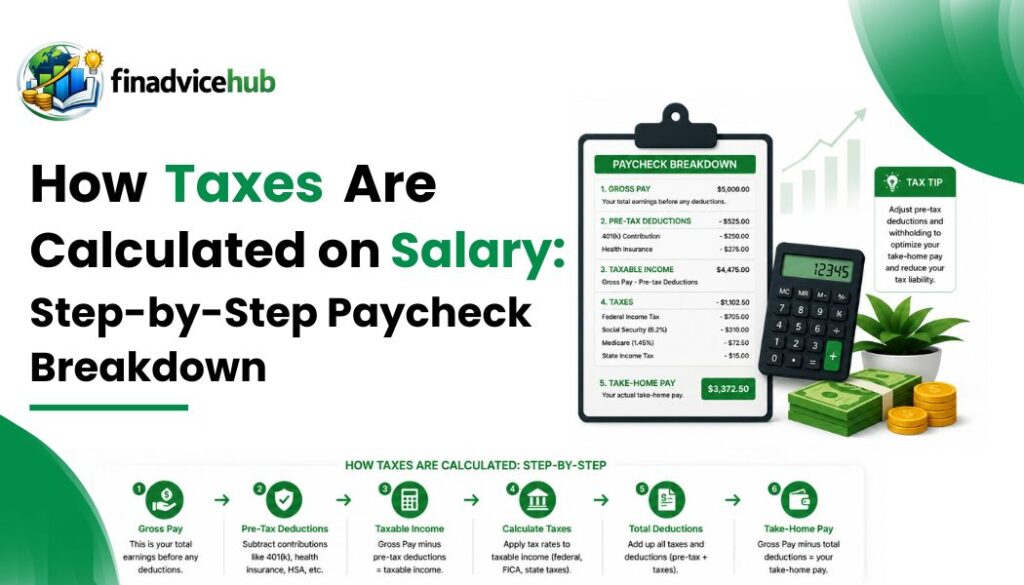
A manual method helps explain how taxes are deducted from paycheck step by step and gives a clearer understanding of real net income calculation.
Steps include:
- Start with gross salary
- Subtract pre-tax deductions (insurance, 401(k), etc.)
- Apply federal income tax on wages
- Add state and local tax deduction from salary
- Apply payroll taxes (Social Security + Medicare)
This creates a clear salary tax calculation example USA and shows payroll taxes vs income tax difference, helping you understand federal vs payroll taxes in practice.
Adjusting W-4 for accuracy
Your W-4 controls the tax withholding system, which directly affects how federal tax is calculated on wages.
Updating it ensures accurate withholding based on:
- filing status
- dependents
- additional income
This is important for avoiding errors in how much tax is deducted from monthly salary and helps improve accuracy in your net income calculation and overall employee compensation tax planning.
Accounting for deductions
To understand what taxes are deducted from salary, you must include all payroll deductions, not just taxes.
These include:
- Health insurance premiums
- Retirement contributions (401(k), Roth 401(k))
- HSA/FSA contributions
- Life and disability insurance
- Union dues
These payroll deductions directly affect your net income after taxes and significantly impact your paycheck tax breakdown.
Forecasting yearly income
To estimate annual income, multiply your net pay by pay periods. This helps you understand how to calculate net salary after taxes on a yearly basis.
This method improves long-term planning for:
- how to estimate take home pay
- salary tax vs total tax liability
- real budgeting based on earnings after tax
Common Mistakes in Salary Tax Calculation
Many people misunderstand how payroll taxes work, leading to incorrect expectations about their take-home pay.
Ignoring payroll taxes
A major mistake is ignoring payroll taxes explained, especially Social Security and Medicare.
These are part of what taxes are deducted from salary, and failing to include them leads to inaccurate paycheck tax breakdown and wrong estimates of how much tax is deducted from salary.
Misunderstanding tax brackets
Many assume their entire salary is taxed at the highest rate, but how tax brackets affect salary is progressive.
Only portions of income fall into each bracket, which impacts income tax on wages and often lowers actual tax compared to expectations.
Incorrect withholding setup
An outdated W-4 leads to errors in the tax withholding system, affecting how federal tax is calculated on wages.
This can result in:
- overpaying taxes during the year
- or owing money at tax time
It directly affects your net income calculation and financial planning accuracy.
Overlooking deductions
Many people forget payroll deductions, which distorts net vs gross salary tax calculations.
Missing deductions leads to incorrect estimates of:
- how much tax is deducted from monthly salary
- actual earnings after tax
- full paycheck tax breakdown
Misestimating net income
A common mistake is assuming net pay equals salary divided by pay periods. This ignores taxes and deductions entirely.
Correct how to estimate take-home pay must include:
- federal and state tax deduction from salary
- payroll taxes
- benefits and contributions
Otherwise, how paycheck taxes are calculated will be misunderstood.
Strategies to Reduce Taxes on Salary
If you’re exploring how to reduce salary taxes, there are several legal strategies that improve your after-tax income.
Pre-tax contributions
Contributing to retirement or health accounts lowers taxable income and improves net income after taxes.
Common options include:
- 401(k) contributions
- HSA accounts
- FSA plans
These reduce employee compensation tax and improve overall payroll deductions efficiency.
Tax credits and deductions
Tax credits directly reduce your tax bill, unlike deductions that reduce taxable income.
They improve income tax on wage outcomes and reduce overall salary tax vs total tax liability.
Adjusting withholding
Updating your W-4 ensures correct withholding and improves accuracy in how payroll taxes work.
This helps align your paycheck with your actual tax obligation and improves how to estimate paycheck after taxes.
Employer benefits optimization
Employer benefits like commuter plans, FSAs, and HSAs reduce taxable income and improve your paycheck tax breakdown.
They also help optimize what taxes are taken out of paycheck and increase net earnings.
Long-term tax planning
Long-term planning helps manage changes in:
- income increases
- bonuses and overtime
- life changes affecting filing status
This improves accuracy in salary tax calculation USA and ensures better financial forecasting for earnings after tax.
Conclusion: How Taxes Are Calculated on Salary
Taxes are calculated on salary through a structured process that reduces gross pay into net take-home income. Pre-tax deductions like insurance and retirement contributions come out first, followed by federal income tax, state tax, and fixed payroll taxes explained such as Social Security and Medicare. Together, these form the complete paycheck tax breakdown, showing the difference between net vs gross salary tax.
In a typical salary tax calculation USA, federal income tax follows progressive brackets while payroll taxes remain flat, creating differences in withholding even when income stays the same. Bonuses and overtime affect withholding amounts during each pay period but do not change overall tax liability.
Simple paycheck tax breakdown methods help estimate earnings after tax, plan monthly budgets, and predict what taxes are taken out of paycheck with greater accuracy.
FAQs
How are taxes calculated on salary?
Taxes are calculated by subtracting pre-tax deductions from gross pay to get taxable income, then applying federal, state, and payroll tax rates to that amount.
What taxes are deducted from paycheck?
Federal income tax, state income tax (in most states), Social Security tax, and Medicare tax are the main taxes deducted from paycheck.
What is the difference between gross and net salary?
Gross salary is your full pay before deductions. Net salary is what you actually receive after taxes and other deductions are taken out.
How much tax is taken from salary in the US?
It varies, but most workers see roughly 20% to 35% of their gross pay go to combined federal, state, and payroll taxes, depending on income and location.
How do payroll taxes work?
Payroll taxes fund Social Security (6.2%) and Medicare (1.45%). Both you and your employer pay these rates on your wages.
How can I reduce taxes on my salary?
Contribute to pre-tax accounts like a 401(k) or HSA, claim eligible tax credits, and keep your W-4 updated.
How do bonuses get taxed?
Bonuses are usually taxed at a flat 22% federal withholding rate, or combined with regular pay and taxed at your normal rate.
How can I estimate my take-home pay?
Use a paycheck calculator, or manually subtract pre-tax deductions and estimated taxes from your gross pay.