

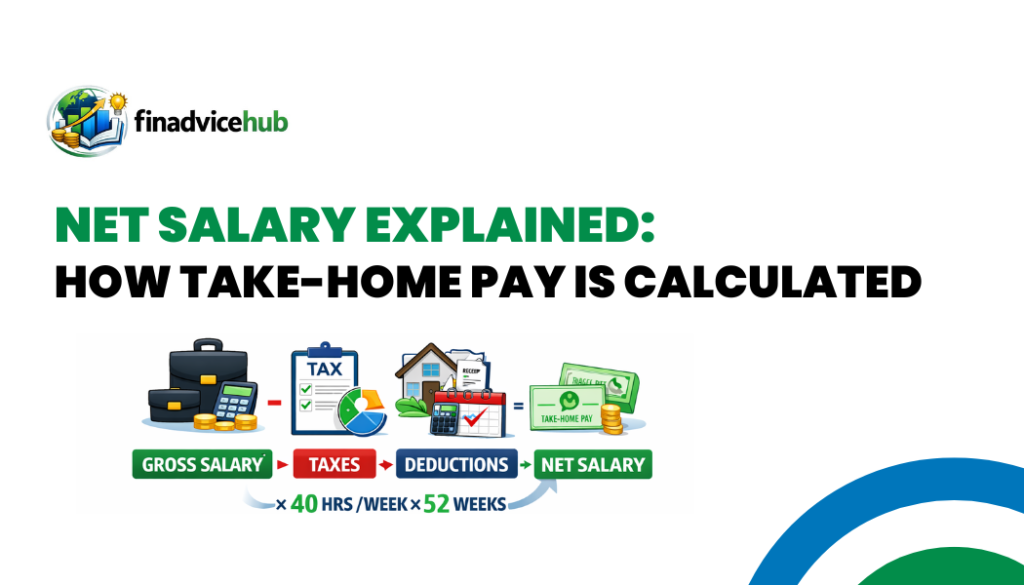
Understanding how your net salary meaning also referred to as take-home pay is calculated is essential for managing your finances. Whether you are a salaried employee or an hourly worker, knowing how net income after taxes is determined helps you plan your budget and save for the future. In this detailed guide, we will explore the entire process behind net salary calculation, the factors that influence it, and how you can better estimate your take-home pay using available tools and strategies.
What does Net Salary mean?
Definition of Net Salary
Net salary meaning refers to the amount of money you receive after all deductions have been made from your gross pay also known as gross salary. It is the actual amount that is deposited into your bank account or given to you in the form of a paycheck. The process of arriving at your net salary involves subtracting various deductions, such as taxes, benefits, and retirement contributions, from your gross earnings.
Difference Between Gross Pay and Net Pay
The difference between gross pay and net pay lies in deductions. Gross pay is the total amount an employee earns before any deductions. This includes base salary, bonuses, commissions, and other forms of compensation. On the other hand, net pay is the amount left after subtracting all mandatory and voluntary deductions like taxes, social security, health insurance premiums, and retirement contributions.
For example:
- Gross salary = $60,000 annually
- Net salary = $45,000 annually (after taxes, deductions, and benefits)
Why Net Salary Is Lower Than Gross Salary
Your net salary is typically lower than your gross salary because various deductions reduce your earnings. These deductions include:
- Federal and state taxes
- Social Security and Medicare taxes
- Health insurance premiums
- Retirement plan contributions
Employers are required to withhold a portion of your pay for taxes and other obligations, which is why your take-home salary ends up being less than the total gross amount.
How Payroll Systems Determine Take-Home Pay
Payroll systems calculate your net salary by considering several factors:
- Your gross pay (whether hourly or salaried)
- Tax withholding based on your filing status and allowances
- Deductions for benefits like health insurance and retirement plans
- In addition to the deductions, such as union dues, garnishments, or other specific deductions, your employer may apply.
These systems then subtract the required amounts from your gross earnings to calculate the final net pay.
Where Net Salary Appears on Your Paycheck
Your net salary is clearly shown on your earnings statement or paycheck stub. It is typically listed under terms like “net pay” or “take-home pay.” Understanding where to locate this on your paycheck is crucial for tracking and verifying your earnings.
Common Paycheck Deductions That Reduce Net Salary
Several deductions reduce your net pay, and they can vary depending on your location, employer, and benefit selections. Here are some common deductions that can impact your take-home salary:
Federal Income Tax Withholding
One of the largest deductions from your gross salary is federal income tax withholding. The amount withheld depends on your filing status, the number of allowances you claim on your W-4 form, and your total taxable income. The IRS tax brackets determine how much you owe in federal income taxes, and this amount is deducted from your pay.
Social Security and Medicare Taxes
In the U.S., employees are required to pay Social Security and Medicare taxes. These are part of the Federal Insurance Contributions Act (FICA) taxes. As of 2023:
- Social Security tax is 6.2% of your income (up to a wage base limit)
- Medicare tax is 1.45% of your income, with an additional 0.9% on wages over $200,000
Together, these taxes make up a significant portion of your paycheck deductions.
State and Local Taxes
Depending on your location, state, and local taxes may also be deducted from your gross salary. States like California and New York have high state income taxes, while others, like Texas and Florida, do not have a state income tax. Local taxes (such as city or county taxes) may also apply in some areas.
Health Insurance Premiums
Many employers offer health insurance as a benefit, and the employee’s portion of the premium is often deducted from their pay. The amount varies depending on the plan selected, coverage level, and whether the employer covers part of the premium cost.
Retirement Plan Contributions
Retirement plan contributions, such as those made to a 401(k) or IRA, are deducted from your salary. These contributions are typically pre-tax, which means they lower your taxable income and reduce your federal income tax burden. However, these contributions reduce your take-home salary until you begin to withdraw funds in retirement.
How Net Salary Is Calculated
Step-by-Step Net Pay Formula
To understand how net pay calculation works, let’s break it down step-by-step:
- Determine Gross Pay: Start with your gross earnings, including base salary, bonuses, and overtime.
- Apply Pre-Tax Deductions: Subtract any pre-tax deductions like retirement contributions or health insurance premiums.
- Calculate Federal and State Tax Withholding: Based on your filing status and allowances, calculate the tax amounts withheld.
- Add Social Security and Medicare Taxes: Apply the standard FICA rates for Social Security and Medicare.
- Subtract Post-Tax Deductions: Subtract any post-tax deductions, such as union dues or child support payments.
- Calculate Final Net Salary: The remaining amount after all deductions is your net salary or take-home pay.
Example Paycheck Calculation
Let’s calculate the net salary for someone earning $60,000 per year:
- Gross salary = $60,000
- Pre-tax deductions (health insurance, retirement) = $5,000
- Federal income tax withholding (estimated) = $7,500
- Social Security and Medicare taxes = $4,590
- Post-tax deductions (child support) = $1,000
Net Salary = $60,000 – $5,000 (pre-tax deductions) – $7,500 (taxes) – $4,590 (FICA) – $1,000 (post-tax deductions) = $41,910
Monthly vs Biweekly Net Salary Differences
Depending on your pay frequency, the net salary per paycheck can vary. For example:
- Monthly: If you earn $60,000 annually, your monthly gross pay is $5,000. After deductions, your net monthly salary might be around $3,493.
- Biweekly: If you’re paid every two weeks, your gross pay is $2,307. After deductions, your net biweekly salary might be approximately $1,615.
How Deductions Change Take-Home Pay
The amount of deductions can vary each pay period based on several factors, such as changes in benefits, withholding allowances, or new tax laws. For example, if you enroll in a more expensive health plan or contribute more to your retirement fund, it will reduce your take-home salary. Understanding these variables helps you anticipate changes in your net earnings payroll.
Using Paycheck Calculators
To get a quick estimate of your net salary, you can use online paycheck calculators. These tools allow you to input your gross pay, filing status, and deductions, and they will calculate your net pay after taxes. This can help you plan your budget and savings better.
Real Paycheck Examples
Example Calculation for $50,000 Annual Salary
For an employee with a $50,000 annual salary, their net salary might be:
- Gross salary: $50,000
- Pre-tax deductions: $4,000 (health insurance and 401(k) contributions)
- Federal and state tax: $5,500
- FICA taxes: $3,825
- Post-tax deductions: $500 (union dues)
Net Salary = $50,000 – $4,000 – $5,500 – $3,825 – $500 = $36,175 annually
Example for Hourly Workers
For an hourly worker earning $20 per hour and working 40 hours a week:
- Gross pay: $20 × 40 hours/week × 52 weeks = $41,600 annually
- Pre-tax deductions: $3,000 (health insurance)
- Federal and state tax: $4,500
- FICA taxes: $3,194
- Post-tax deductions: $400
Net Salary = $41,600 – $3,000 – $4,500 – $3,194 – $400 = $30,506 annually
Example with Benefits Deductions
Let’s say an employee earns $75,000 annually and has the following deductions:
- Gross salary: $75,000
- Pre-tax deductions (health insurance, 401(k)): $7,500
- Federal tax: $10,000
- FICA taxes: $5,700
Post-tax deductions (union dues, child support): $1,000
Net Salary = $75,000 – $7,500 (pre-tax deductions) – $10,000 (federal taxes) – $5,700 (FICA) – $1,000 (post-tax deductions) = $51,800 annually
Example with Overtime Earnings
For an employee with a regular salary of $50,000, but who worked 10 hours of overtime at a rate of $30 per hour:
- Regular salary: $50,000
- Overtime earnings: 10 hours × $30/hour = $300
- Gross pay: $50,000 + $300 = $50,300
- Pre-tax deductions: $4,000 (health insurance, retirement contributions)
- Federal and state tax: $5,500
- FICA taxes: $3,825
- Post-tax deductions: $500
Net Salary = $50,300 – $4,000 (pre-tax deductions) – $5,500 (taxes) – $3,825 (FICA) – $500 (post-tax deductions) = $36,475 annually
This example shows how overtime pay can increase an employee’s net earnings payroll, and highlights the importance of understanding how extra hours worked affect your take-home salary.
Why Net Salary Changes Over Time?
Your net salary can fluctuate for a variety of reasons, including tax adjustments, changes in benefits, or additional income such as bonuses or overtime. Here are some common factors that can cause variations in your take-home pay:
Tax Withholding Adjustments
One of the main reasons your net salary might change is an adjustment to your tax withholding. If you update your W-4 form to increase or decrease the number of allowances you claim, your employer will adjust how much federal tax is withheld from each paycheck. A change in your tax withholding could increase or decrease your net salary.
For example, if you reduce your withholding allowances, more money will be deducted from your paycheck for taxes, which will decrease your take-home salary. Conversely, increasing allowances could result in less federal income tax withheld and a larger net paycheck.
Changes in Benefits Enrollment
If you change your benefits enrollment, such as adding or removing dependents from your health insurance or changing your retirement contribution percentage, it can have a direct impact on your net pay. For example, enrolling in a more expensive health insurance plan will reduce your net salary because the additional premiums will be deducted from your paycheck.
Bonuses and Overtime Pay
Bonuses and overtime pay can also influence your net salary. If you receive a year-end bonus or work extra hours, your gross pay will increase, which could lead to a higher net salary. However, remember that overtime pay is also subject to taxes, so while your gross pay might increase, your net earnings payroll might not rise proportionally.
Payroll Corrections or Updates
In some cases, payroll errors can lead to discrepancies in your net salary. Employers may make corrections to previously underpaid or overpaid wages, and this can impact your take-home pay for that period. Ensure you regularly review your earnings statement to catch any payroll mistakes and report them to your HR or payroll department promptly.
Changes in Federal or State Tax Laws
Tax laws change over time, and these changes can affect the amount of federal income tax or state income tax withheld from your paycheck. For example, if there is a change in federal tax brackets or state income tax rates, your net salary could increase or decrease accordingly. Staying up-to-date on tax law changes is important for managing your take-home salary expectations.
Tips for Understanding Your Take-Home Pay
Managing your net salary involves understanding your paycheck and staying on top of deductions. Here are some tips for making the most of your take-home pay:
Reading a Paycheck Stub Correctly
Understanding your earnings statement or paycheck stub is crucial for tracking your net salary. Make sure to review the breakdown of your gross pay, deductions, and net pay. Check if your tax withholding matches your expected rates and that all benefits and deductions have been applied correctly.
Tracking Deductions Each Pay Period
Regularly tracking your paycheck deductions will help you identify any changes in your net salary. If you notice an increase in deductions or a drop in your take-home salary without any explanation, it may be worth investigating with your employer to ensure everything is accurate.
Reviewing Tax Withholding Accuracy
It’s essential to review your tax withholding periodically, especially if your financial situation changes. If you’ve recently had a change in marital status, number of dependents, or additional income, it may be necessary to adjust your withholding on the W-4 form. Using online AI tax withholding estimators can help you determine whether your current withholding is appropriate.
Estimating Yearly Net Income
To get a clearer picture of your net income after taxes, you can estimate your yearly net salary by multiplying your net pay from one paycheck by the number of pay periods in the year. For instance, if you are paid biweekly and your net pay is $1,500, your estimated annual net salary would be $1,500 × 26 = $39,000.
Using Payroll Tools for Salary Projections
Online payroll tools and AI paycheck calculators can help you estimate your take-home salary after considering various deductions. These tools are particularly useful if you are anticipating changes in income, such as a raise, promotion, or bonus, or if you’re trying to figure out how benefit deductions or tax changes will impact your net earnings.
Final Thoughts
Understanding net salary meaning is a crucial part of managing your personal finances. By grasping how payroll deductions such as taxes, employee benefits, and retirement contributions impact your earnings, you can better plan your budget and avoid being caught off guard by changes in your take-home salary. Whether it’s net pay vs gross pay or calculating net salary after taxes, knowing the full scope helps you make informed financial decisions.
Additionally, tools like AI payroll calculators and automated payroll deduction systems can assist you in tracking your earnings and making a more accurate net pay calculation. These tools can be especially helpful when estimating your salary after deductions and understanding how taxes affect your net salary.
Being proactive about reviewing your earnings statement, adjusting your tax withholding as necessary, and staying on top of paycheck deductions explained will give you a clearer picture of your net income after taxes, enabling you to meet your financial goals more effectively.
FAQs
What is the difference between net salary and gross salary?
Gross salary refers to the total amount an employee earns before any deductions, while net salary (or take-home salary) is the amount left after deductions like taxes, insurance, and retirement contributions.
How is net salary calculated from gross pay?
To calculate net salary, subtract deductions such as federal tax, state tax, FICA taxes, insurance premiums, and retirement contributions from your gross pay. The result is your net pay or salary after deductions.
Why is my net salary lower than expected?
Your net salary may be lower than expected due to higher tax withholding, additional employee benefits deductions, or other payroll processing errors. It could also be impacted by changes in your benefits or unexpected paycheck deductions explained.
What deductions are taken from a paycheck?
Common payroll deductions from a paycheck include federal income tax, state tax, Social Security and Medicare taxes, health insurance premiums, and retirement contributions. Each of these reduces your take-home salary.
How can I estimate my take-home pay?
To estimate your take-home salary, subtract anticipated tax withholding and benefit contributions from your gross pay. Online AI paycheck calculators or automated payroll deduction tools can help you quickly estimate your net salary and salary after deductions.
Does overtime increase net salary?
Yes, overtime increases your gross salary and thus your net salary, although it is subject to taxes and other payroll deductions.
Can net salary change each paycheck?
Yes, net salary can change from paycheck to paycheck due to changes in tax withholding, benefits enrollment, overtime pay, or other payroll processing adjustments.