
When considering a loan, understanding how to calculate your monthly payment is essential. Whether you’re applying for a personal loan, mortgage, or auto loan, knowing what to expect in terms of repayment can help you plan your finances more effectively. By understanding the different components of a loan payment, including principal, interest, and fees, you’ll have a clearer picture of your financial commitment.
The following guide will methodically instruct the reader through the process of calculating loan payments and will provide practical examples in support of the reader’s comprehension. Moreover, this guide will demonstrate the utilization of online loan calculators to accurately estimate loan repayments.
Understanding Loan Payments
Definition of Loan Payment
A loan payment is the amount you must pay to the lender periodically (typically monthly) in exchange for borrowing money. The payment generally covers two main components: the principal (the amount you borrowed) and the interest (the cost of borrowing that amount). Additionally, some loans may involve other fees, such as insurance or administrative charges, which can affect your overall payment.
Understanding the breakdown of these components helps you see how much of your monthly payment goes toward the principal and how much goes toward interest.
Components: Principal, Interest, Fees
When you take out a loan, the total amount you owe consists of:
- Principal: This is the amount you initially borrow. Over time, your payments reduce the principal.
- Interest: This is the cost of borrowing, calculated as a percentage of the principal. The interest rate may be fixed or variable, depending on your loan terms.
- Fees: Some loans come with additional charges, such as origination fees, late payment fees, or insurance costs. These can increase the total cost of your loan.
| Component | Description |
| Principal | The amount borrowed. |
| Interest | The fee charged for borrowing the money is expressed as a percentage. |
| Fees | Additional costs, such as origination fees or insurance. |
Monthly vs Total Payment
When calculating loan payments, it’s important to distinguish between the monthly payment and the total repayment amount.
- Monthly payment refers to the amount you will pay each month during the loan term.
- Total repayment refers to the total amount paid over the life of the loan, including both principal and interest.
For example, a $20,000 loan with a 5% interest rate and a 5-year term might have a monthly payment of around $377. However, over the life of the loan, you’ll pay $22,620 (including interest).
Loan Term Impact
The loan term plays a significant role in your monthly payments. A longer loan term usually results in smaller monthly payments, but you will end up paying more interest over time. A shorter term will mean higher monthly payments, but you will pay less in interest overall.
Choosing the right loan term can help balance affordability with the total cost of the loan.
Using Payment Calculators
An amortization calculator or loan calculator online is a helpful tool for estimating your monthly payment, total interest, and total repayment. By entering details such as your loan amount, interest rate, and loan term, these tools can quickly give you an accurate payment forecast. Using a loan repayment calculator ensures that you’re prepared for the costs ahead.
How to Calculate Loan Payments
Step-by-Step Formula
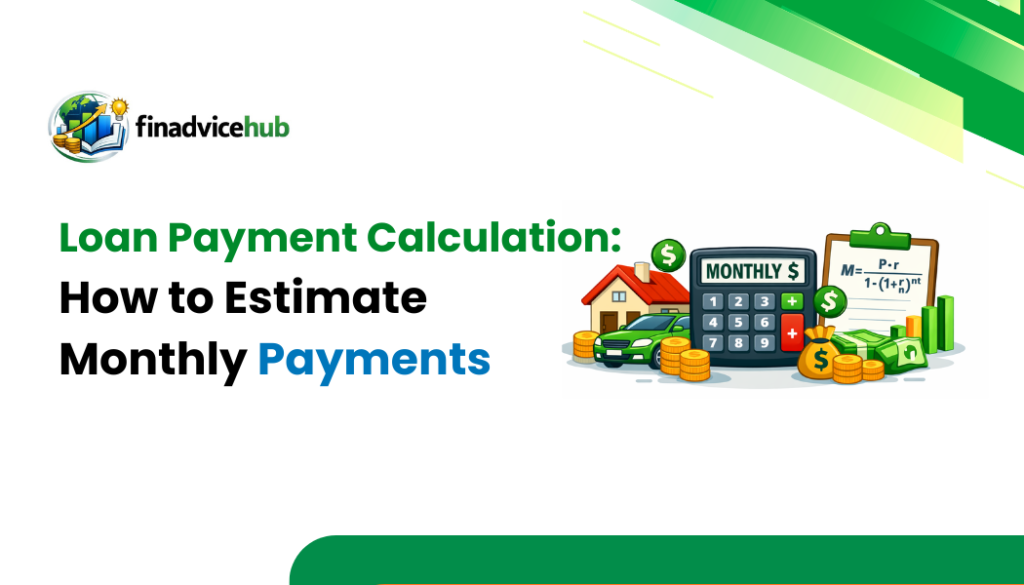
To calculate your monthly loan payment, you can use the following formula:
Monthly Payment (M) = [P × r × (1 + r)^n] ÷ [(1 + r)^n − 1]
Where:
- MMM = Monthly payment
- PPP = Loan principal (amount borrowed)
- rrr = Monthly interest rate (annual rate divided by 12)
- nnn = Number of payments (loan term in months)
Principal vs Interest
In the early stages of loan repayment, your monthly payment will mostly cover interest. Over time, as the principal balance decreases, a larger portion of your monthly payment will go toward paying it off.
Example: Loan Breakdown
Consider a $10,000 loan at an 8% annual interest rate for 5 years.
- Month 1: Payment = $202.76; Interest = $66.67; Principal Paid = $136.09.
- Month 2: Payment = $202.76; Interest = $65.87; Principal Paid = $136.89.
As you progress, the interest component decreases, and the principal component increases.
Early Repayment Examples
If you decide to pay off your loan early, you could save on interest. Early repayment reduces the outstanding balance, which reduces the interest charged. Let’s look at how an early repayment can affect your loan:
- Original loan: $10,000 at 8% interest, 5-year term.
- If you pay off the loan after 2 years instead of 5, you will save money on interest payments.
Always check with your lender to see if there are any early repayment penalties before making additional payments.
Using Calculators for Accuracy
To avoid miscalculating your payments, consider using online loan calculators. These tools automatically factor in principal, interest, loan term, and even potential fees to give you a more accurate estimate. Whether you’re calculating your personal loan payments or a mortgage loan, these calculators ensure you’re fully informed.
Real-Life Scenarios
Let’s explore some real-life loan examples to understand how calculations work:
- Mortgage Loan: A $200,000 loan with a 3.5% interest rate and a 30-year term results in a monthly payment of approximately $898.
- Car Loan: A $25,000 loan with a 5% interest rate for a 5-year term would have a monthly payment of about $471.
- Personal Loan: A $5,000 loan at a 10% interest rate with a 3-year term results in a monthly payment of about $161.
Amortization Schedules
Definition of Amortization
Amortization refers to the process of spreading out a loan’s principal and interest payments over time. An amortization schedule shows how much of each payment goes toward the principal and how much goes toward interest.
Principal vs Interest Over Time
At the start of the loan, the majority of your payments will go toward the interest. Over time, more of your monthly payment will go toward paying off the principal. This change in the payment structure is key to understanding how your loan repayment progresses.
Example Amortization Schedule
| Month | Payment | Interest Paid | Principal Paid | Remaining Balance |
| 1 | $200 | $50 | $150 | $9,850 |
| 2 | $200 | $48.67 | $151.33 | $9,698.67 |
| 3 | $200 | $47.32 | $152.68 | $9,546.99 |
How Term Affects Interest
The length of the loan term directly impacts the total interest paid over the life of the loan. Longer loan terms generally mean lower monthly payments, but you’ll end up paying more in interest.
Using Amortization for Planning
An amortization schedule can help you plan your finances by showing exactly how much you owe at any given time. It can also be used to estimate the total interest cost over the life of the loan, helping you make informed decisions about refinancing or paying off the loan early.
Loan Calculator Examples
Mortgage Loan Payment Calculation
For a $300,000 mortgage with a 4% interest rate and a 30-year term, your monthly payment would be approximately $1,432. Over 30 years, you’ll pay a total of $515,520.
Car Loan Calculation Example
If you take out a $20,000 car loan at a 6% interest rate for 5 years, your monthly payment will be about $387. The total repayment would amount to $23,220.
Personal Loan Calculation
A $10,000 personal loan with a 10% interest rate for 3 years results in a monthly payment of $322 and a total repayment of $11,592.
Multi-Loan Comparison
Using a loan calculator online, you can compare multiple loans to find which one offers the most favorable terms. This comparison can help you assess the overall cost of borrowing and choose the loan that fits your budget.
Forecasting Total Repayment
A payment forecast tool can help you estimate your total repayment cost by factoring in the loan amount, interest rate, fees, and repayment schedule. This allows you to make more informed decisions about loan terms and payments.
Challenges and Tips
Accounting for Fees and Insurance
When calculating your monthly loan payment, don’t forget to factor in any hidden fees, such as origination fees, late fees, or insurance costs. These can increase your overall loan cost and affect your payment.
Variable Interest Rates
Loans with variable interest rates can fluctuate, making it harder to predict your monthly payment. Be sure to consider this potential change when budgeting for your loan.
Early Payoff Planning
If you plan to pay off your loan early, use early repayment calculators to estimate how much interest you can save by paying off your loan ahead of schedule.
Misinterpretation of Monthly vs Total Payment
It’s important to distinguish between monthly payments and the total repayment amount. While your monthly payment might seem affordable, the total amount you pay over time could be much higher than you expected.
Using Multiple Calculators for Accuracy
To ensure accurate results, it’s a good idea to use multiple calculators for comparison. This will give you a more comprehensive understanding of your loan and help you make the right decision.
Conclusion
Understanding loan payment calculation is crucial for anyone taking out a loan. Whether it’s for a mortgage, auto loan, or personal loan, knowing how much you’ll pay each month and how much you’ll end up paying in total helps you plan your finances more effectively. By using loan calculators online, you can easily estimate your monthly loan payment, compare different loans, and make more informed decisions.
FAQs
How is a loan payment calculated?
Loan payments are calculated based on the loan amount, interest rate, and loan term. The formula involves dividing the loan principal and interest across the loan’s term.
Can one calculator handle mortgage, car, and personal loans?
Yes, many loan calculators online can handle all types of loans by allowing you to input different loan details to calculate payments for mortgages, car loans, and personal loans.
What is an amortization schedule?
An amortization schedule breaks down each payment, showing how much goes toward interest and how much goes toward reducing the principal.
How does the interest rate affect the monthly payment?
Higher interest rates increase your monthly payment, as you’re paying more for the borrowed amount. Lower interest rates lead to smaller monthly payments.
How to estimate early repayment savings?
By paying off your loan early, you reduce the principal faster, which lowers the interest charged. Early repayment calculators can help estimate the savings.
What inputs are needed for the calculation?
To calculate loan payments, you’ll need the loan amount, interest rate, loan term, and any additional fees.
Are online loan calculators accurate?
Yes, loan calculators online are accurate as long as you input the correct information. Always double-check your numbers and terms with your lender before making decisions.