
If you invest in stocks, real estate, crypto, or even collectibles, there’s one tax rule you cannot ignore: capital gains tax in the USA. It affects how much profit you actually keep after selling an asset.
Many people focus only on buying and selling, but the real surprise comes at tax time when profits are reduced by federal income tax rates for individuals, explained through capital gains rules. Understanding this system helps you make smarter investment decisions and avoid costly mistakes.
Let’s break it down in a clear, practical way.
What Is Capital Gains Tax?
Definition of Capital Gains
A capital gain is the profit you make when you sell an asset for more than you paid for it.
In simple terms:
Selling Price – Purchase Price = Capital Gain
This gain is what gets taxed under the federal tax system rules.
Assets Subject to Capital Gains Tax
Capital gains tax applies to many types of investments:
| Asset Type | Examples |
| Stocks | Apple, Tesla shares |
| ETFs | Index funds |
| Real estate | Rental or investment property |
| Cryptocurrency | Bitcoin, Ethereum |
| Collectibles | Art, antiques, rare items |
Each of these falls under what income is taxable federally, depending on how the asset is sold or exchanged.
Realized vs Unrealized Gains
Not all gains are taxed immediately.
| Type | Meaning | Taxed? |
| Unrealized gain | Asset value increases, but is not sold | No |
| Realized gain | The asset is sold for profit | Yes |
Only realized gains are included in your taxable income calculation.
Why Governments Tax Capital Gains?
Capital gains tax is part of the broader progressive tax system in the USA, designed to:
- Tax investment profits fairly
- Generate government revenue
- Balance income inequality in investment gains
It is integrated into the overall structure of how federal income tax works.
Common Investment Scenarios
Capital gains tax applies when you:
- Sell stocks for profit
- Sell a house or rental property
- Trade cryptocurrency
- Cash out long-term investments
Each triggers a tax liability calculation based on profit and holding period.
Short-Term vs Long-Term Capital Gains
Holding Period Rules
The biggest factor in capital gains taxation is how long you hold an asset.
| Type | Holding Period |
| Short-term | 1 year or less |
| Long-term | More than 1 year |
This rule determines the impact of your federal income tax brackets.
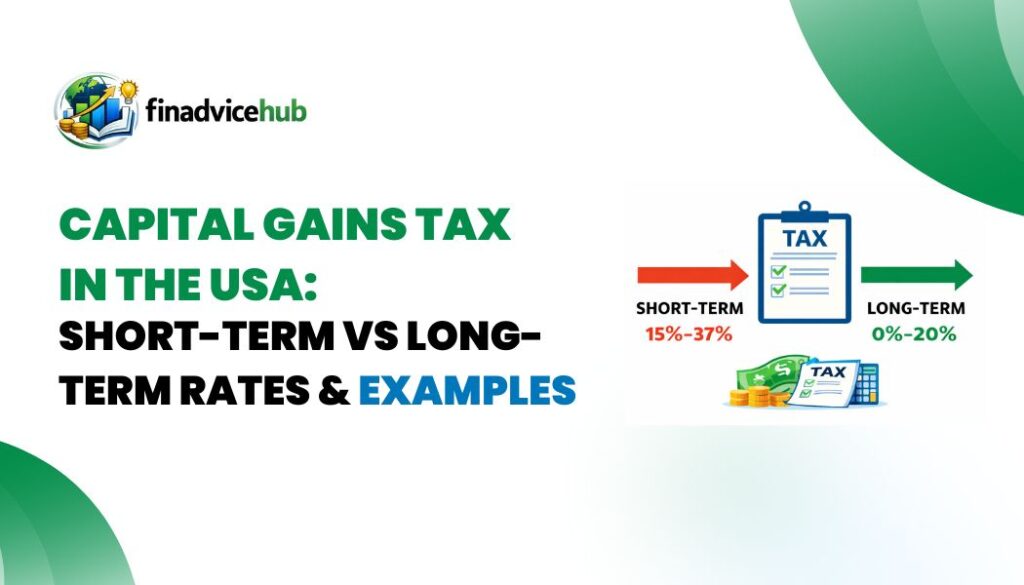
Short-Term Capital Gains Tax Rates
Short-term gains are taxed like regular income.
| Income Level | Tax Rate |
| Low income | 10%–12% |
| Middle income | 22%–24% |
| High income | Up to 37% |
These follow standard federal income tax rates under ordinary income brackets.
Long-Term Capital Gains Tax Rates
Long-term investments are taxed at lower rates:
| Filing Status | Rate Range |
| Most taxpayers | 0%–15% |
| High earners | 20% |
This is one of the biggest advantages of long-term investing.
Key Differences in Taxation
| Feature | Short-Term | Long-Term |
| Holding period | ≤ 1 year | > 1 year |
| Tax rate | Higher (ordinary income) | Lower (preferential rates) |
| Tax impact | Less favorable | More favorable |
Understanding this helps reduce your overall tax liability calculation legally.
Example Comparison
If you earn $10,000 profit:
- Short-term: taxed up to 37% → higher tax bill
- Long-term: taxed at 15% → significantly lower tax bill
This is why tax strategy matters in investing.
How is Capital Gains Tax Calculated?
Capital gains tax in the USA is calculated through a straightforward sequence of steps: determine your investment cost, measure your profit or loss, and then apply the correct tax rate based on holding period and income level. Each step directly feeds into your taxable income calculation and final tax liability calculation under the federal tax system.
Determining Cost Basis
The cost basis represents the total amount you originally spent to acquire an asset. It is the starting point for every capital gains calculation.
In most cases, it includes:
- Purchase price of the asset
- Transaction fees or commissions (if applicable)
- Adjustments such as reinvested dividends (for stocks/ETFs)
Cost Basis Example
| Item | Value |
| Purchase price | $5,000 |
| Fees | $0 |
| Cost basis | $5,000 |
This figure is essential because it is subtracted from the selling price to determine taxable profit. Any error here directly affects your taxable income calculation.
Calculating Profit or Loss
Once the cost basis is known, the next step is to measure the actual financial outcome of the sale.
Formula
| Step | Calculation |
| Gain/Loss | Selling Price – Cost Basis |
Example
| Item | Value |
| Selling price | $8,000 |
| Cost basis | $5,000 |
| Capital gain | $3,000 |
If the result is negative, it becomes a capital loss, which can reduce taxable income and offset other gains within your tax liability calculation.
Applying Capital Gains Rates
After profit is determined, the IRS applies tax rates based on how long the asset was held and your income level.
| Category | Tax Treatment |
| Short-term gains | Taxed at ordinary federal income tax rates |
| Long-term gains | Taxed at reduced capital gains rates |
Short-term gains are aligned with standard IRS tax brackets, as explained, meaning they follow your regular income tax structure. Long-term gains benefit from lower rates under the progressive tax system in the USA.
This stage determines how your gains fit into your overall federal income tax brackets and significantly impacts your final tax outcome.
Example Stock Sale Calculation
A simple stock transaction shows how the process works in practice.
| Item | Value |
| Buy price | $5,000 |
| Sell price | $8,000 |
| Profit | $3,000 |
Tax Outcome Scenarios
| Holding Period | Tax Treatment | Result |
| Short-term | Taxed as ordinary income | Higher tax burden under the federal income tax in the USA, rates |
| Long-term | Taxed at a reduced capital gains rate | Lower tax liability calculation |
The difference between these two scenarios can significantly change the final tax owed, even when the profit remains identical.
Example Real Estate Sale Calculation
Real estate follows the same basic structure but includes additional adjustments that affect the final taxable amount.
| Item | Value |
| Purchase price | $200,000 |
| Sale price | $300,000 |
| Gross gain | $100,000 |
However, this is not always the final taxable figure.
Before completing the taxable income calculation, adjustments may apply:
- Depreciation recapture (for rental properties)
- Selling costs such as agent fees or closing expenses
- Possible exclusions for primary residences
These adjustments ensure that the final reported gain aligns with the federal tax filing rules in the USA and reflects the true taxable portion.
Capital Gains Tax Rules for Different Assets
Capital gains tax in the USA is not applied in a one-size-fits-all way. The IRS treats each asset differently depending on how it’s used, how it’s sold, and how gains are realized. These differences directly affect your taxable income calculation, final tax liability, and where your income falls within federal income tax brackets or capital gains brackets.
Below is a clear, non-repetitive breakdown of how taxation works across major asset types.
Stocks and ETFs
Stocks and ETFs follow the most straightforward capital gains rules, but timing still matters a lot.
| Rule Area | How It Works |
| Tax trigger | Tax applies only when you sell the asset |
| Holding period | Determines whether gains are short-term or long-term |
| Reporting | Brokerages report sales through IRS forms (1099-B) |
Short-term sales (under 1 year) are taxed using federal income tax rates, while long-term holdings benefit from reduced capital gains rates. This difference is one of the most important factors in how the federal income tax works for investors.
A key issue here is that frequent buying and selling can unintentionally push gains into higher taxable income calculation brackets.
Real Estate Property
Real estate has more layered tax treatment compared to financial assets because it involves usage rules, depreciation, and exclusions.
| Property Type | Tax Treatment | Key Rule |
| Primary residence | Partial gain exclusion available | Must meet ownership/use conditions |
| Rental property | Fully taxable on sale | Depreciation must be recaptured |
| Investment property | Capital gains applied fully | Based on profit after adjustments |
Depreciation is a major factor here, it reduces taxable income during ownership but increases taxable gain when the property is sold. This directly affects your final tax liability calculation in ways many investors underestimate.
Cryptocurrency
Crypto taxation is one of the most transaction-heavy areas under the capital gains tax in the USA.
| Activity Type | Tax Treatment |
| Buying crypto | Not taxable |
| Selling crypto for fiat | Taxable gain/loss |
| Crypto-to-crypto trade | Taxable event |
| Using crypto for purchases | Treated as a sale |
Unlike stocks, every transaction can trigger a taxable event. This creates frequent adjustments in taxable income calculation, especially for active traders.
The biggest challenge is cost basis tracking across multiple wallets and exchanges, which often requires automated tax estimation tools or AI tax planning software to stay accurate.
Collectibles and Art
Collectibles follow separate capital gains rules and are often taxed at less favorable rates compared to standard investments.
| Asset Type | Tax Feature |
| Art and antiques | Subject to special capital gains rate (often higher) |
| Rare coins | Same treatment as collectibles |
| Luxury items | Taxed when sold at a profit |
Even long-term holdings do not always benefit from the same reduced rates as stocks or ETFs. This can increase your overall tax liability calculation, especially for high-value sales.
Strategies to Reduce Capital Gains Tax
Reducing capital gains tax liability in the USA isn’t about avoiding taxes; it’s about using legal strategies built into the federal tax system. When used correctly, these approaches can significantly improve your after-tax returns and optimize your overall taxable income calculation. The goal is simple: keep more of your investment gains while staying compliant with federal tax filing rules in the USA.
Tax Loss Harvesting
Tax loss harvesting is one of the most practical strategies investors use to reduce their tax burden. It works by balancing gains with losses in your portfolio.
When you sell an investment at a loss, that loss can be used to offset gains from other investments. This directly reduces your tax liability calculation.
How Tax Loss Harvesting Works?
| Action | What Happens | Tax Benefit |
| Sell losing assets | Realized capital loss | Reduces taxable gains |
| Offset profits | Loss applied against gains | Lowers taxable income |
| Carry forward losses | Excess losses used in future years | Long-term tax reduction |
For example, if you earn $5,000 in gains but realize $2,000 in losses, you only pay tax on $3,000. This directly lowers your taxable income calculation and may even shift you into a lower federal income tax bracket.
Long-Term Investment Strategy
One of the simplest yet most powerful ways to reduce capital gains tax is to hold investments for more than a year.
Under the IRS tax brackets explained rules, long-term capital gains are taxed at significantly lower rates compared to short-term gains.
Tax Comparison by Holding Period
| Holding Period | Tax Type | Tax Impact |
| Less than 1 year | Short-term gains | Higher rates (ordinary income) |
| More than 1 year | Long-term gains | Lower preferential rates |
By holding assets longer, you reduce your exposure to higher federal income tax rates and improve overall investment efficiency.
This strategy also helps stabilize your taxable income calculation over time, reducing sudden spikes in tax liability.
Using Retirement Accounts
Retirement accounts are one of the most effective tools for minimizing or deferring capital gains tax exposure.
Accounts like IRAs and 401(k)s are designed to provide tax advantages under the federal tax system.
Retirement Account Tax Benefits
| Account Type | Tax Advantage | Capital Gains Impact |
| Traditional IRA | Tax-deferred growth | No yearly capital gains tax |
| Roth IRA | Tax-free withdrawals | No capital gains tax on qualified gains |
| 401(k) | Pre-tax contributions | Deferred taxation until withdrawal |
These accounts allow investments to grow without immediate tax consequences, effectively removing capital gains tax from annual reporting and simplifying federal income tax calculation.
Gifting Assets
Gifting assets is another strategy used to reduce taxable gains, but it must be handled carefully.
When you transfer assets as gifts, the tax responsibility may shift depending on the structure and timing.
Gifting Strategy Overview
| Action | Tax Outcome | Benefit |
| Gift appreciated assets | May transfer cost basis | Reduces immediate tax burden |
| Gift within annual exclusion limit | No gift tax triggered | Efficient wealth transfer |
| Transfer to family members | Potential lower tax bracket benefit | Reduces overall tax exposure |
This strategy can help manage your tax liability calculation, especially when coordinated with family income levels and federal income tax brackets differences.
Timing Asset Sales
Timing is one of the most overlooked strategies in tax planning. When you sell assets can significantly impact how much tax you pay.
By selling investments in lower-income years, you may qualify for lower federal income tax rates for individuals, as explained, reducing your overall tax burden.
Timing Strategy Breakdown
| Timing Strategy | How It Works | Tax Advantage |
| Sell in a low-income year | Lower total income | Lower tax brackets applied |
| Delay sales | Defer taxable gains | Postpone tax liability |
| Spread sales across years | Smooth income levels | Avoid bracket jumps |
This approach is especially useful when managing fluctuations in income, such as freelance work or business earnings, where taxable income calculation can vary year to year.
Common Capital Gains Tax Challenges
Even when you understand the basics of capital gains tax in the USA, real-life investing can still get messy. The main issue isn’t the tax rules themselves; it’s tracking everything correctly and applying those rules consistently. Small mistakes can affect your taxable income calculation, distort your tax liability calculation, and sometimes even push you into higher federal income tax brackets than expected.
Below are the most common challenges investors face, explained in a simple, practical way with tables to make everything easier to follow.
Cost Basis Errors
Your cost basis is the original price you paid for an investment. It’s the starting point for calculating profit or loss. When this number is wrong, your entire federal income tax calculation becomes inaccurate.
Common Cost Basis Issues
| Problem | What Goes Wrong | Impact |
| Missing purchase records | Old trades not documented | Wrong gain/loss calculation |
| Reinvested dividends ignored | Extra shares not tracked | Understated cost basis |
| Broker reporting errors | Incorrect 1099-B data | IRS mismatch issues |
| Manual tracking mistakes | Human error in spreadsheets | Incorrect taxable income |
For example, if you bought shares at different prices but only record one purchase price, your reported profit may be much higher than reality. That directly affects your taxable income calculation and can increase your tax bill unnecessarily.
Short-Term Trading Impact
Frequent trading is one of the biggest hidden tax triggers. Every time you sell an asset within a year, it is treated as short-term and taxed at higher federal income tax rates.
Impact of Trading Frequency
| Trading Behavior | Tax Treatment | Result |
| Long-term holding | Lower capital gains rates | Lower taxes |
| Occasional trading | Mixed tax impact | Moderate complexity |
| Frequent trading | Short-term gains taxed as income | Higher tax bill |
More trades = more taxable events = more entries in your tax liability calculation.
Frequent trading can also push income into higher federal income tax brackets, especially when combined with salary or freelance income.
Record Keeping Difficulties
Keeping track of investments is harder than most people expect, especially when dealing with multiple accounts or crypto platforms.
Common Tracking Challenges
| Activity Type | Why It’s Hard | Risk if Mismanaged |
| Multiple stock purchases | Different prices over time | Incorrect cost basis |
| Partial sales | Selling part of holdings | Confusion in gains tracking |
| Crypto transactions | High transaction volume | Missing taxable events |
| Dividend reinvestment | Automatic share increases | Underreported income |
Poor record keeping directly impacts your taxable income calculation and can lead to mistakes when using a tax bracket calculator USA or filing through the IRS e-file system.
Complex Investment Portfolios
The more diversified your investments, the more complicated your taxes become. Each asset type follows different rules under how federal income tax works, especially when it comes to holding periods and reporting.
Portfolio Complexity Breakdown
| Asset Type | Tax Rule Complexity | Reporting Difficulty |
| Stocks/ETFs | Medium | Moderate |
| Real estate | High | Complex depreciation rules |
| Cryptocurrency | Very high | Frequent taxable events |
| Collectibles | High | Special tax rates apply |
A diversified portfolio often leads to:
- Harder taxable income calculation
- More adjustments in IRS tax tables explained
- Increased need for federal income tax calculator tools
- Higher risk of reporting mistakes
Reporting Mistakes
Even small errors in reporting can create major issues. The IRS compares your return with data from brokers, exchanges, and financial institutions.
Common Reporting Errors
| Mistake | Cause | Possible Outcome |
| Missing transactions | Incomplete records | IRS correction notice |
| Incorrect gains reported | Wrong calculations | Higher tax liability |
| Unreported income | Forgotten trades | Penalties and interest |
| Mismatched broker data | 1099 errors or user input mistakes | Audit risk |
These mistakes can distort your tax liability calculation and affect how your income is placed within federal income tax brackets.
Final Thoughts
Understanding the capital gains tax in the USA is essential for anyone investing in stocks, real estate, or digital assets. The difference between short-term and long-term gains can significantly impact your tax liability calculation, especially when combined with federal income tax brackets and your overall income level.
Once you understand how taxable income calculation, holding periods, and federal income tax rates work together, you can make smarter investment decisions. Using tools like a federal income tax calculator, tax bracket calculator USA, or modern AI tax planning software can also help you estimate outcomes and reduce surprises.
In investing, it’s not just about how much you earn, it’s about how much you keep after taxes.
FAQs
What is the capital gains tax?
Capital gains tax is a tax applied to the profit earned when selling an asset such as stocks, real estate, cryptocurrency, or other investments. The tax is only applied when the asset is sold, and a gain is realized, which then becomes part of your overall taxable income calculation under the federal tax system.
How do capital gains tax brackets work?
Capital gains tax brackets depend mainly on two factors: how long the asset was held and your total income level. Short-term gains are taxed using federal income tax rates, while long-term gains follow reduced capital gains rates under the progressive tax system in the USA.
| Factor | Impact |
| Holding period | Determines short-term vs long-term classification |
| Income level | Affects the final tax rate applied |
What is the difference between the marginal and the effective tax rate?
The marginal tax rate is the rate applied to your next dollar of income, while the effective tax rate is the average rate you actually pay on your total income.
| Tax Type | Meaning |
| Marginal tax rate | Tax on additional income earned |
| Effective tax rate | Average tax paid across the total income |
This distinction is important when estimating your tax liability calculation and placing income within federal income tax brackets.
Who must file capital gains tax?
Anyone who sells taxable assets and earns a profit is required to report capital gains. This includes investors in stocks, real estate, crypto, and other assets. The reporting is part of standard federal tax filing rules in the USA, and must be included in your federal income tax calculation.
How is taxable income calculated?
Taxable income is calculated by starting with total income, then subtracting allowable deductions and adjusting for gains or losses.
| Step | Process |
| 1 | Start with total income |
| 2 | Subtract the cost basis of assets |
| 3 | Apply deductions |
| 4 | Arrive at taxable income |
This final figure determines your position within federal income tax brackets and affects overall tax liability.
What income is not taxable federally?
Some income is excluded from federal taxation depending on IRS rules. For example, certain primary home sale gains may be excluded if conditions are met. These exclusions reduce your taxable income calculation under the federal tax system.
How are capital gains tax rates determined?
Capital gains tax rates are determined by two main factors: holding period and income level. Short-term gains follow federal income tax rates, while long-term gains are taxed at reduced rates defined by the IRS under IRS tax brackets explained rules.
What happens if capital gains are not reported?
Failing to report capital gains can lead to serious consequences. The IRS may impose penalties, interest charges, and additional enforcement actions. This can also result in adjustments to your tax liability calculation and potential audits under the federal tax filing rules in the USA.