
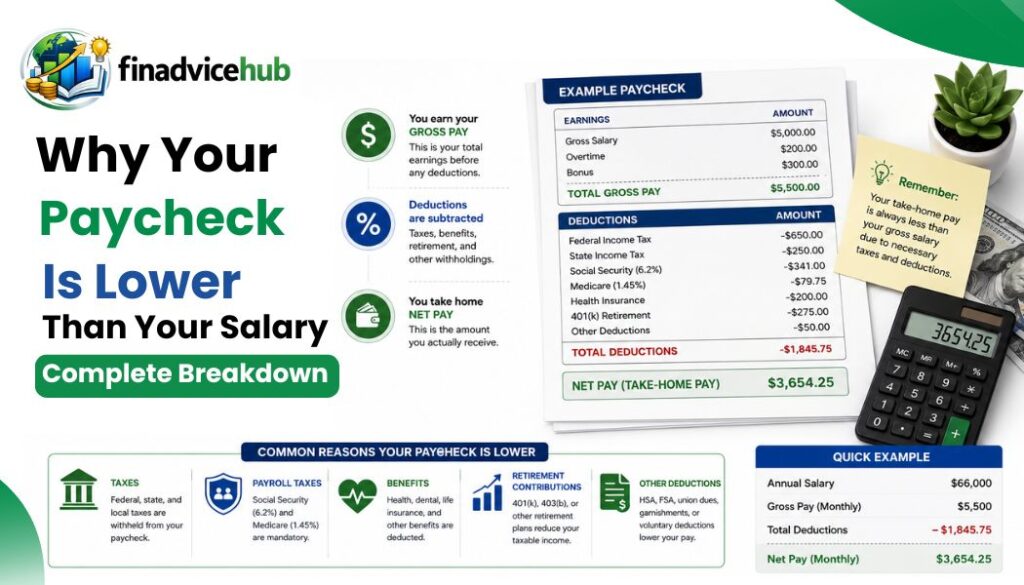
Many employees experience confusion when they receive their first paycheck and notice that the amount deposited is significantly lower than the salary they were promised. A job offer may mention a yearly salary of $60,000, $80,000, or even $100,000, but the actual paycheck amount can feel surprisingly smaller.
This experience is extremely common. Many employees take home only around 70% to 75% of their gross salary after taxes and other payroll deductions, meaning a person earning a $60,000 annual salary may actually receive significantly less in their bank account depending on taxes, benefits, retirement contributions, and other deductions.
The reason is simple: your salary is usually your gross pay, not the money you receive after deductions. Gross salary represents your total earnings before taxes, insurance costs, retirement contributions, and other payroll adjustments are removed. Your paycheck reflects your net pay, which is the amount remaining after all required and voluntary deductions.
Your salary is the starting point of your compensation. Your paycheck is the final amount available for spending.
Understanding the difference between salary and take-home pay helps you plan your budget, evaluate job offers, adjust tax withholding, and make better financial decisions.
The Reality Gap Between Salary and Paycheck
Why salary looks higher than reality
Salary often creates unrealistic expectations because people naturally focus on the annual number shown in an offer letter rather than the amount they will actually receive each pay period.
For example, an employee earning a $72,000 annual salary may expect to receive the full $72,000 divided across their paychecks. However, that figure represents gross earnings before deductions. The actual deposited amount may be thousands of dollars lower because taxes and benefits are removed first.
A salary represents the value of your work before government obligations and employee-selected benefits are considered. Your paycheck represents the amount that reaches you after those financial responsibilities are paid.
The difference between these two numbers is sometimes called the salary-to-take-home gap. This gap is normal in most employment situations and varies depending on individual circumstances.
What employers don’t explain clearly
Many employers explain compensation using gross salary because it is the standard method for comparing jobs. However, employees sometimes misunderstand this number because the offer does not always show the expected take-home amount.
A compensation package may include several components besides base salary, including health insurance benefits, retirement plans, bonuses, stock options, and other incentives. Some benefits improve your overall compensation but may also reduce your paycheck if you contribute toward their cost.
For example, an employee might earn a $70,000 salary but choose a health insurance plan that costs $250 per month and contribute 5% toward a retirement account. Those choices reduce the amount received in each paycheck while increasing long-term financial benefits.
Common first-paycheck shock
The first paycheck is often surprising because it is the first time employees see the complete breakdown of deductions.
A person who accepts a job based on a $65,000 salary may discover that their biweekly paycheck is much smaller than expected. This happens because payroll systems automatically remove required taxes and selected benefits before payment is issued.
The first paycheck provides a clearer picture of real income because it shows gross earnings, taxes, deductions, and final net pay together.
Understanding this breakdown prevents future budgeting problems and helps employees accurately calculate their monthly income.
Overview of deductions
A paycheck usually contains several categories of deductions. Some are required by law, while others are optional decisions made by the employee.
Federal income tax, Social Security tax, and Medicare tax are common mandatory deductions. Depending on where an employee lives, state and local taxes may also apply.
Other deductions may include health insurance premiums, retirement contributions, flexible spending accounts, life insurance, disability coverage, union dues, or legal deductions such as wage garnishments.
The combination of these deductions creates the difference between gross salary and actual take-home pay.
Major Reason 1 – Federal Income Taxes
Federal income taxes are one of the biggest reasons a paycheck is lower than salary. Employers generally withhold a portion of each paycheck and send it to the federal government on the employee’s behalf.
The amount withheld depends on factors such as income level, filing status, information provided on Form W-4, and other tax-related adjustments.
How federal taxes are applied
Federal income tax is based on taxable income rather than simply the salary amount. Taxable income is generally calculated after certain adjustments and deductions are considered.
The payroll system estimates how much tax should be withheld from each paycheck based on employee information. At the end of the year, employees compare the amount withheld with their actual tax liability when filing a tax return.
If too much was withheld, the employee may receive a refund. If too little was withheld, additional tax may be owed.
Role of tax brackets
The United States uses a progressive tax system, meaning different portions of income are taxed at different rates.
A common misunderstanding is that moving into a higher tax bracket means all income is taxed at that higher rate. In reality, only the income within that bracket is taxed at that rate.
Tax brackets influence paycheck withholding, but they do not mean employees lose a fixed percentage of their entire salary.
Withholding impact
Tax withholding directly affects paycheck size. Employees who request more withholding on their W-4 will generally receive smaller paychecks throughout the year but may owe less when filing taxes.
Employees who reduce withholding may see larger paychecks but could have a higher tax bill later. Finding the right balance helps avoid unexpected tax payments or unnecessarily small paychecks.
Example deduction
Suppose an employee earns $5,000 in gross pay during a monthly pay period. After federal income tax withholding and other deductions, the employee may receive significantly less than $5,000 deposited into their account.
The exact amount depends on personal tax details, but the example shows why gross salary and paycheck amounts are different measurements.
Major Reason 2 – FICA Taxes (Social Security & Medicare)
FICA taxes are another major reason why your paycheck is lower than your salary. Unlike federal income taxes, which depend on income level and tax situation, FICA taxes are generally calculated as fixed percentages of your wages up to certain limits established by law.
FICA stands for the Federal Insurance Contributions Act. These payroll taxes help fund Social Security and Medicare programs, which provide retirement, disability, and healthcare benefits for eligible Americans.
What FICA taxes include
FICA taxes consist of two primary deductions: Social Security tax and Medicare tax. Social Security tax helps fund retirement and disability benefits. Medicare tax helps support the federal health insurance program primarily used by older adults and certain individuals with disabilities.
Most employees see both deductions listed separately on their paycheck because payroll systems show each contribution individually.
Unlike federal income tax withholding, FICA taxes are not adjusted based on your W-4 choices. They are calculated according to payroll rules.
How they reduce your paycheck
Because FICA taxes are deducted directly from wages, they reduce the amount of money you receive after each pay period.
For example, an employee with a gross paycheck of $4,000 will not receive the full $4,000 because Social Security and Medicare taxes are removed before payment.
These deductions can create a noticeable difference between your expected salary amount and your actual bank deposit, especially when combined with income taxes and benefit costs.
Fixed percentage impact
For most employees, Social Security and Medicare taxes represent a predictable percentage of wages.
Employee FICA contributions generally include:
Social Security tax: 6.2% of wages up to the annual Social Security wage base limit.
Medicare tax: 1.45% of wages, with an additional Medicare tax applying to certain higher-income earners.
Because these percentages apply automatically, employees often notice them immediately when reviewing their paycheck deductions.
Example calculation
Imagine an employee earns $6,000 in gross wages during a pay period. Social Security and Medicare taxes alone could remove several hundred dollars before federal and state taxes are even considered.
After adding income tax withholding, insurance premiums, and retirement contributions, the final paycheck amount may be significantly lower than the original salary calculation.
Major Reason 3 – State & Local Taxes
Federal taxes apply nationwide, but state and local taxes vary depending on where you live and work. This creates another reason why two employees with identical salaries may receive different paycheck amounts.
Location plays an important role in determining take-home pay.
An employee earning $80,000 in one state may have a different net paycheck compared with someone earning the same amount in another state because of differences in income tax policies.
State tax variations
Some states collect state income tax, while others do not have a broad state income tax on wages. States with income taxes typically calculate withholding based on state tax rules, income level, and employee information.
The difference can be significant over an entire year. Employees comparing job opportunities should consider after-tax income rather than salary alone.
A higher salary does not always create a higher take-home amount if taxes and living costs are substantially different.
Local taxes impact
Some cities, counties, or municipalities impose additional income taxes or payroll-related taxes. These local deductions may appear as separate lines on a paycheck and can reduce take-home pay further.
Employees who move for work sometimes experience paycheck changes even when their salary remains the same because their tax location changes.
States with no income tax
Some states do not impose a general state income tax on wages. Employees living in these states may keep more of their salary compared with workers in states that collect income tax.
However, overall financial impact depends on other factors, including housing costs, sales taxes, property taxes, and living expenses.
A state with no income tax does not automatically guarantee a lower cost of living or higher financial savings.
Example deduction
An employee earning $75,000 may see different paycheck amounts depending on their location.
A worker in a state with income tax may have an additional deduction from each paycheck, while a worker in a state without state income tax may avoid that specific deduction. The salary remains the same, but the take-home pay changes.
Major Reason 4 – Pre-Tax Deductions
Pre-tax deductions are employee-selected contributions or payments that are removed from income before certain taxes are calculated.
Although they reduce the size of your paycheck, they can also provide valuable financial advantages by lowering taxable income.
Many employees misunderstand these deductions because they see less money deposited, but do not realize they are receiving financial benefits elsewhere.
Health insurance
Health insurance premiums are one of the most common paycheck deductions. Many employers cover part of the insurance cost, while employees contribute the remaining amount through payroll deductions.
Depending on the plan and payroll setup, employee health insurance contributions may be deducted before taxes, reducing taxable income.
A more expensive insurance plan may result in a smaller paycheck, even though the employee is receiving broader healthcare coverage.
Retirement contributions
Retirement plans such as employer-sponsored 401(k) accounts can reduce current take-home pay because money is automatically transferred from each paycheck into retirement savings.
For example, an employee contributing 5% of their salary toward retirement will receive less money today but increase their long-term savings.
Some retirement contributions may also reduce taxable income, creating potential tax advantages.
Flexible spending accounts
Flexible spending accounts allow employees to set aside money for eligible healthcare or dependent care expenses. Because contributions are typically made before taxes, they can lower taxable income.
However, they also reduce the amount of money appearing in each paycheck because the funds are redirected toward future expenses.
How they reduce taxable income
Pre-tax deductions work by lowering the amount of income subject to certain taxes. For example, an employee earning $60,000 who contributes money toward eligible pre-tax benefits may have taxable wages lower than their full salary.
The result is a smaller paycheck today, but possible tax savings and financial benefits over time.
Major Reason 5 – Post-Tax Deductions
Unlike pre-tax deductions, post-tax deductions are removed after taxes have already been calculated.
These deductions directly reduce your final take-home pay because they come out of the money remaining after tax withholding.
Insurance add-ons
Additional insurance options, such as supplemental life insurance or certain voluntary coverage plans, may be deducted after taxes, depending on the benefit structure.
Employees sometimes forget about these optional benefits because enrollment may happen during hiring or annual benefits periods. Reviewing benefit selections can reveal deductions that were added months or years earlier.
Wage garnishments
A wage garnishment is a legal process requiring an employer to withhold part of an employee’s wages to satisfy a debt or legal obligation. Examples may include certain unpaid debts, court orders, or child support obligations.
Because garnishments directly reduce the final paycheck amount, they can create a noticeable difference between expected and actual income.
Union dues
Employees who belong to unions may have membership dues deducted from their paychecks. These deductions support union operations and representation services. The amount varies depending on the organization and agreement.
Impact on final pay
Post-tax deductions can make a paycheck appear unexpectedly low because they reduce the amount employees receive after all required taxes have been removed.
A complete paycheck review should include both tax deductions and voluntary deductions to understand where money is going.
Hidden Factors That Reduce Your Paycheck
Many employees understand that taxes reduce their paycheck, but fewer realize that several smaller factors can also create a noticeable difference between salary expectations and actual take-home pay.
These hidden paycheck reduction factors often explain why someone’s net pay changes even when their salary stays the same.
Reviewing your pay stub carefully can reveal adjustments related to tax settings, benefits, payroll timing, and compensation structure.
Incorrect W-4 settings
Your W-4 form tells your employer how much federal income tax to withhold from your paycheck.
If your W-4 information does not accurately reflect your current financial situation, your paycheck may be smaller or larger than expected.
For example, employees who request additional withholding may receive smaller paychecks because more money is sent to the IRS throughout the year.
Employees who withhold too little may receive larger paychecks but could face an unexpected tax bill when filing their return.
Life changes such as marriage, having children, starting a second job, or receiving additional income can affect whether your withholding amount still matches your situation.
Reviewing your W-4 periodically can help ensure your paycheck reflects your preferred balance between monthly cash flow and tax payments.
Benefit selections
Employee benefits can significantly affect take-home pay. Many companies offer health insurance, dental coverage, vision plans, retirement accounts, disability insurance, and other workplace benefits. While these benefits increase the overall value of employment, many require employee contributions.
A person comparing two job offers may focus only on salary differences while ignoring benefit costs.
For example, a $75,000 salary with expensive insurance contributions may produce a lower paycheck than a slightly lower salary with more affordable benefits. The real value of compensation depends on total rewards, not salary alone.
Bonuses taxed differently
Many employees are surprised when their bonus payment is lower than expected. Bonuses are considered supplemental wages and may be subject to different withholding rules compared with regular wages.
The actual tax treatment depends on applicable federal, state, and payroll rules. A bonus may have a higher withholding amount at the time of payment, which can make the net amount appear smaller.
This does not always mean the employee permanently pays more tax. The final tax calculation is determined when the employee files their annual tax return.
Understanding the difference between withholding and actual tax liability helps explain why bonus checks may feel smaller.
Pay period differences
Your paycheck amount depends on how often you are paid. An annual salary is divided differently depending on whether you receive payments weekly, biweekly, semimonthly, or monthly.
For example, an employee earning $52,000 annually may see different paycheck amounts depending on whether the company pays 12, 24, or 26 times per year.
A smaller paycheck does not always mean lower annual earnings. Sometimes it simply reflects a different pay schedule.
Real Paycheck vs Salary Example
A practical example makes the difference between salary and paycheck easier to understand. Suppose an employee receives a job offer with a yearly salary of $72,000.
The employee is paid twice per month, meaning the gross paycheck before deductions is:
$72,000 ÷ 24 pay periods = $3,000 gross pay per paycheck.
The employee may expect to receive $3,000 every payday. However, that is only the gross amount.
Example salary setup
The employee has the following payroll deductions:
- Federal income tax withholding.
- Social Security and Medicare taxes.
- State income tax.
- Health insurance contribution.
- Retirement contribution.
The exact amounts depend on personal circumstances, location, and benefit choices.
Step-by-step deductions
Starting gross pay:
- $3,000
- Federal income tax withholding reduces the amount available.
- FICA taxes remove Social Security and Medicare contributions.
- State taxes may reduce the paycheck further.
Health insurance premiums and retirement contributions are deducted according to the employee’s selections.
After all deductions are applied, the employee receives the final net paycheck.
Final take-home pay
The employee may receive a paycheck that is significantly lower than $3,000.
For example, after deductions, the deposited amount might be around $2,000 to $2,400, depending on taxes, benefits, and personal choices.
This example demonstrates why salary and paycheck amounts should not be treated as the same number.
Insights
The difference between salary and paycheck is not usually caused by one single deduction.
Instead, multiple smaller reductions combine:
- Taxes reduce required payments.
- Benefits redirect money toward services and protection.
- Retirement contributions build future savings.
- Other deductions may cover additional obligations.
Understanding the complete payroll picture allows employees to make better financial decisions.
How to Estimate Your Real Take-Home Pay
Before accepting a job offer or creating a budget, estimating your actual paycheck can help you understand your available income.
A salary number alone is not enough for accurate financial planning.
Percentage-based estimation
A simple method is estimating take-home pay as a percentage of gross salary.
Many employees receive a percentage of their salary after taxes and deductions, but the exact percentage varies widely.
Factors affecting this percentage include:
- Income level.
- Tax filing status.
- Location.
- Insurance costs.
- Retirement contributions.
- Other deductions.
A rough estimate can be useful for planning, but a detailed calculation provides better accuracy.
Using paycheck calculators
Online paycheck calculators can estimate take-home pay by considering factors such as salary, location, filing status, and deductions.
These tools are helpful when comparing job offers or planning monthly expenses.
However, they should be treated as estimates because actual payroll calculations depend on individual circumstances.
Adjusting for deductions
The most accurate way to estimate your paycheck is to review your expected deductions.
Consider:
- Health insurance costs.
- Retirement contributions.
- Tax withholding choices.
- Flexible spending contributions.
- Additional benefits.
A person with higher benefit contributions may intentionally receive a smaller paycheck because more money is being directed toward financial goals.
Improving accuracy
For a more accurate estimate, use your employer’s benefits information, tax withholding details, and payroll schedule.
Comparing a sample pay statement with your expected salary can provide a realistic picture of your future income. A good financial decision is based on net pay, not only gross salary.
How to Increase Your Take-Home Pay
If your paycheck feels lower than expected, there are several legitimate ways to review and potentially increase your net income.
The goal is not simply to reduce deductions but to make sure your payroll choices match your financial priorities.
Adjusting W-4
Updating your W-4 can change how much federal income tax is withheld from each paycheck.
Employees who are consistently receiving large tax refunds may be withholding more than necessary throughout the year.
Adjusting withholding may increase paycheck amounts, although employees should ensure enough tax is still being withheld to avoid unexpected payments.
Optimizing deductions
Reviewing your deductions can reveal opportunities to improve cash flow.
Employees should examine:
- Unused benefits.
- Insurance selections.
- Retirement contribution levels.
- Flexible spending contributions.
- Optional deductions.
Some deductions provide valuable benefits, so removing them is not always the best choice. The goal is finding the right balance between current income and future financial security.
Managing benefits
Benefits should be evaluated based on personal needs.
A higher-cost insurance plan may not be necessary for everyone. Similarly, retirement contributions should match individual financial goals.
Employees should compare benefit options during enrollment periods and understand how each choice affects paycheck size.
Tax planning strategies
Tax planning throughout the year can help employees avoid surprises.
Helpful strategies include:
- Reviewing withholding after major life changes.
- Understanding available tax deductions and credits.
- Tracking retirement contributions.
- Planning for bonuses or additional income.
- Consulting a qualified tax professional for complex situations.
Tax planning is not about avoiding taxes illegally. It is about making informed decisions within the tax rules.
Common Mistakes Employees Make When Reviewing Paychecks
Many paycheck misunderstandings happen because employees look only at the final deposit amount.
A complete review requires understanding each section of the pay statement.
Common mistakes include assuming salary equals take-home pay, ignoring benefit costs, forgetting about retirement contributions, and failing to update tax withholding after major life changes.
Employees should review their paycheck regularly instead of waiting until tax season or noticing a major income change.
A paycheck is a financial document that explains how compensation is calculated.
Expert Tips for Understanding Your Paycheck
Experienced financial planners often recommend focusing on three numbers:
- Gross pay shows total earnings before deductions.
- Total deductions show where money is going.
- Net pay shows the actual amount available for spending.
Understanding the relationship between these numbers helps employees compare jobs, create budgets, and make smarter financial decisions.
Your salary tells you what you earn. Your paycheck tells you what you actually receive.
FAQs
Why is my paycheck lower than my salary?
Your paycheck is lower than your salary because salary usually refers to gross income before deductions, while your paycheck shows net income after taxes, benefits, retirement contributions, and other payroll deductions are removed. Federal taxes, FICA taxes, state taxes, insurance premiums, and voluntary contributions all reduce the amount you receive.
How much tax is taken from a paycheck?
The amount of tax taken from a paycheck depends on factors such as income level, filing status, location, withholding settings, and applicable tax rules. Employees may have federal income tax, Social Security tax, Medicare tax, and possibly state or local taxes deducted from their wages.
What deductions reduce my paycheck the most?
The largest paycheck deductions are often federal income taxes, Social Security and Medicare taxes, health insurance premiums, retirement contributions, and state or local taxes. The biggest deduction varies by employee because tax situations and benefit choices are different for everyone.
Why is my first paycheck so small?
A first paycheck may seem smaller because it reflects actual payroll deductions that were not included in the advertised salary amount. It may also include fewer working days if you started in the middle of a pay period, along with taxes, benefits, and other deductions.
Do benefits reduce take-home pay?
Yes, employee-paid benefits can reduce take-home pay. Health insurance premiums, retirement contributions, flexible spending accounts, and other workplace benefits may lower the amount deposited into your bank account. However, these deductions often provide valuable financial protection or future savings.
How can I increase my net salary?
You can potentially increase your net salary by reviewing tax withholding, adjusting unnecessary deductions, choosing benefits carefully, managing retirement contributions, and planning taxes throughout the year. Any changes should consider both short-term cash flow and long-term financial goals.
Why are bonuses taxed more?
Bonuses may appear to be taxed more because employers often apply different withholding methods to supplemental wages. The higher withholding on a bonus does not always mean you owe more total tax. Your final tax responsibility is determined when you file your annual tax return.
How do I estimate my real paycheck?
To estimate your real paycheck, start with your gross salary, divide it by your pay frequency, and subtract expected deductions such as taxes, insurance, retirement contributions, and other payroll adjustments. Online paycheck calculators can provide estimates, but your employer’s payroll information usually gives the most accurate result.
Why does my salary not match my paycheck?
Your salary does not match your paycheck because salary represents your total earnings before deductions. Your paycheck reflects what remains after required taxes and voluntary deductions are removed. The difference is the normal gap between gross pay and take-home pay.
Why is my take-home pay lower than expected?
Take-home pay may be lower than expected because of increased tax withholding, benefit changes, retirement contributions, payroll adjustments, or unexpected deductions. Reviewing your pay stub line by line can help identify exactly what changed.
Can changing my W-4 increase my paycheck?
Changing your W-4 can increase your paycheck if less federal income tax is withheld from each pay period. However, reducing withholding may affect your tax balance at the end of the year, so adjustments should be made carefully.
Does a higher salary always mean more money in my pocket?
A higher salary usually increases earnings, but the difference in take-home pay depends on taxes, benefits, location, and deductions. Someone with a higher salary may not see as large an increase in their paycheck if deductions also increase.