
Your paycheck is more than just your salary divided by the number of pay periods. The amount that reaches your bank account depends on how your compensation is structured and which payroll deductions are applied before and after taxes. According to the U.S. Bureau of Labor Statistics, benefits made up 30.1% of total employer compensation costs for private industry workers in March 2026, while wages and salaries accounted for the remaining 69.9%. This highlights how important deductions, benefits, and payroll decisions are in determining your true take-home pay.
Understanding pre-tax vs. post-tax deductions helps employees make smarter choices about retirement contributions, health insurance, and other workplace benefits. Two employees with the same salary can receive different net pay amounts because their deductions are handled differently.
Many employees see deductions listed on their pay stubs but do not fully understand how they affect their paycheck. Pre-tax deductions reduce taxable income before taxes are calculated, while post-tax deductions are taken after taxes have already been withheld. Knowing the difference can help you better understand your salary breakdown and make informed decisions about your compensation.
This guide explains pre-tax vs. after-tax deductions, common paycheck deduction examples in the USA, and practical strategies for managing your salary deductions to maximize your take-home pay.
What Are Payroll Deductions in a Paycheck
Every paycheck includes a series of adjustments that move your gross salary toward your final take-home pay. These adjustments are known as payroll deductions.
Payroll deductions represent amounts removed from your earnings for taxes, employee benefits, retirement plans, legal requirements, or voluntary programs. They create the bridge between your gross compensation and your actual net pay.
A clear understanding of payroll deductions is essential because deductions do not all work the same way. Some reduce your taxable wages, while others simply reduce your final paycheck amount after taxes are calculated.
Definition of Deductions
A payroll deduction is an amount withheld from an employee’s gross pay before receiving their net paycheck. Employers typically process these deductions automatically through payroll systems based on employee elections, government requirements, or legal obligations.
The basic paycheck calculation looks like this:
Gross pay − deductions − taxes = take-home pay
However, the exact order matters. A pre-tax deduction may be removed before taxes are calculated, reducing the income subject to taxation. A post-tax deduction is removed after taxes have already been applied.
This deduction classification framework is one of the most important concepts in understanding how compensation works.
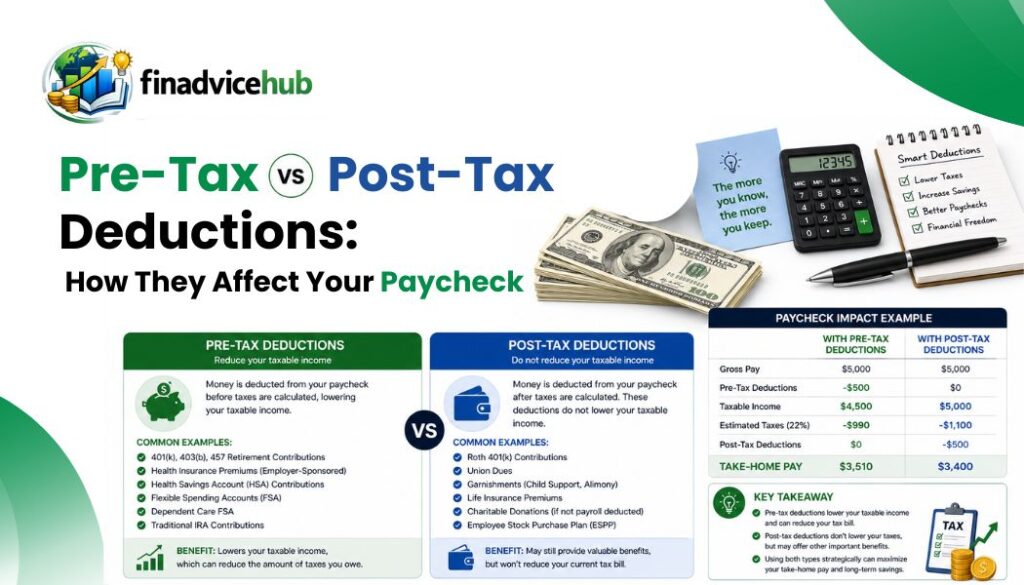
For example, if an employee earns $5,000 per month and contributes $500 to an eligible pre-tax retirement plan, taxes may only apply to $4,500 instead of the full $5,000. A $500 post-tax deduction, however, would generally come out after taxes are calculated.
Why Deductions Exist
Payroll deductions exist because employees often use part of their compensation for benefits, savings programs, insurance coverage, and legally required payments.
Employers use payroll deductions to simplify payments and ensure employees consistently contribute toward selected programs without manually paying bills each month.
Common reasons deductions appear on a paycheck include:
- Funding employer-sponsored health benefits
- Saving for retirement
- Paying required payroll taxes
- Supporting insurance programs
- Meeting court-ordered obligations
- Participating in workplace benefits
Deductions are not automatically negative. Many deductions provide valuable benefits, and some can improve financial efficiency by reducing taxable income or helping employees build long-term savings.
Types of Payroll Deductions
Payroll deductions generally fall into three categories:
Mandatory deductions: These are required by law and usually include federal income tax, Social Security, Medicare, and applicable state or local taxes.
Voluntary deductions: These are employee-selected benefits or savings contributions, such as retirement plans, health insurance premiums, or flexible spending accounts.
Court-ordered deductions: These include obligations such as wage garnishments or certain legal payments.
The following paycheck layers explained framework shows how deductions typically flow:
- Gross earnings are calculated.
- Eligible pre-tax deductions are removed.
- Taxes are calculated on remaining taxable wages.
- Post-tax deductions are applied.
- The employee receives net pay.
Understanding these layers makes paycheck deduction breakdowns much easier to interpret.
How Deductions Affect Salary
Deductions directly affect how much money reaches your bank account, but their impact depends on their classification.
A deduction can lower your take-home pay immediately while still providing financial advantages. For example, contributing to a 401(k) reduces your paycheck today but increases retirement savings and may lower current taxable income.
The key is understanding the difference between reducing your paycheck amount and reducing your taxable income.
An employee focused only on the final paycheck number may avoid useful benefits because they appear to reduce income. However, some deductions improve overall compensation value by providing tax advantages or employer contributions.
What Are Pre-Tax Deductions
Pre-tax deductions are amounts removed from an employee’s paycheck before certain taxes are calculated. They are one of the most important tools employees use when planning benefits and managing taxable income.
The primary advantage of pre-tax deductions is that they can lower taxable wages. Because taxes are calculated on a smaller income amount, employees may owe less in current taxes.
Definition and Meaning
Pre-tax deductions are payroll deductions taken from gross income before federal income taxes and, in many cases, other applicable taxes are calculated.
The term “pre-tax” means the deduction happens before taxation.
When comparing pre tax vs post tax meaning, the simplest distinction is:
- Pre-tax deductions reduce the amount of income subject to certain taxes.
- Post-tax deductions are removed after taxes have already been calculated.
This difference determines whether a deduction provides an immediate tax benefit.
Examples of commonly eligible pre-tax deductions include retirement contributions, certain health insurance premiums, FSAs, and HSAs.
How Pre-Tax Deductions Work
The process of how pre tax deductions reduce taxable income is relatively straightforward.
Suppose an employee earns $60,000 annually and contributes $5,000 to an eligible pre-tax retirement plan. Instead of being taxed on the entire $60,000, the employee may only be taxed on $55,000 for applicable income tax purposes.
The employee still earns the same salary, but the taxable income calculation changes.
A simplified example:
Annual salary: $60,000
Pre-tax retirement contribution: $5,000
Adjusted taxable wages: $55,000
The employee may pay taxes based on the lower taxable amount, creating potential savings.
Actual tax savings depend on income level, tax brackets, contribution limits, and applicable tax rules.
Impact on Taxable Income
The biggest advantage of pre-tax deductions is their effect on taxable income. Taxable income is the portion of earnings used to determine tax liability. By lowering taxable wages, certain deductions can reduce the amount of income subject to taxation.
This is why many employees use pre-tax benefits as part of their income reduction strategies.
Common examples of deductions that may reduce taxable income include:
- Traditional retirement contributions
- Certain employer health insurance premiums
- Flexible spending account contributions
- Health savings account contributions
However, not every deduction reduces every type of tax. Some deductions may affect federal income tax but not Social Security or Medicare taxes, depending on the benefit and applicable rules.
Why They Reduce Taxes
Pre-tax deductions reduce taxes because they lower the income amount used in tax calculations.
For example, an employee in a higher tax bracket may receive greater immediate tax savings from pre-tax contributions compared with someone in a lower tax bracket.
The benefit works because part of the employee’s compensation is redirected toward approved benefits before taxation occurs.
This does not mean the deduction is free money. The employee is still allocating earnings toward a specific purpose, such as retirement savings or healthcare expenses. The advantage comes from receiving those benefits in a more tax-efficient way.
Common Examples of Pre-Tax Deductions
Employees often encounter pre-tax deductions through employer benefit programs. These deductions can influence both current paychecks and long-term financial planning.
Health Insurance Premiums
Health insurance premiums are among the most common pre-tax deductions offered by employers.
When health insurance premiums qualify for pre-tax treatment, the employee’s contribution is deducted before certain taxes are calculated. This reduces taxable wages and may lower the employee’s overall tax burden.
For example, an employee paying $200 per month toward employer-sponsored health insurance may have that amount removed before taxes instead of paying the full amount after taxes.
The tax advantage can make employer health coverage more affordable compared with purchasing similar coverage using after-tax income.
401(k) Retirement Contributions
Traditional 401(k) contributions are a major example of a pre-tax deduction. Employees contribute part of their paycheck toward retirement savings before federal income taxes are calculated. This allows employees to save for retirement while potentially reducing current taxable income.
A 401(k) contribution also supports long-term financial goals because many employers offer matching contributions.
However, employees should understand that traditional 401(k) withdrawals are generally taxed later when money is taken from the account during retirement.
Flexible Spending Accounts (FSA)
Flexible Spending Accounts allow employees to set aside money for eligible healthcare or dependent care expenses.
Because contributions are typically made before taxes, FSAs can reduce taxable income while helping employees pay predictable expenses.
For example, an employee who knows they will have medical expenses during the year may contribute to an FSA and use those funds for eligible costs.
FSAs usually follow annual rules and deadlines, so employees should carefully estimate their contributions.
Health Savings Accounts (HSA)
Health Savings Accounts provide another example of a tax-advantaged benefit. HSAs are available to individuals enrolled in qualifying high-deductible health plans. Contributions may provide tax advantages, and unused funds can generally remain available for future healthcare expenses.
Unlike some workplace benefits that disappear at the end of the year, HSA funds typically belong to the employee and can continue growing over time.
The combination of tax benefits, healthcare savings, and long-term flexibility makes HSAs an important consideration in a pre tax vs after tax benefits comparison.
What Are Post-Tax Deductions
Post-tax deductions are amounts removed from an employee’s paycheck after taxes have already been calculated and withheld. Unlike pre-tax deductions, these deductions do not generally reduce taxable income.
Understanding post-tax deductions is essential when reviewing a paycheck because they directly reduce your final take-home pay without lowering the amount of income used to calculate taxes.
When comparing pre tax vs post tax deductions, the biggest difference is timing. Pre-tax deductions happen before taxation, while post-tax deductions happen after taxation.
This distinction affects both your tax liability and your net pay. A post-tax deduction may still provide an important financial benefit, but it usually does not create an immediate tax reduction.
Definition and Meaning
A post-tax deduction is a payroll deduction taken from an employee’s remaining income after required taxes have already been calculated.
In simple terms:
Gross pay → taxes calculated → post-tax deductions removed → final paycheck
Unlike pre-tax deductions, post-tax deductions do not lower taxable wages. The employee pays taxes on the full taxable income amount before the deduction is applied.
For employees trying to understand what is the difference between pre tax and post tax deductions, this timing difference is the foundation of the answer.
For example, if an employee earns $5,000 monthly and has a $100 post-tax deduction, taxes are generally calculated using the full taxable income amount. The $100 is then removed from the paycheck after taxes.
When Deductions Are Applied
Post-tax deductions are applied after payroll taxes and income tax calculations have been completed.
The typical order looks like this:
- Employee earns gross wages.
- Eligible pre-tax deductions are removed.
- Taxable wages are calculated.
- Required taxes are withheld.
- Post-tax deductions are applied.
- Remaining amount becomes take-home pay.
This order explains why post-tax deductions usually have a more direct impact on the amount deposited into an employee’s bank account.
A salary deduction breakdown can look confusing because employees may see several deductions listed together. However, the order in which each deduction appears determines its financial effect.
Why They Don’t Reduce Taxes
Post-tax deductions do not reduce taxes because they are applied after taxable income has already been determined.
For example, if an employee contributes to a Roth retirement account, the contribution is usually made after taxes. The employee does not receive an immediate reduction in taxable income, but the retirement account may provide tax advantages in the future.
The same principle applies to many insurance policies, union dues, and other voluntary deductions.
A post-tax deduction is not necessarily worse than a pre-tax deduction. The right choice depends on the employee’s financial goals, current tax situation, and long-term plans.
Impact on Net Pay
Post-tax deductions reduce the final amount an employee receives because they come directly out of after-tax income.
For example:
Gross pay: $4,000
Taxes: $800
Post-tax deduction: $150
Take-home pay: $3,050
The employee’s taxable income was not reduced by the $150 deduction, but the final paycheck amount decreased.
This is why it is important to grasp how deductions affect take-home pay by considering both the tax and cash flow impacts.
Some employees prefer post-tax options because they provide future benefits, flexibility, or specific protections that are valuable despite reducing current paycheck amounts.
Common Examples of Post-Tax Deductions
Post-tax deductions appear frequently on employee paychecks. Some are voluntary benefits, while others are required due to legal or contractual obligations.
Understanding these examples helps employees identify their own paycheck deduction types and determine how each item affects their compensation.
Life Insurance Premiums
Life insurance premiums can be either pre-tax or post-tax depending on the policy structure and employer plan design.
Many supplemental life insurance policies purchased through an employer are funded using after-tax dollars. This means the employee pays taxes on the income first, and the premium is then deducted from the remaining paycheck amount.
One advantage of certain post-tax life insurance arrangements is that future benefits may receive different tax treatment compared with some employer-paid policies.
Employees should review their specific benefit documents because tax treatment varies depending on the type of coverage.
Wage Garnishments
Wage garnishments are one of the most recognizable examples of mandatory post-tax deductions.
A wage garnishment occurs when an employer is legally required to withhold part of an employee’s earnings to satisfy a financial obligation, such as certain court judgments, child support payments, or government debts.
Because garnishments are generally applied after taxable wages are calculated, they do not usually reduce taxable income.
Employees facing garnishments should carefully review their pay stubs and legal notices to understand the amount being withheld and the duration of the deduction.
Union Dues
Union dues are often deducted from an employee’s paycheck after taxes have been calculated. Employees who belong to labor organizations may authorize their employer to automatically deduct membership dues from each paycheck.
These deductions support union operations and representation but typically do not provide a direct tax reduction.
The treatment of union dues can vary based on tax laws and individual circumstances, so employees should consider their overall financial situation when reviewing these costs.
Roth Retirement Contributions
Roth retirement contributions are one of the most common examples used in a pre tax vs after tax benefits comparison.
Unlike traditional 401(k) contributions, Roth contributions are made with after-tax dollars.
The employee pays taxes on the income first, contributes money to the Roth account afterward, and may receive tax-free qualified withdrawals in retirement.
Example:
Traditional 401(k):
- Contribution made before taxes
- Potential immediate tax savings
- Withdrawals generally taxed later
Roth 401(k):
- Contribution made after taxes
- No immediate taxable income reduction
- Qualified withdrawals may be tax-free
Neither option is universally better. The better choice depends on factors such as current income, expected future tax rates, and retirement goals.
Key Differences Between Pre-Tax and Post-Tax Deductions
The difference between pre-tax and post-tax deductions comes down to when the deduction occurs and how it affects taxable income. Both deduction types reduce your paycheck, but they influence your finances differently.
A pre-tax deduction may reduce taxes today, while a post-tax deduction may provide benefits that become valuable later.
Understanding these differences allows employees to make better decisions about benefit elections and compensation structure.
Tax Impact Comparison
The most important difference is the effect on taxable income. Pre-tax deductions reduce the amount of income subject to certain taxes. Post-tax deductions do not.
For example, a $500 pre-tax retirement contribution may reduce taxable wages, while a $500 Roth contribution does not reduce current taxable income.
However, tax benefits should not be viewed only from a short-term perspective. A Roth contribution may provide greater long-term advantages depending on future tax circumstances.
Timing of Deductions
Timing determines whether a deduction affects your current taxes.
Pre-tax deductions are removed before tax calculations:
Salary → pre-tax deduction → taxes → post-tax deductions → take-home pay
Post-tax deductions happen later:
Salary → taxable income calculation → taxes → post-tax deduction → take-home pay
This deduction timing difference is the core reason employees see different results from similar contribution amounts.
Effect on Take-Home Pay
Both deduction types reduce take-home pay, but they do so differently. A pre-tax deduction may reduce your paycheck by less than the actual contribution amount because of tax savings.
For example, contributing $300 before taxes may reduce your paycheck by only $230–$270 depending on your tax situation.
A $300 post-tax deduction usually reduces your paycheck by the full $300 because taxes have already been applied.
This is why a real deduction impact comparison requires looking beyond the deduction amount alone.
Example Comparison Table
| Feature | Pre-Tax Deductions | Post-Tax Deductions |
| When applied | Before taxes are calculated | After taxes are calculated |
| Effect on taxable income | Usually reduces taxable income | Usually does not reduce taxable income |
| Immediate tax benefit | Yes, in many cases | Usually no |
| Effect on paycheck | May reduce paycheck less due to tax savings | Reduces paycheck by full deduction amount |
| Common examples | Traditional 401(k), HSA, FSA, eligible health premiums | Roth contributions, union dues, wage garnishments |
| Main advantage | Potential current tax savings | Potential future benefits or flexibility |
The best choice depends on personal circumstances. Employees should consider their income level, tax bracket, retirement goals, and immediate financial needs.
Step-by-Step Example of Deduction Impact
Seeing an actual paycheck deduction example often makes the difference between deduction types easier to understand.
Consider an employee earning a monthly salary of $5,000.
For simplicity, assume:
- Federal and payroll taxes total 20%
- The employee contributes $500 toward benefits
- No state-specific calculations are included
This example is simplified and does not represent an exact payroll calculation.
Starting Salary Example
The employee’s gross monthly salary is: Gross pay: $5,000
Without any deductions, taxes would generally be calculated based on the employee’s taxable wages.
The employee’s goal is to decide whether certain deductions should be structured before or after taxes.
Applying Pre-Tax Deductions
The employee contributes $500 to a qualifying pre-tax retirement plan.
Calculation:
Gross pay: $5,000
Pre-tax deduction: −$500
Taxable wages: $4,500
Taxes are calculated using the reduced taxable amount.
Assuming a 20% tax rate:
Taxes: $900
Remaining pay: $4,500 − $900 = $3,600
The employee contributed $500 toward retirement while reducing taxable income.
Applying Taxes
Now compare the same $500 contribution as a post-tax deduction.
The employee is taxed on the full $5,000.
Calculation:
Gross pay: $5,000
Taxes (20%): −$1,000
Remaining after taxes: $4,000
The $500 contribution is then deducted.
$4,000 − $500 = $3,500
The employee’s take-home pay is $100 lower in this simplified example.
The difference represents the tax impact of the pre-tax contribution.
Applying Post-Tax Deductions
After taxes are calculated, any post-tax deductions are removed.
For example:
After-tax income: $4,000
Post-tax deduction: −$500
Final paycheck: $3,500
This illustrates why the same deduction amount can produce different paycheck outcomes depending on whether it is pre-tax or post-tax.
How Deductions Affect Your Take-Home Pay
To calculate your take-home pay, you need to look beyond the number shown on your salary offer. Your gross salary represents your total earnings before any adjustments are made, whereas your take-home pay is what you receive after taxes and deductions have been taken into account.
The difference between these two numbers can be significant, especially for employees who participate in employer benefit programs. A strong understanding of pre tax vs post tax deductions helps explain why two employees with identical salaries may receive different net pay.
Deductions influence your paycheck in two main ways: they can change how much income is taxed, and they can change how much money is removed after taxes. Both factors determine your final compensation.
Short-Term vs Long-Term Impact
Pre-tax and post-tax deductions often create different short-term and long-term financial outcomes.
Pre-tax deductions typically provide an immediate benefit because they can reduce taxable income. Employees may notice that their paycheck does not decrease by the full contribution amount because taxes are calculated on a smaller income base.
For example, contributing $400 to a traditional retirement account may reduce take-home pay by less than $400 because of the tax savings created by the contribution.
Post-tax deductions usually have a more noticeable immediate effect because the full deduction amount comes directly from after-tax income. However, some post-tax options may provide valuable future benefits.
A Roth retirement contribution is a good example. Although it does not reduce taxable income today, qualified withdrawals in retirement may provide tax advantages.
The best choice depends on whether your priority is:
- Increasing current paycheck flexibility
- Reducing current taxable income
- Building long-term financial security
- Preparing for future tax situations
Tax Savings vs Net Pay Reduction
One of the most common misunderstandings about paycheck deductions is assuming that a larger deduction always means a larger financial loss.
A deduction reduces your paycheck, but the overall financial impact depends on what happens before and after taxes.
Consider two employees who each contribute $500 toward retirement:
- Employee A chooses a traditional 401(k) contribution.
- Employee B chooses a Roth 401(k) contribution.
- Employee A may experience a smaller reduction in take-home pay because the contribution lowers taxable income.
- Employee B may see the full $500 removed from after-tax income because taxes were already calculated.
However, Employee B may benefit from tax-free qualified withdrawals later.
This is why a proper real paycheck deductions breakdown should evaluate both current cash flow and long-term value.
Benefit Trade-Offs
Workplace benefits often require employees to balance immediate income with future financial advantages.
Choosing additional benefits may reduce your paycheck today, but those benefits can replace expenses you would otherwise pay out of pocket.
For example:
- A health insurance premium reduces your paycheck but provides medical coverage.
- A retirement contribution reduces current spending money but builds future savings.
- An HSA contribution reduces current taxable income while creating healthcare savings.
Employees should evaluate benefits based on total value rather than only looking at the final paycheck amount.
A smaller paycheck does not always mean a worse financial outcome.
Real Paycheck Scenarios
A realistic paycheck comparison shows why deduction choices matter.
Imagine two employees each earning $75,000 annually.
Employee A:
- Contributes $5,000 to a traditional 401(k)
- Pays eligible health premiums through payroll
- Receives lower taxable wages
Employee B:
- Uses a Roth retirement contribution
- Pays benefits after taxes
- Has higher taxable wages
Both employees save money and receive benefits, but their paychecks may look different because their deduction structures are different.
The important question is not simply, “Which employee gets more money today?”
The better question is:
“How does each deduction choice affect taxes, savings, benefits, and financial goals over time?”
Strategies to Optimize Your Paycheck Using Deductions
Using deductions strategically can help employees improve their overall financial position. The goal is not always to maximize the number on each paycheck. Instead, it is to create the right balance between current income, tax efficiency, and future financial security.
A thoughtful pre vs post tax optimization strategy considers your income, expenses, benefits, and long-term goals.
Maximizing Pre-Tax Contributions
One of the most effective ways employees can improve tax efficiency is by taking advantage of eligible pre-tax benefits.
Common opportunities include:
- Increasing traditional retirement contributions
- Using eligible healthcare savings accounts
- Reviewing employer-sponsored benefit options
- Taking advantage of employer matching programs
For example, if your employer offers a 401(k) match, failing to contribute enough to receive the full match may mean missing part of your compensation package.
However, employees should avoid contributing more than they can comfortably afford. A tax benefit is valuable, but maintaining financial stability is equally important.
Choosing the Right Benefits
Employee benefits are a major part of compensation, but not every benefit is suitable for every person.
When reviewing benefits, consider:
- Expected healthcare expenses
- Retirement timeline
- Current tax bracket
- Future income expectations
- Monthly cash flow needs
For example, an employee with regular medical expenses may benefit from an HSA or FSA, while someone focused on retirement savings may prioritize retirement contributions.
The right benefits depend on individual circumstances.
Balancing Savings vs Liquidity
One of the biggest mistakes employees make is focusing only on tax savings while ignoring cash flow.
Pre-tax deductions can be powerful, but they also reduce the amount of money available immediately.
Someone who contributes too aggressively to retirement accounts may struggle with everyday expenses, emergency savings, or debt payments.
A balanced approach usually includes:
- Maintaining emergency savings
- Managing high-interest debt
- Taking advantage of valuable employer benefits
- Increasing contributions gradually over time
The best deduction strategy supports both current needs and future goals.
Avoiding Over-Deductions
More deductions are not always better. Employees sometimes select every available benefit without considering whether each option provides meaningful value.
For example, paying for duplicate insurance coverage or contributing too much to accounts they cannot use effectively may reduce financial flexibility.
Review your deductions regularly, especially after major life changes such as:
- Marriage
- Having children
- Changing jobs
- Receiving a salary increase
- Moving to a different state
A deduction strategy should change as your financial situation changes.
Common Mistakes Employees Make With Deductions
Many paycheck mistakes happen because employees choose workplace benefits without fully understanding how each deduction works or how it affects their taxes. A better understanding of payroll deduction types and the way deductions are classified can help employees make smarter decisions about their compensation.
Your paycheck contains several layers, including taxes, benefit contributions, retirement savings, and other salary adjustments. Knowing where each item fits in the process makes it easier to understand your actual earnings and avoid unexpected changes in take-home pay.
Ignoring Tax Advantages
One common mistake is overlooking deductions that can reduce taxable income. Some employees avoid retirement contributions or healthcare savings options because they only focus on the immediate reduction in their paycheck.
However, certain pre-tax benefits can provide significant value by lowering taxable wages and helping employees save for future expenses. Understanding how benefits reduce taxes and which deductions qualify as taxable income deductions allows employees to make better financial decisions.
For example, contributing to a traditional 401(k), HSA, or eligible FSA may reduce the amount of income subject to certain taxes. While these deductions may slightly lower your current paycheck, the overall deduction impact on paycheck can be positive when tax savings and long-term benefits are considered.
Choosing Unnecessary Benefits
Another common mistake is selecting benefits simply because they are available. Employers often provide a wide range of options, but not every benefit fits every employee’s financial situation.
For example, paying for duplicate insurance coverage or choosing benefit options that do not match your needs can reduce your take-home pay without providing meaningful value.
A smart approach is to compare the cost of each benefit with the protection or savings it provides. Reviewing the difference between pre tax benefits vs post tax benefits can also help you understand whether a benefit provides immediate tax advantages or long-term financial value.
Misunderstanding Deduction Types
Confusing pre-tax and post-tax deductions can lead to unexpected paycheck results. Many employees assume all retirement contributions, insurance premiums, or workplace benefits receive the same tax treatment, but that is not always true.
For example, traditional retirement contributions are generally handled differently from Roth contributions. Understanding pre tax vs post tax deductions helps employees recognize why similar-looking deductions can create different results on a paycheck.
The paycheck deduction layers explained concept is useful here. Deductions are not all applied at the same stage. Some are removed before taxes are calculated, while others are deducted after taxes have already been applied.
Not Reviewing Pay Stubs
Many employees rarely check their pay stubs after setting up their payroll elections. This can lead to missed errors, outdated benefit selections, or incorrect deductions continuing longer than expected.
Regular paycheck reviews help employees confirm:
- Benefit premiums are correct
- Retirement contributions match expectations
- Tax withholding appears accurate
- Unexpected deductions are identified
A pay stub provides a detailed paycheck deduction breakdown and shows how your gross salary becomes your final take-home pay. Reviewing it regularly can also reveal opportunities for improving your finances, such as adjusting contributions or exploring how to increase take home pay without losing valuable benefits.
Your paycheck is one of the most important financial documents you receive because it shows exactly how your compensation is being allocated.
Conclusion
Understanding pre tax vs post tax deductions is essential for making smarter decisions about your paycheck, workplace benefits, and overall financial strategy.
The primary difference comes down to timing. Pre-tax deductions are taken before taxes are calculated and may reduce taxable income, while post-tax deductions are applied after taxes and generally do not reduce current taxable wages.
A proper pre tax benefits vs post tax benefits comparison helps employees understand that both options can play an important role in financial planning. Pre-tax benefits such as traditional retirement contributions, eligible health premiums, FSAs, and HSAs can lower taxable income while supporting long-term goals. Post-tax deductions such as Roth contributions, certain insurance premiums, union dues, and wage garnishments serve different purposes and may provide value despite not creating immediate tax savings.
The right choice depends on your financial situation, income level, future goals, and cash flow needs. There is no single deduction strategy that works for everyone. Instead, employees should evaluate their benefits, understand their salary adjustments, and choose options that support both present and future financial priorities.
By reviewing your paycheck deduction examples USA workers commonly see and understanding how each deduction affects your earnings, you can make better decisions about saving, taxes, and take-home pay.
A paycheck is not just a payment. It is a reflection of your financial strategy and how you choose to structure your compensation.
FAQs
What is the difference between pre-tax and post-tax deductions?
The main difference between pre-tax and post-tax deductions is when they are applied during payroll processing.
Pre-tax deductions are removed before taxes are calculated, which may reduce taxable income. Post-tax deductions are removed after taxes have already been calculated and generally do not reduce taxable wages.
Examples of pre-tax deductions include traditional 401(k) contributions, eligible health insurance premiums, FSAs, and HSAs. Examples of post-tax deductions include Roth retirement contributions, certain insurance premiums, and wage garnishments.
Do pre-tax deductions reduce taxable income?
Yes, many pre-tax deductions reduce taxable income because they are removed before certain taxes are calculated.
For example, traditional 401(k) contributions generally reduce taxable income for federal income tax purposes. Eligible health savings account contributions may also provide tax advantages.
A pre tax deduction calculation example shows how this works: if an employee earns $5,000 and contributes $500 to an eligible pre-tax account, taxes may be calculated on $4,500 instead of the full amount.
However, the exact tax impact depends on the specific deduction, contribution limits, and applicable tax rules.
Which deductions reduce your paycheck the most?
The deductions that reduce your paycheck the most depend on your benefit choices, contribution levels, and financial obligations.
Common deductions that may significantly affect take-home pay include:
- Retirement contributions
- Health insurance premiums
- Flexible spending contributions
- Additional insurance coverage
Mandatory deductions such as taxes and wage garnishments can also create a noticeable post tax deduction impact on salary because they reduce the final amount received after taxes.
Are 401(k) contributions pre-tax or post-tax?
Traditional 401(k) contributions are generally pre-tax, meaning they may reduce taxable income today.
Roth 401(k) contributions are generally post-tax because taxes are paid before the contribution is made.
Choosing between them depends on whether you prefer potential tax savings now or potential tax-free withdrawals later. Employees should consider their current income, expected future tax situation, and retirement goals.
Do post-tax deductions affect taxes?
Post-tax deductions generally do not reduce taxable income because taxes have already been calculated before the deduction occurs.
However, post-tax benefits may still provide financial advantages depending on the type of account or benefit. For example, Roth retirement accounts may provide tax benefits when funds are withdrawn during retirement.
How can I increase my take-home pay using deductions?
Increasing take-home pay is not always about removing deductions. Sometimes it involves choosing more efficient options.
Strategies may include:
- Reviewing unnecessary benefits
- Adjusting retirement contributions based on financial goals
- Using eligible pre-tax benefits
- Avoiding duplicate coverage
- Reviewing tax withholding and deductions regularly
Are health insurance premiums pre-tax?
Many employer-sponsored health insurance premiums are deducted on a pre-tax basis, meaning they may reduce taxable income.
However, tax treatment depends on the employer’s plan structure and applicable regulations. Employees should review their benefit documents or payroll information to confirm how their premiums are handled.
What deductions are mandatory on a paycheck?
Mandatory paycheck deductions usually include government-required taxes such as:
- Federal income tax
- Social Security tax
- Medicare tax
- State or local taxes where applicable
Other mandatory deductions may include court-ordered wage garnishments or legally required payments.