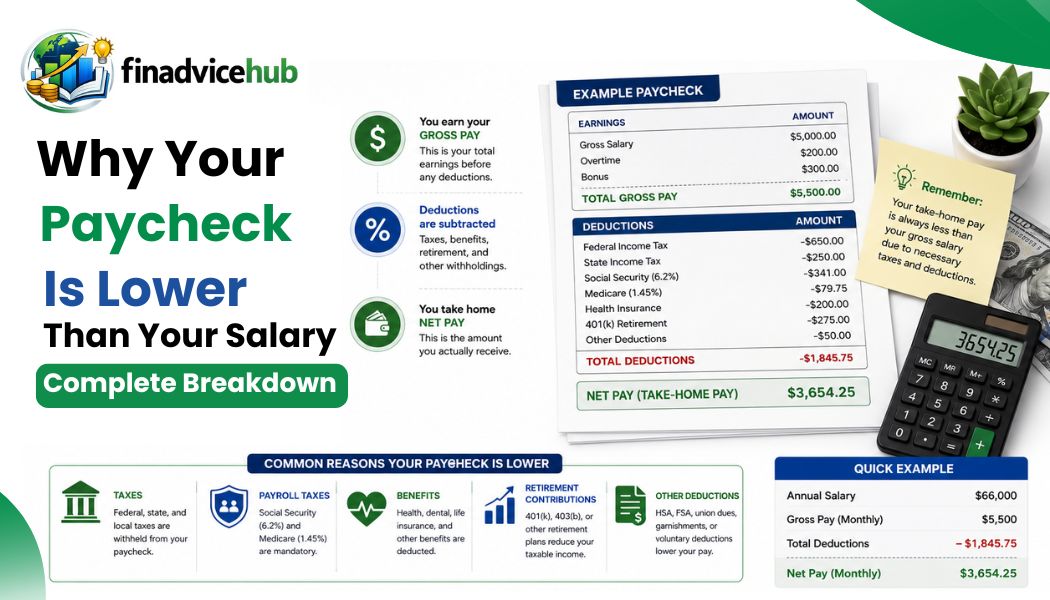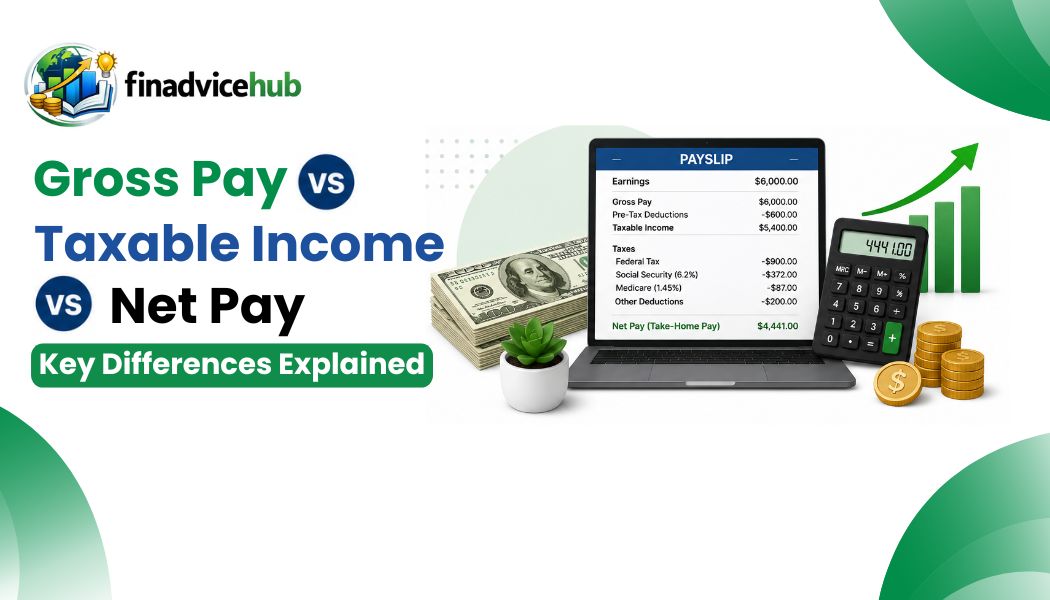

When you receive a job offer, the listed salary is rarely the amount of money that actually lands in your bank account on payday. Most workers look at their pay stubs and wonder where a significant portion of their earnings went; in fact, official survey data from the U.S. Bureau of Labor Statistics (BLS) shows that employee benefits and payroll withholdings account for over 30% of total compensation for American workers. The main driver behind this difference between your gross pay and net pay is your workplace compensation package, specifically how various employee perks interact with your routine payroll deductions.
Understanding how benefits affect paycheck amounts is essential for effective personal budgeting and long-term financial planning. While seeing lower net pay can feel disappointing at first glance, taking full advantage of workplace programs offers important safety nets and tax advantages that far outweigh immediate costs. This complete breakdown explores how health coverage, retirement savings, and voluntary programs shape your bottom line.
What Are Employee Benefits in a Paycheck
To evaluate your earnings accurately, you first need to look at what workplace perks actually represent on your pay stub. Employers offer these programs to support your physical, mental, and financial benefits, but they directly interact with your money during every pay period.
Definition of benefits
Employee benefits are non-wage compensation provided to employees in addition to their regular salaries or hourly wages. These programs include health coverage, retirement accounts, paid time off, and life insurance. When you enroll in these options, your portion of the cost is usually managed through automatic benefits and payroll deductions.
Types of benefits
Workplace options generally fall into two categories: monetary and non-monetary perks. Monetary perks include retirement contributions, stock options, and insurance premiums, which create direct paycheck deductions. Non-monetary perks include flexible work hours and remote work arrangements.
| Benefit Category | Common Examples | Direct Paycheck Impact |
| Health & Wellness | Medical, Dental, Vision, HSA | Lowers net pay (Pre-tax) |
| Financial Security | 401(k), 403(b), Stock Options | Lowers net pay (Pre or Post) |
| Protection & Insurance | Term Life, Disability | Lowers net pay (Usually Post) |
| Tax-Advantage Accounts | FSA, Commuter Benefits | Lowers net pay (Pre-tax) |
Why employers offer benefits
Employers offer comprehensive coverage to attract top talent, support employee health, and build workforce stability. Additionally, offering group coverage gives companies corporate tax advantages, creating a system that supports both the business and its employees.
Benefits vs salary
Your base salary is the fixed amount you earn for performing your job duties, whereas your total compensation includes your salary plus the total monetary value of all your perks. Comparing salary vs benefits total compensation gives you a much clearer picture of what a job offer is actually worth than looking at base earnings alone. When you see total compensation explained, it becomes obvious that your actual value extends far beyond base pay.
How Benefits Are Deducted From Your Paycheck
The deduction process happens automatically behind the scenes every pay period. Knowing how these subtractions work helps you track your earnings accurately and manage monthly expenditures.
Payroll deduction process
During onboarding, you select your coverage choices and choose specific contribution percentages or dollar amounts. During each pay cycle, payroll systems subtract these costs from your gross earnings before depositing your net pay into your bank account.
Pre-tax vs post-tax benefits
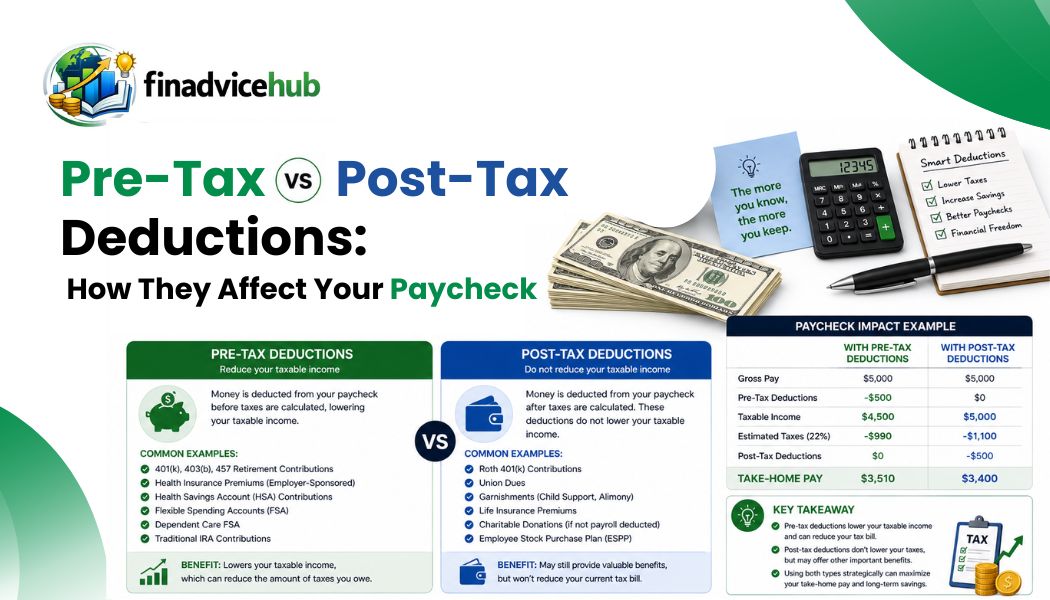
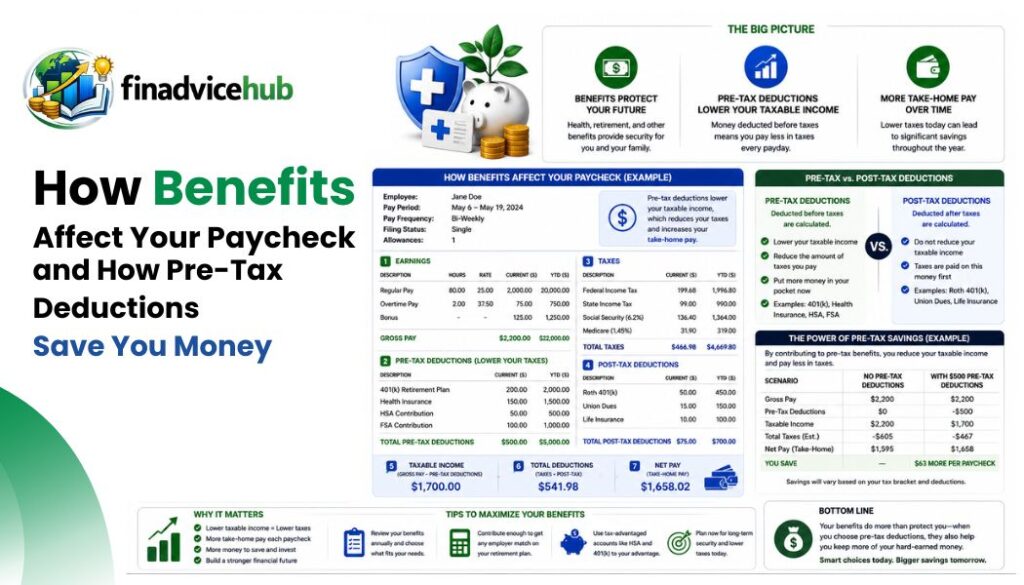
Understanding pre tax benefits vs post tax benefits paycheck rules is critical because it changes how much tax you owe each pay period:
- Pre-tax benefits: Money is withheld from your gross pay before income and payroll taxes are calculated, lowering your overall taxable income.
- Post-tax benefits: Money is subtracted after all taxes have been calculated and removed from your earnings, such as with Roth 401(k) accounts.
Timing of deductions
Most employee benefits deductions paycheck schedules match your regular pay frequency, whether weekly, bi-weekly, or semi-monthly. If you earn a fixed monthly salary, total annual plan costs are divided evenly across all pay periods to keep your take-home pay steady.
Example deduction flow
Suppose your gross earnings for a pay period are $2,000. If you choose $150 in pre-tax health insurance premiums and $100 in pre-tax retirement contributions, your taxable income drops to $1,750. Taxes are then calculated on this lower $1,750 amount, reducing your immediate tax burden before any post-tax choices are subtracted.
Health Insurance and Its Paycheck Impact
Health coverage is often the largest single deduction on a worker’s pay stub. Examining how health insurance affects salary reveals how premium choices balance monthly costs against medical protection.
Monthly premium deductions
Your health insurance premium is the set amount paid to keep coverage active. This cost is split evenly across your yearly paychecks. Choosing a traditional plan with comprehensive coverage results in higher per-check deductions, whereas high-deductible plans lower immediate payroll subtractions. Many workers ask how health insurance reduces paycheck totals so significantly; it is because comprehensive care requires higher shared risk pool contributions.
Employer contribution
Companies rarely require employees to cover the full price of medical coverage. Evaluating how employer benefits impact salary demonstrates that organizations typically pay 70% to 80% of an employee’s total health premium, making group plans far more affordable than individual coverage on the private market.
Cost variations
Your overall healthcare costs depend heavily on your chosen tier of coverage and plan structure.
| Coverage Level | Average Employee Monthly Cost | Average Employer Contribution |
| Employee Only | $100 – $200 | $450 – $600 |
| Employee + Spouse | $250 – $450 | $700 – $950 |
| Family Coverage | $400 – $750 | $1,100 – $1,500 |
Example calculation
If your total health coverage premium is $600 per month and your employer pays $480, your remaining share is $120 per month. If you are paid bi-weekly, payroll subtracts $60 in pre-tax funds from each check to cover your portion.
Retirement Contributions (401k) and Paycheck Impact
Saving for retirement lowers your current spendable earnings, but it remains one of the most effective ways to build personal wealth over time.
Pre-tax contributions
When you put money into a traditional 401(k), those funds are subtracted straight from your gross pay before taxes are applied. Understanding how 401k contributions affect take-home pay is essential: a $200 savings contribution lowers your gross pay by $200, but your actual take-home pay drops by a smaller amount (often around $150) due to immediate tax savings.
Employer matching
Many employers match employee retirement contributions up to a set percentage of salary. For example, if your company matches 100% of contributions up to 4% of your salary, contributing 4% doubles your saved money instantly at no extra cost to your household budget.
Long-term benefits
While building retirement savings reduces immediate income, pre-tax investments grow over time without annual tax friction. This creates long-term security while keeping your current taxable income lower. Analyzing the 401k impact on take-home pay shows that tax savings cushion the reduction in spendable income.
Example impact
If you earn $5,000 monthly and contribute 6% to a pre-tax retirement plan, $300 goes into your account. Assuming a 22% marginal tax rate, that $300 contribution reduces your spendable check by only $234, saving you $66 in current taxes.
Other Common Benefits That Affect Paychecks
Beyond medical plans and retirement savings, several other routine coverage choices alter your final earnings.
Dental and vision insurance
Dental and vision insurance options are relatively inexpensive compared to health insurance. Dental deductions usually range from $10 to $30 per paycheck, while vision options cost between $5 and $15 per check, both typically deducted on a pre-tax basis.
Life insurance
Employers often supply basic term life insurance equal to one year’s salary at no cost. If you purchase supplemental coverage, those additional premiums are usually deducted post-tax.
Disability insurance
Short-term and long-term disability plans protect your earnings if illness or injury prevents you from working. Deducting these small premiums on a post-tax basis ensures that any future disability benefit payouts arrive tax-free.
Flexible spending accounts
Flexible Spending Accounts (FSAs) let you save pre-tax money for expected medical or dependent care costs. This lowers your taxable income while reserving funds for health expenses.
Benefits vs Take-Home Pay Trade-Off
Selecting coverage requires balancing your immediate spending cash against future protection. Conducting a structured benefits vs paycheck tradeoff analysis helps optimize overall cash flow.
Lower paycheck vs long-term value
Opting out of workplace programs yields higher net pay today, but leaves you vulnerable to sudden emergency expenses. Uncovered medical events or inadequate retirement savings can cost far more over time than modest paycheck deductions.
| Financial Metric | High Benefits Strategy | Minimal Benefits Strategy |
| Immediate Take-Home Pay | Lower | Higher |
| Out-of-Pocket Emergency Risk | Low (Protected) | High (Unprotected) |
| Annual Tax Burden | Lower (Optimized) | Higher |
| Long-Term Wealth Potential | High Growth | Lower Growth |
Tax advantages
Pre-tax options lower your taxable gross pay, occasionally placing you in a lower effective tax bracket. These tax reductions offset a portion of your benefit costs, giving you reliable protection at a discount.
Cost vs benefit analysis
To see if an option is worthwhile, compare its per-paycheck cost against individual market rates. Group programs provided by employers are almost always significantly cheaper than buying private policies.
Real-life scenario
Consider an worker earning $60,000 annually who enrolls in an HSA-eligible health plan and saves $2,000 pre-tax per year. They lower their annual federal tax bill by roughly $440 while building a reserved savings pool for future medical needs.
Real Paycheck Example With Benefits Breakdown
To visualize how these mechanics work together, let us review a realistic paycheck benefits breakdown for a salaried worker.
Salary setup
Imagine an employee earning $52,000 per year, paid on a bi-weekly schedule (26 pay periods per year). Their base gross pay is $2,000 per check before taxes and deductions.
Applying benefits
The employee chooses the following options per pay period:
- Health Insurance: $80 (Pre-tax)
- Dental & Vision: $20 (Pre-tax)
- 401(k) Retirement: 5% of gross = $100 (Pre-tax)
- Flexible Spending Account: $50 (Pre-tax)
Deduction impact
Here is a real paycheck benefits breakdown example using a clear benefits impact calculation model:
| Calculation Step | Amount |
| Gross Base Earnings | $2,000.00 |
| Pre-Tax Deductions Total | – $250.00 |
| Adjusted Taxable Income | $1,750.00 |
| Estimated Taxes (Income + FICA) | – $350.00 |
| Post-Tax Deductions (Life Ins.) | – $10.00 |
| Final Net Take-Home Pay | $1,390.00 |
Final net pay
This benefits deduction example paycheck shows that despite $250 in pre-tax contributions, net income remains strong because taxable gross income fell to $1,750. Understanding your salary after benefits deductions clarifies the full compensation benefits impact on your overall household budget.
How to Choose the Right Benefits
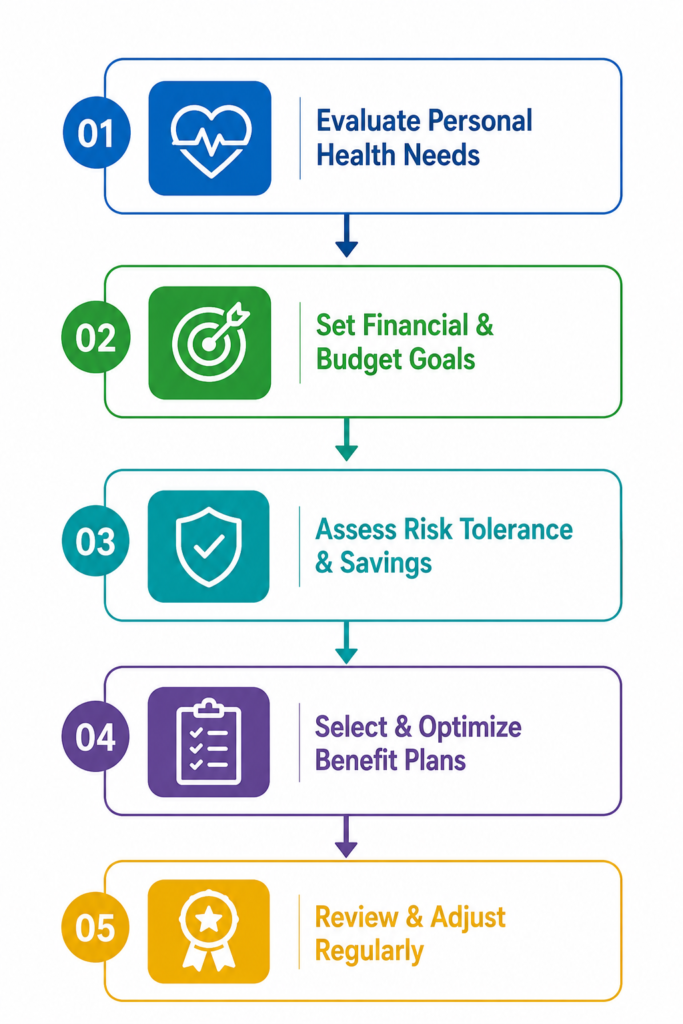
Selecting coverage during enrollment can feel complex. Evaluating key personal metrics helps ensure you choose options that support your personal budget.
Financial goals
Align your coverage with your immediate budget goals and long-term strategy. If you need to know how to choose benefits effectively, begin by assessing whether immediate cash flow or long-term wealth building takes priority right now.
Health needs
Review your household’s expected medical needs for the coming year. If you anticipate regular doctor visits or prescriptions, paying higher paycheck premiums for a lower deductible plan can prevent high out-of-pocket costs.
Risk tolerance
Evaluate your comfort level with unexpected medical bills. If a sudden emergency expense would harm your finances, comprehensive coverage offers financial safety. If you maintain strong emergency savings, higher-deductible plans with lower deductions may work best.
Budget constraints
Ensure your take-home pay covers core living expenses like housing, groceries, and debt payments. Never let optional deductions compromise your ability to meet essential monthly obligations.
How to Optimize Your Paycheck With Benefits
Once you understand payroll mechanics, you can adjust options to balance spendable income with tax savings.
Maximizing tax advantages
Use pre-tax tools like Health Savings Accounts (HSAs) and Flexible Spending Accounts (FSAs). HSAs offer pre-tax contributions, tax-free growth, and tax-free withdrawals for qualified medical costs, lowering overall taxes while building health savings.
Avoiding unnecessary deductions
Review pay stubs regularly to avoid paying for unneeded coverage. For instance, if you are covered under a partner’s plan, declining duplicate medical coverage leaves more cash in your check.
Balancing savings and income
Contribute enough to your 401(k) to receive your full company match, securing an immediate return. Once you receive the full match, evaluate whether remaining extra funds should go toward paying down high-interest debt or building short-term emergency cash reserves.
Reviewing annually
Your health needs and family budget change over time. Use every annual open enrollment window to review deductions, adjust savings rates, and verify your choices still match your goals.
Common Mistakes When Selecting Benefits
Avoiding standard enrollment mistakes prevents unnecessary costs and protects spendable income.
Overpaying for insurance
Selecting high-tier medical plans when you rarely visit the doctor needlessly reduces take-home pay. For healthy individuals, a High Deductible Health Plan paired with an HSA lowers paycheck deductions while building savings.
Ignoring employer match
Failing to contribute enough to gain your full company match leaves free compensation behind. It is essentially turning down extra income that builds long-term wealth.
Not understanding tax impact
Passing up pre-tax accounts because gross pay decreases ignores tax savings. Understanding tax-advantaged accounts ensures you do not pay unnecessary income taxes on money set aside for healthcare or childcare.
Choosing wrong plans
Selecting options simply because coworkers chose them leads to mismatched coverage. Evaluating your unique medical history and budget helps construct an optimized coverage strategy.
Conclusion
Employee benefits may reduce the amount you see deposited into your bank account each payday, but they are not simply deductions taking money away from your earnings. They represent a larger part of your total compensation and provide financial protection, tax advantages, and long-term security. Health insurance, retirement contributions, and other workplace programs can lower your immediate take-home pay, yet they often save you money and reduce financial risks that could be much more expensive in the future.
The key is not to focus only on the final number on your paycheck. A smaller paycheck with valuable benefits can often be worth more than a higher salary with little protection or savings support. By understanding how benefits affect paycheck totals, taxes, and financial goals, you can make smarter enrollment decisions and create a compensation plan that works for both your present needs and your future stability.
FAQs
Do employee benefits reduce your paycheck?
Yes, voluntary contributions toward healthcare, retirement, and flexible spending accounts directly lower your net pay. However, do benefits reduce take-home pay entirely? Pre-tax choices lower your taxable income, reducing the total amount of income tax subtracted from your pay.
How does health insurance affect take-home pay?
Health premiums are typically subtracted from gross earnings on a pre-tax basis. This reduces net earnings, but because funds are removed before tax calculations, it lowers your taxable base and reduces overall tax liability.
Is 401(k) deducted before or after tax?
Traditional 401(k) contributions are deducted pre-tax, reducing current taxable income. Roth 401(k) contributions are subtracted post-tax; they do not lower current tax obligations, but future withdrawals in retirement arrive tax-free.
Are benefits worth the cost?
Yes. Workplace coverage offers significantly better value than individual market plans. Group rates, company contributions, and tax savings ensure every dollar subtracted provides major financial protection. If you are debating should I take employer benefits, evaluating group rate discounts usually confirms their value.
How much do benefits cost per paycheck?
Costs depend on plan design, location, and coverage tier. If you wonder how much do benefits cost or how much benefits cost per paycheck, individual medical plans typically range from $50 to $150 per check, while family coverage and optional perks can exceed $300 per pay period.
What benefits reduce taxable income?
Pre-tax options that lower taxable income include traditional 401(k) contributions, health premiums, HSAs, FSAs, and pre-tax commuter passes.
Can I change my benefits anytime?
Generally no. You can change coverage during your employer’s annual open enrollment window or after experiencing a qualifying life event, such as marriage, birth of a child, or loss of alternate coverage.
How do I choose the best benefits plan?
Evaluate your health needs, annual medical costs, and household budget. Contribute enough to claim any 401(k) employer match, and weigh premiums against deductibles to balance immediate pay against financial safety. Understanding how benefits affect paycheck outcomes alongside the benefits vs. salary tradeoff helps you choose the right balance for your lifestyle.