
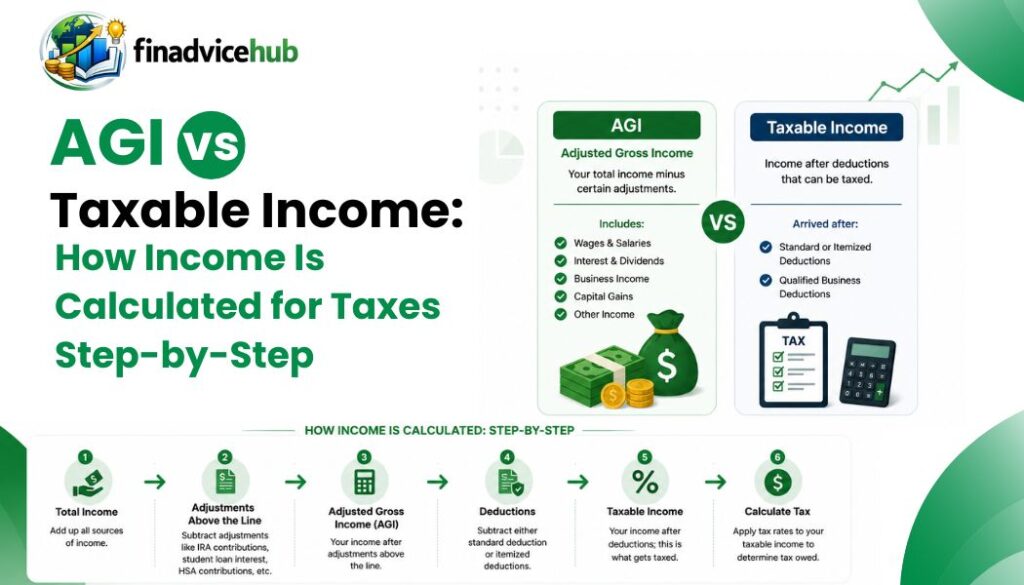
Understanding AGI vs taxable income is one of the most important parts of learning how the U.S. tax system works. Yet it is also one of the most misunderstood topics among taxpayers. Many people assume that the amount they earn during the year is the same amount the IRS taxes. In reality, income moves through several stages before the government calculates the final tax bill.
A taxpayer might earn $100,000 during the year, report an Adjusted Gross Income (AGI) of $90,000, end up with taxable income of $75,000, and ultimately owe taxes on only a portion of that amount after credits are applied. This multi-step process often creates confusion because taxpayers encounter several different income figures on their tax returns.
The difference between gross income, AGI, and taxable income affects everything from tax bracket placement to eligibility for deductions and credits. It also influences retirement planning, self-employment tax strategies, healthcare subsidy eligibility, education benefits, and overall tax planning decisions.
This guide provides a complete breakdown of AGI vs taxable income, including the adjusted gross income vs taxable income difference, calculation formulas, IRS methodology, examples, planning strategies, and practical ways to understand how income flows through the federal tax system.
By the end of this blog, you will understand:
- The difference between gross income, AGI, and taxable income
- How to calculate AGI
- How taxable income is calculated
- The complete IRS income calculation process
- How deductions and credits affect taxes
- How AGI impacts tax credit eligibility
- How to optimize taxable income legally
- How income flows through a tax return from start to finish
Understanding Income Types in the US Tax System
The federal tax system follows an income hierarchy. Before understanding deductions, credits, and tax brackets, taxpayers must first understand the three major income figures used throughout the tax return.
What is gross income?
Gross income is the total amount of taxable income earned during the tax year before any adjustments or deductions are applied.
Under IRS income definitions, gross income includes most forms of compensation and earnings received throughout the year.
Examples of gross income include:
- Wages and salaries
- Bonuses
- Tips
- Self-employment income
- Consulting income
- Freelance earnings
- Rental income
- Interest income
- Dividend income
- Capital gains
- Unemployment compensation
- Certain retirement distributions
Gross income serves as the foundation of the entire tax calculation process. Every tax return begins with determining total income from all taxable sources.
For example, consider a taxpayer who earns:
| Income Source | Amount |
| Salary | $80,000 |
| Freelance Income | $8,000 |
| Interest Income | $1,000 |
| Dividend Income | $1,000 |
Total Gross Income: $90,000
At this stage, no deductions or adjustments have been applied.
When comparing gross income vs AGI vs taxable income, gross income is generally the highest number because no reductions have yet occurred.
Many taxpayers mistakenly assume gross income is the amount taxed by the IRS. However, gross income is simply the starting point in the tax computation flow.
What is adjusted gross income (AGI)
Adjusted Gross Income, commonly called AGI, represents income after specific IRS-approved adjustments have been subtracted from gross income.
AGI is one of the most important figures on a federal tax return because it acts as a gateway number for numerous tax benefits.
The IRS allows certain expenses and contributions to reduce income before taxable income is determined. These reductions are called income adjustments or above-the-line deductions.
Common AGI adjustments include:
- Traditional IRA contributions
- Health Savings Account (HSA) contributions
- Student loan interest deductions
- Self-employed health insurance deductions
- SEP IRA contributions
- SIMPLE IRA contributions
- Certain educator expenses
Because these adjustments occur before taxable income is calculated, they can significantly influence future tax calculations.
For example:
Gross Income: $90,000
Adjustments:
- IRA contribution: $4,000
- HSA contribution: $3,000
Total Adjustments: $7,000
AGI:
$90,000 − $7,000 = $83,000
This process illustrates the first major reduction in the tax system.
AGI is particularly important because many tax benefits are based on AGI thresholds. This is one reason taxpayers frequently ask why AGI matters in taxes.
What is taxable income
Taxable income is the amount of income that remains after deductions have been subtracted from AGI. This is the figure the IRS uses when applying federal income tax brackets. Taxable income represents your actual taxable earnings for federal income tax purposes.
After AGI is calculated, taxpayers generally reduce it further through either:
- Standard deduction
- Itemized deductions
Suppose a taxpayer has:
AGI = $83,000
Standard Deduction = $15,000
Taxable Income:
$83,000 − $15,000 = $68,000
Although the taxpayer earned $90,000 during the year, only $68,000 becomes subject to federal income tax calculations. Understanding this distinction is essential for understanding AGI vs taxable income.
Key differences between income types
The difference between gross income AGI and taxable income can be summarized through the income hierarchy used by the IRS.
| Income Type | Purpose | Reductions Applied |
| Gross Income | Starting point | None |
| AGI | Income after adjustments | Income adjustments |
| Taxable Income | Income subject to tax | Adjustments and deductions |
The adjusted gross income vs taxable income difference lies in where each figure appears within the tax calculation process. AGI determines eligibility for many credits and deductions. Taxable income determines how much income is actually taxed.
Why this distinction matters
Understanding the distinction between these income figures provides several benefits.
Taxpayers who understand the relationship between AGI and taxable income can:
- Estimate taxes more accurately
- Plan retirement contributions strategically
- Understand tax bracket exposure
- Improve tax planning decisions
- Evaluate tax-saving opportunities
- Preserve eligibility for credits and deductions
Without understanding this process, many taxpayers struggle to understand why their reported income differs from the amount ultimately taxed.
How to Calculate Adjusted Gross Income (AGI)
Starting with total income
The first step in the AGI calculation process is determining total gross income.
Every taxable income source must be included.
Common sources include:
- Employment income
- Self-employment income
- Investment income
- Rental income
- Business income
- Retirement distributions
This total becomes the starting point for the AGI calculation steps used by the IRS.
For example:
Salary: $85,000
Freelance Income: $10,000
Interest Income: $2,000
Gross Income:
$97,000
Above-the-line deductions explained
Above-the-line deductions are deductions claimed before AGI is calculated. These deductions are valuable because they lower AGI directly. Unlike itemized deductions, taxpayers generally do not need to choose between standard and itemized deductions to receive these benefits. These deductions help reduce adjusted income early in the tax computation flow.
Examples include:
- Traditional IRA contributions
- HSA contributions
- Self-employed health insurance
- Student loan interest
- Certain retirement plan contributions
Many taxpayers refer to these deductions as pre-tax deductions because they reduce income before later calculations occur.
Common AGI Adjustments
One of the most effective ways to reduce your tax burden is by taking advantage of adjustments that lower your Adjusted Gross Income (AGI). These adjustments are often called above-the-line deductions because they are subtracted from gross income before AGI is calculated. Lowering AGI can provide a double benefit: it reduces taxable income indirectly and may improve eligibility for valuable tax credits and deductions that have AGI-based income limits.
The following are some of the most common AGI adjustments available to taxpayers.
Retirement Contributions
Contributions to certain retirement accounts can reduce your AGI while helping you save for the future. Traditional retirement plans are particularly valuable because they provide an immediate tax benefit in the year the contribution is made.
For example, if your gross income is $80,000 and you contribute $5,000 to a qualifying traditional retirement account, your AGI may be reduced to $75,000, assuming you meet the eligibility requirements.
Reducing AGI through retirement contributions can also help preserve eligibility for other tax benefits that phase out at higher income levels.
Traditional IRA Contributions
Contributions to a Traditional Individual Retirement Account (IRA) are among the most widely used AGI reduction strategies. Depending on your income level, filing status, and participation in an employer-sponsored retirement plan, some or all of your contribution may be deductible.
For example:
- Gross Income: $90,000
- Traditional IRA Contribution: $6,000
AGI Calculation:
$90,000 − $6,000 = $84,000 AGI
In addition to lowering current-year AGI, traditional IRA contributions allow investments to grow tax-deferred until retirement.
HSA Contributions
Health Savings Accounts (HSAs) offer one of the most tax-efficient opportunities available under the tax code. Contributions made to an HSA generally reduce AGI and can be used to pay for qualified medical expenses.
HSAs are often referred to as providing a “triple tax advantage” because:
- Contributions may be tax-deductible
- Investment growth can be tax-free
- Qualified withdrawals are generally tax-free
For example:
- Gross Income: $75,000
- HSA Contribution: $3,500
AGI:
$75,000 − $3,500 = $71,500
This adjustment not only lowers AGI but can also help taxpayers save for future healthcare costs.
Student Loan Interest
Taxpayers who are repaying qualified education loans may be able to deduct a portion of the interest paid during the year. This deduction is especially valuable because it can be claimed even if the taxpayer takes the standard deduction.
For example:
- Gross Income: $65,000
- Student Loan Interest Deduction: $1,500
AGI:
$65,000 − $1,500 = $63,500
However, income limits may reduce or eliminate this deduction for higher-income taxpayers. Because the deduction lowers AGI directly, it may also improve eligibility for other tax benefits.
Self-Employed Health Insurance
Self-employed individuals often pay for their own health insurance coverage rather than receiving benefits through an employer. Under certain conditions, premiums paid for medical, dental, and qualifying long-term care insurance may be deductible as an AGI adjustment.
This deduction can provide significant savings because healthcare costs are often substantial for business owners, freelancers, and independent contractors.
For example:
- Net Self-Employment Income: $85,000
- Health Insurance Premiums: $6,000
AGI:
$85,000 − $6,000 = $79,000
This adjustment helps reduce adjusted income before taxable income is calculated.
Self-Employed Retirement Plans
Self-employed taxpayers have access to several retirement plans that can generate substantial AGI reductions while building long-term retirement savings.
Common options include:
- SEP IRA
- SIMPLE IRA
- Solo 401(k)
Because contribution limits for self-employed retirement plans are often higher than those for traditional IRAs, these plans can significantly reduce AGI.
For example:
- Net Business Income: $120,000
- SEP IRA Contribution: $15,000
AGI:
$120,000 − $15,000 = $105,000
For freelancers, consultants, and business owners, this is often one of the most effective answers to the question of how to lower AGI legally.
Why AGI Adjustments Matter
Many taxpayers focus only on deductions that reduce taxable income, but AGI adjustments can be even more powerful because they affect earlier stages of the tax computation flow.
Lower AGI may:
- Reduce taxable income indirectly
- Increase eligibility for tax credits
- Prevent phase-outs of certain benefits
- Improve access to education credits and healthcare subsidies
- Reduce overall tax liability
Understanding these adjustments is a critical part of learning how AGI is calculated step by step, maximizing tax benefits, and developing effective tax planning strategies. By identifying and claiming all eligible AGI adjustments, taxpayers can often lower both their AGI and their eventual taxable income while remaining fully compliant with IRS rules.
Step-by-step AGI formula
AGI Formula
AGI = Gross Income − Income Adjustments
This formula forms the foundation of the IRS income calculation process.
The formula remains consistent regardless of filing status.
AGI Calculation Example
Gross Income = $97,000
IRA Contribution = $4,000
HSA Contribution = $3,000
Student Loan Interest = $1,000
Total Adjustments = $8,000
AGI:
$97,000 − $8,000 = $89,000
Example calculation
This example demonstrates how to calculate AGI and taxable income with example figures.
A taxpayer earns:
Salary: $95,000
Interest Income: $1,500
Freelance Income: $3,500
Gross Income:
$100,000
Adjustments:
IRA Contribution: $5,000
HSA Contribution: $3,000
Student Loan Interest: $1,000
Total Adjustments:
$9,000
Final AGI:
$91,000
This illustrates how AGI is calculated step by step and shows the impact of income adjustments on overall taxable earnings.
How to Calculate Taxable Income
Subtracting standard or itemized deductions
Once AGI has been determined, the next stage involves deductions.
Taxpayers typically choose between:
Standard deduction
A fixed deduction established by Congress.
Itemized deductions
Specific deductible expenses such as:
- Mortgage interest
- Charitable contributions
- State and local taxes
- Certain medical expenses
The larger deduction generally produces the lower taxable income.
Applying additional adjustments
Depending on the tax year and taxpayer circumstances, additional qualified deductions may affect taxable income.
These adjustments occur after AGI has already been calculated.
Taxable income formula
Formula
Taxable Income = AGI − Standard Deduction or Itemized Deductions
This is the primary taxable income formula USA taxpayers use.
It is also the standard formula to calculate taxable income from AGI.
Example calculation
Assume:
AGI = $91,000
Standard Deduction = $15,000
Taxable Income:
$91,000 − $15,000 = $76,000
Final taxable income result
Although the taxpayer earned $100,000, only $76,000 remains subject to federal income tax calculations.
This illustrates the difference between:
- Gross Income = $100,000
- AGI = $91,000
- Taxable Income = $76,000
This example clearly demonstrates the step by step AGI vs taxable income calculation process.
AGI vs Taxable Income: Key Differences Explained
Although AGI and taxable income are closely related, they serve very different purposes within the U.S. tax system. Understanding where each number appears in the tax computation flow can help taxpayers make better financial decisions and avoid confusion when reviewing tax returns.
Many taxpayers see AGI and assume it represents the amount of income they are taxed on. Others mistakenly believe taxable income is simply their annual salary. Neither assumption is correct.
The relationship between these figures becomes easier to understand when viewed as stages in a tax calculation process rather than separate concepts.
Calculation stage differences
The biggest distinction between AGI and taxable income is where each figure appears in the IRS income calculation workflow.
AGI is calculated first.
Taxable income is calculated afterward.
The IRS begins by determining gross income from all taxable sources. Next, eligible income adjustments reduce gross income to create AGI. Only after AGI is determined are standard deductions or itemized deductions applied.
The calculation sequence looks like this:
Income Calculation Sequence
Gross Income
↓
Income Adjustments
↓
AGI
↓
Standard or Itemized Deduction
↓
Taxable Income
This sequence highlights the adjusted gross income vs taxable income difference more clearly than simply comparing definitions.
Impact on tax brackets
Another major difference involves tax brackets. Federal tax brackets do not apply to gross income. Federal tax brackets do not apply directly to AGI. Instead, tax brackets apply to taxable income. This distinction matters because deductions can significantly reduce the amount of income exposed to higher tax rates.
For example:
Example
Gross Income = $120,000
Adjustments = $10,000
AGI = $110,000
Standard Deduction = $15,000
Taxable Income = $95,000
In this scenario, tax brackets apply to $95,000 rather than $120,000.
Understanding how taxable income is calculated helps taxpayers better estimate future tax obligations and evaluate tax-saving opportunities.
Role in tax credits eligibility
AGI plays a critical role in determining eligibility for many tax credits and deductions. The IRS frequently uses AGI as an eligibility threshold.
Examples include:
- Premium Tax Credit
- Education credits
- Retirement Saver’s Credit
- Child Tax Credit phase-outs
- Roth IRA eligibility limits
This is why understanding how AGI affects tax credits eligibility is so important.
A taxpayer with an AGI slightly below a phase-out threshold may qualify for a valuable credit, while another taxpayer with a slightly higher AGI may lose all or part of the benefit.
Differences in tax planning
Tax planning strategies often focus on either AGI reduction or taxable income reduction.
AGI-focused strategies may include:
- Traditional IRA contributions
- HSA contributions
- SEP IRA contributions
- Self-employed health insurance deductions
Taxable-income-focused strategies may include:
- Itemized deductions
- Charitable contributions
- Mortgage interest deductions
- State tax deductions
This distinction helps answer questions about what reduces AGI vs taxable income. Some strategies reduce AGI directly. Others reduce taxable income after AGI has already been calculated.
Comparison table
| Feature | AGI | Taxable Income |
| Based on Gross Income | Yes | Yes |
| Reduced by Income Adjustments | Yes | Included |
| Reduced by Standard Deduction | No | Yes |
| Reduced by Itemized Deductions | No | Yes |
| Used for Credit Eligibility | Frequently | Sometimes |
| Used for Tax Brackets | No | Yes |
| Used to Calculate Federal Tax | Indirectly | Directly |
| Appears Earlier in Tax Calculation | Yes | No |
| Used for Phase-Out Rules | Often | Less Frequently |
| Represents Income Actually Taxed | No | Yes |
Full Tax Calculation Flow from Income to Tax Liability
One of the most effective ways to understand AGI vs taxable income is to view the entire tax calculation process from beginning to end.
Most taxpayers focus only on the final tax bill. However, the IRS uses several calculation stages before determining tax liability.
Understanding this complete process helps taxpayers make better financial decisions and identify opportunities to optimize their tax situation legally.
Income → AGI → Taxable Income → Tax
The federal tax system follows a structured progression.
Every taxpayer begins with gross income.
That income is gradually reduced through adjustments and deductions before tax rates are applied.
The process can be summarized as follows:
Complete Tax Computation Flow
Gross Income
↓
Income Adjustments
↓
Adjusted Gross Income (AGI)
↓
Standard Deduction or Itemized Deductions
↓
Taxable Income
↓
Tax Brackets
↓
Tentative Tax
↓
Tax Credits
↓
Final Tax Liability
This represents the complete income hierarchy tax system USA uses for individual tax returns.
Role of deductions and credits
Many taxpayers confuse deductions and credits, even though they affect taxes differently.
Deductions
Deductions reduce income.
Examples:
- Standard deduction
- Mortgage interest
- Charitable contributions
- State tax deductions
Deductions lower taxable income before taxes are calculated.
Credits
Credits reduce taxes directly.
Examples:
- Child Tax Credit
- Education Credits
- Premium Tax Credit
Tax credits generally provide greater tax savings because they reduce the tax bill dollar-for-dollar.
Understanding this distinction is essential when reviewing tax deductions explained resources.
Where tax brackets apply
Tax brackets are applied only after taxable income has been determined. This is one of the most misunderstood concepts in personal taxation. Many taxpayers incorrectly assume their entire salary is taxed at their highest marginal tax rate.
In reality, federal tax brackets apply progressively to taxable income. This means only portions of income are taxed at higher rates. Understanding how tax brackets work helps taxpayers estimate taxes more accurately and avoid common misconceptions.
Final tax liability calculation
The final tax liability is determined after credits are applied.
Consider the following example:
Example
Taxable Income = $80,000
Tax Before Credits = $9,000
Child Tax Credit = $2,000
Education Credit = $1,000
Total Credits = $3,000
Final Tax Liability:
$9,000 − $3,000 = $6,000
This demonstrates how credits can significantly reduce taxes after taxable income has already been calculated.
Visualization of flow
The following visual summarizes the complete tax workflow.
Income Calculation Diagram
Gross Income
↓
Income Adjustments
↓
AGI
↓
Standard/Itemized Deduction
↓
Taxable Income
↓
Federal Tax Brackets
↓
Tentative Tax
↓
Tax Credits
↓
Final Tax Liability
This AGI vs taxable income visual flow explanation helps clarify the complete full income calculation breakdown USA taxpayers follow each year.
Real-Life Examples of AGI vs Taxable Income
The best way to understand the relationship between AGI and taxable income is through practical scenarios.
These examples show how income moves through the tax system under different circumstances.
Single filer example
Consider a taxpayer who earns a salary of $70,000.
Income Breakdown
Salary: $70,000
Traditional IRA Contribution: $4,000
HSA Contribution: $2,000
Total Adjustments: $6,000
AGI:
$70,000 − $6,000 = $64,000
Standard Deduction:
$15,000
Taxable Income:
$64,000 − $15,000 = $49,000
Although the taxpayer earned $70,000, federal income tax is calculated using taxable income of $49,000.
Married filer example
Married taxpayers often benefit from larger deductions and additional planning opportunities.
Household Example
Combined Employment Income: $150,000
IRA Contributions: $8,000
HSA Contributions: $4,000
Total Adjustments: $12,000
AGI:
$150,000 − $12,000 = $138,000
Standard Deduction:
$30,000
Taxable Income:
$138,000 − $30,000 = $108,000
This example highlights how deductions can significantly reduce taxable earnings.
Freelancer example
Understanding AGI vs taxable income for freelancers is particularly important because self-employed taxpayers have additional deduction opportunities.
Freelancer Scenario
Freelance Revenue: $120,000
Business Expenses: $25,000
Net Income: $95,000
SEP IRA Contribution: $8,000
Health Insurance Deduction: $4,000
AGI:
$95,000 − $12,000 = $83,000
Standard Deduction:
$15,000
Taxable Income:
$68,000
Freelancers often benefit greatly from strategic AGI planning because many deductions occur before AGI is calculated.
High-income example
Higher-income taxpayers frequently face AGI-based phase-outs.
High-Income Scenario
Gross Income: $350,000
Income Adjustments: $20,000
AGI: $330,000
Itemized Deductions: $35,000
Taxable Income: $295,000
At this income level, taxpayers often lose access to certain credits and deductions because of AGI limitations.
Low-income example
Low-income taxpayers may qualify for numerous credits based on AGI.
Example
Gross Income: $35,000
Income Adjustments: $2,000
AGI: $33,000
Standard Deduction: $15,000
Taxable Income: $18,000
A lower AGI may improve eligibility for valuable tax credits and government benefits.
These examples provide realistic AGI vs taxable income real examples USA taxpayers can use to understand how income flows through the tax return process.
How AGI Affects Tax Credits and Deductions
One of the biggest reasons taxpayers should understand AGI vs taxable income is that AGI often determines eligibility for valuable tax benefits. While taxable income is used to calculate tax liability, AGI acts as a screening mechanism for many credits, deductions, and tax-saving opportunities.
In practice, two taxpayers with similar taxable income may qualify for very different tax benefits simply because their AGIs differ.
This is why tax professionals frequently focus on AGI management as part of a broader tax planning strategy.
Credit eligibility thresholds
Many tax credits use AGI thresholds to determine whether a taxpayer qualifies.
The IRS uses AGI because it provides a more standardized measure of financial resources than gross income.
Common AGI-based credits include:
- Premium Tax Credit
- Child Tax Credit
- American Opportunity Tax Credit
- Lifetime Learning Credit
- Saver’s Credit
- Certain energy-related credits
For example, a taxpayer whose AGI falls below a specific threshold may qualify for the full value of a credit. Another taxpayer earning only slightly more may receive a reduced credit or lose eligibility altogether.
This demonstrates why understanding how AGI affects tax credits can be financially significant.
Phase-outs explained
A phase-out is a gradual reduction of a tax benefit as income rises.
Rather than ending abruptly, many credits and deductions decrease incrementally once AGI exceeds certain limits.
Example of a Phase-Out
Assume a tax credit provides:
- Full benefit below $80,000 AGI
- Reduced benefit between $80,000 and $100,000 AGI
- No benefit above $100,000 AGI
A taxpayer with an AGI of $79,000 receives the full credit.
A taxpayer with an AGI of $90,000 receives only part of the credit.
A taxpayer with an AGI of $101,000 receives no credit.
This explains why many tax planning strategies focus on lowering AGI rather than simply reducing taxable income.
Impact on deductions
Certain deductions are also affected by AGI.
Some tax provisions use AGI as a benchmark when determining:
- Deduction limitations
- Eligibility requirements
- Contribution limits
- Medical expense calculations
This illustrates the deductions and AGI relationship.
Lower AGI may increase access to deductions that become restricted at higher income levels.
Taxpayers often overlook this relationship and focus exclusively on reducing taxable income, even though AGI reduction may create additional tax-saving opportunities.
Planning Around AGI
Effective tax planning often involves managing Adjusted Gross Income (AGI) strategically. Since AGI serves as the foundation for numerous tax calculations, lowering it can create benefits that extend beyond simply reducing taxable income. A lower AGI may increase eligibility for tax credits, preserve deductions that phase out at higher income levels, and improve access to various tax-saving opportunities.
Strategic AGI planning does not involve hiding income or using questionable tax tactics. Instead, it focuses on making informed financial decisions that take advantage of legitimate provisions within the tax code. Understanding how to lower AGI legally is a key part of long-term tax planning because many tax benefits are linked directly to AGI rather than taxable income.
Tax professionals often evaluate AGI first when looking for ways to optimize a taxpayer’s overall tax position. Even a relatively small reduction in AGI can sometimes unlock credits or deductions worth hundreds or thousands of dollars.
Retirement Contributions
One of the most common AGI reduction strategies involves contributing to tax-advantaged retirement accounts.
Contributions to accounts such as:
- Traditional IRAs
- SEP IRAs
- SIMPLE IRAs
- Certain employer-sponsored retirement plans
may reduce AGI while helping taxpayers build retirement savings.
For example, if a taxpayer earns $90,000 and contributes $6,000 to a deductible Traditional IRA, AGI may be reduced to $84,000. Not only does this reduce current-year income, but it can also improve eligibility for AGI-sensitive tax benefits.
Retirement contributions are often considered one of the most effective methods for taxpayers seeking to lower AGI while simultaneously improving long-term financial security.
HSA Contributions
Health Savings Accounts (HSAs) provide another valuable opportunity to reduce AGI.
Eligible contributions to an HSA generally lower AGI and can be used for qualified medical expenses. Because HSA funds may grow tax-free and qualified withdrawals are typically tax-free, many tax professionals view HSAs as one of the most tax-efficient savings vehicles available.
For example:
- Gross Income: $75,000
- HSA Contribution: $4,000
New AGI:
$75,000 − $4,000 = $71,000
A lower AGI may improve eligibility for certain deductions, credits, and healthcare-related benefits.
Self-Employment Deductions
Business owners, independent contractors, and freelancers often have additional opportunities to reduce AGI through qualified business-related deductions.
Potential AGI-reducing deductions may include:
- Self-employed health insurance premiums
- SEP IRA contributions
- SIMPLE IRA contributions
- Solo 401(k) contributions
- Certain self-employment retirement plan contributions
For self-employed taxpayers, reducing AGI can be particularly valuable because it may affect both income tax calculations and eligibility for various tax benefits.
This is one reason understanding AGI vs taxable income for freelancers is so important. Freelancers frequently have more flexibility than employees when it comes to managing AGI through retirement contributions and business-related tax planning.
Income Timing
In some situations, taxpayers may benefit from strategically managing when income is recognized or when deductible expenses are incurred.
Examples may include:
- Delaying year-end bonuses into the following tax year
- Deferring self-employment income when appropriate
- Accelerating deductible expenses before year-end
- Managing capital gains and losses strategically
The goal is not to avoid taxes permanently but rather to manage income across tax years in a way that produces more favorable outcomes.
Income timing strategies can be especially useful for taxpayers approaching AGI thresholds that determine eligibility for credits or deductions.
Why AGI Planning Matters
Many taxpayers focus solely on reducing taxable income. However, because so many tax benefits are tied directly to AGI, lowering AGI can sometimes create larger overall tax savings than a comparable reduction in taxable income.
Effective AGI planning may help taxpayers:
- Preserve tax credits
- Avoid phase-outs
- Increase deduction eligibility
- Reduce overall tax liability
- Improve healthcare subsidy eligibility
- Maintain retirement contribution eligibility
This is why AGI management remains a central component of comprehensive tax planning.
Examples of AGI-Based Limits
One of the primary reasons AGI matters is that many tax benefits become limited or unavailable as AGI increases. The IRS uses AGI thresholds to determine whether taxpayers qualify for various credits, deductions, and tax-advantaged savings opportunities.
As income rises, certain benefits may be reduced gradually through phase-outs or eliminated once a specific AGI threshold is exceeded.
Understanding these limits is essential for taxpayers who want to maximize available tax benefits and avoid unexpected reductions in credits or deductions.
Roth IRA Eligibility
Direct contributions to a Roth IRA are subject to income limitations based on AGI. As AGI increases, the amount that can be contributed to a Roth IRA may be reduced. Once AGI exceeds the applicable limit, taxpayers may become ineligible for direct Roth IRA contributions altogether.
Because Roth IRAs offer tax-free qualified withdrawals in retirement, preserving eligibility can be an important financial planning objective.
For taxpayers approaching Roth IRA income limits, reducing AGI through retirement contributions or other adjustments may help maintain eligibility.
Education Credits
Several education-related tax benefits use AGI thresholds to determine eligibility.
Examples include:
- American Opportunity Tax Credit
- Lifetime Learning Credit
These credits may be reduced or phased out as AGI rises above specified levels.
For families paying college expenses, maintaining a lower AGI can significantly increase the value of available education benefits.
This illustrates another example of how AGI affects tax credits eligibility.
Healthcare Subsidies
Health insurance subsidies available through the Health Insurance Marketplace are heavily influenced by AGI.
Premium Tax Credit eligibility is generally based on household income measured against federal poverty guidelines. As AGI increases, subsidy amounts may decrease.
For some households, even a modest AGI reduction may result in meaningful healthcare savings.
Because healthcare subsidies can be worth thousands of dollars annually, AGI planning often plays a major role in overall financial planning.
Retirement Saver’s Credit
The Saver’s Credit is designed to encourage retirement savings among low- and moderate-income taxpayers.
Eligibility and credit amounts are based largely on AGI.
Taxpayers who contribute to retirement accounts while keeping AGI below applicable thresholds may qualify for this additional tax benefit.
In some cases, retirement contributions not only reduce AGI but also generate eligibility for the Saver’s Credit, creating a powerful combination of tax advantages.
Other AGI-Sensitive Tax Benefits
AGI also influences numerous other tax provisions throughout the tax code, including:
- Certain deduction limitations
- Education-related benefits
- Healthcare-related tax provisions
- State tax programs
- Income-based assistance programs
Because AGI serves as a benchmark for so many calculations, even small reductions can have ripple effects throughout a taxpayer’s overall tax situation.
These examples demonstrate the substantial AGI impact on credits and deductions throughout the federal tax system. Understanding these relationships helps taxpayers make informed decisions about retirement contributions, healthcare savings, business deductions, and other strategies designed to optimize their tax outcomes legally.
Strategies to Reduce AGI and Taxable Income
Tax planning is not simply about reducing taxes in the current year. Effective planning involves understanding where reductions occur within the tax computation flow and using legal strategies to optimize outcomes.
Many taxpayers ask:
- What reduces AGI vs taxable income?
- How can I lower AGI legally?
- How can I optimize taxable income?
The answer depends on where a particular deduction occurs within the tax return.
Retirement contributions
Retirement accounts remain one of the most effective tax planning tools available.
Contributions to qualifying retirement plans may reduce AGI directly.
Examples include:
- Traditional IRA contributions
- SEP IRA contributions
- SIMPLE IRA contributions
- Certain self-employed retirement plans
Example
Gross Income: $100,000
Traditional IRA Contribution: $6,000
AGI Reduction:
$100,000 → $94,000
Because AGI affects many credits and deductions, retirement contributions often provide multiple tax benefits simultaneously.
For taxpayers wondering how to lower AGI legally, retirement contributions are frequently among the most effective solutions.
Health savings accounts
Health Savings Accounts (HSAs) offer another valuable tax-planning opportunity.
HSA contributions may:
- Reduce AGI
- Grow tax-deferred
- Potentially provide tax-free withdrawals for qualified medical expenses
This creates a triple-tax advantage that makes HSAs particularly attractive.
Example
Income: $80,000
HSA Contribution: $4,000
New AGI:
$76,000
This reduction may improve eligibility for additional tax benefits.
Business expense deductions
Business owners and freelancers often have unique opportunities to reduce both AGI and taxable income.
Legitimate business expenses may include:
- Home office expenses
- Software subscriptions
- Professional services
- Equipment purchases
- Advertising costs
- Continuing education expenses
Proper documentation is essential because the IRS requires support for business deductions. This is especially important when analyzing AGI vs taxable income for freelancers.
Timing Income and Expenses
The timing of when income is received and when deductible expenses are paid can have a meaningful impact on taxes. While taxpayers cannot simply ignore income or create deductions that do not exist, they can often make legitimate financial decisions that shift income or expenses between tax years. These timing strategies may help reduce AGI, preserve eligibility for tax benefits, or lower taxable income in a particular year.
Timing strategies are especially valuable for self-employed individuals, business owners, investors, and taxpayers whose income fluctuates from year to year. Since many tax credits, deductions, and phase-outs are tied to AGI, even a modest reduction in income during a specific tax year can sometimes produce significant tax savings.
The goal of timing strategies is not to avoid taxes permanently but rather to manage when income is recognized and when deductions are claimed so that taxes are calculated more efficiently.
Deferring Income
Deferring income means postponing the receipt or recognition of income until a future tax year.
In some situations, delaying income can reduce current-year AGI and taxable income, particularly when a taxpayer expects to be in a lower tax bracket in the future or is approaching an AGI threshold that affects tax benefits.
Examples of income deferral strategies may include:
- Delaying year-end freelance invoices until January
- Postponing certain consulting payments
- Deferring bonuses when an employer allows it
- Delaying retirement account withdrawals when appropriate
- Managing the timing of business revenue recognition
For example, assume a freelancer expects to earn $95,000 during the current tax year and has a client willing to pay a $10,000 invoice either in December or January.
If the payment is received in January rather than December:
- Current-Year Income: $95,000 instead of $105,000
- AGI may be lower
- Eligibility for certain deductions or credits may be preserved
This can be particularly beneficial when a taxpayer is close to an AGI phase-out threshold.
However, income deferral strategies should always be evaluated carefully because delaying income may affect future tax years differently.
Accelerating Expenses
Accelerating expenses involves paying deductible expenses before the end of the current tax year rather than waiting until the following year.
Doing so may increase current-year deductions and reduce taxable income sooner.
Examples include:
- Making charitable donations before year-end
- Purchasing business equipment during the current tax year
- Paying deductible professional expenses before December 31
- Prepaying qualifying business expenses when allowed
- Scheduling deductible medical procedures within the current tax year
For self-employed individuals, accelerating legitimate business expenses may provide substantial tax benefits.
For example:
Current-Year Business Income: $80,000
Additional Equipment Purchase: $5,000
Potential Taxable Income Reduction:
$80,000 → $75,000
By accelerating a deductible expense into the current year, the taxpayer may reduce taxable income and potentially lower overall tax liability.
This strategy demonstrates how timing decisions can directly affect the tax computation flow.
Managing Capital Gains
Investors often use capital gain and loss management strategies to improve tax efficiency.
Capital gains increase taxable income, while capital losses may offset gains and reduce taxable income under IRS rules.
Common approaches include:
- Selling investments with losses to offset gains
- Delaying asset sales until a future tax year
- Coordinating gains and losses within the same year
- Managing investment income around AGI thresholds
For example:
Capital Gain Realized: $8,000
Capital Loss Realized: $5,000
Net Taxable Gain:
$3,000
Without the capital loss, the taxpayer would report the full $8,000 gain.
Managing gains and losses strategically can help reduce taxable income while maintaining an investment portfolio aligned with long-term goals.
This is one example of how investors can influence their overall tax base calculation through careful planning.
Why Timing Strategies Matter
Income and expense timing decisions can influence:
- AGI
- Taxable income
- Credit eligibility
- Deduction eligibility
- Tax bracket exposure
- Healthcare subsidy eligibility
- Retirement planning opportunities
Although timing strategies are highly dependent on individual circumstances, they demonstrate how taxpayers can make informed decisions that improve overall tax efficiency while remaining fully compliant with IRS rules.
Understanding these strategies helps taxpayers see how income flows through a tax return and how thoughtful planning can support broader financial goals.
Legal Optimization Strategies
Effective tax planning is about using the tax code as it was intended. Legal tax optimization focuses on claiming available deductions, maximizing eligible contributions, and structuring financial decisions in a way that minimizes taxes without violating IRS regulations.
Tax optimization should never involve hiding income, inflating deductions, or using questionable tax schemes. Instead, it involves understanding the relationship between AGI, taxable income, deductions, credits, and tax brackets.
For taxpayers seeking practical ways to reduce taxes, several proven strategies can help lower AGI, reduce taxable income, or preserve eligibility for valuable tax benefits.
Maximizing Retirement Contributions
Retirement contributions remain one of the most powerful tax-planning tools available.
Contributions to eligible retirement accounts can reduce AGI while simultaneously increasing long-term retirement savings.
Examples include:
- Traditional IRA contributions
- SEP IRA contributions
- SIMPLE IRA contributions
- Solo 401(k) contributions
- Certain employer-sponsored retirement plans
Consider the following example:
Gross Income: $100,000
Traditional IRA Contribution: $6,000
Adjusted Gross Income:
$94,000
The contribution not only lowers AGI but may also help preserve eligibility for AGI-sensitive credits and deductions.
For many taxpayers, retirement contributions provide one of the most effective answers to the question of how to lower AGI legally.
Funding HSAs
Health Savings Accounts (HSAs) offer unique tax advantages that can improve both current and future tax outcomes.
Qualified HSA contributions generally:
- Reduce AGI
- Grow tax-deferred
- Allow tax-free withdrawals for qualified medical expenses
This combination makes HSAs one of the most efficient tax-planning tools available.
For example:
Income: $85,000
HSA Contribution: $4,000
New AGI:
$81,000
Lower AGI may improve eligibility for other tax benefits while simultaneously building healthcare savings.
Tracking Business Expenses
Business owners, freelancers, and independent contractors should maintain accurate records of deductible business expenses throughout the year.
Common deductible expenses may include:
- Office supplies
- Professional software
- Advertising costs
- Internet and phone expenses
- Continuing education
- Professional memberships
- Business travel expenses
Failure to track expenses properly can result in missed deductions and higher taxable income.
Accurate recordkeeping ensures taxpayers claim every deduction they are legally entitled to receive.
For self-employed individuals, this can have a substantial impact on both AGI and taxable income.
Reviewing Filing Status
Filing status plays a major role in tax calculations.
It affects:
- Standard deduction amounts
- Tax bracket thresholds
- Credit eligibility
- Deduction limitations
Common filing statuses include:
- Single
- Married Filing Jointly
- Married Filing Separately
- Head of Household
- Qualifying Surviving Spouse
Selecting the correct filing status is essential because it influences nearly every stage of the tax computation flow.
A filing status error can lead to incorrect AGI calculations, reduced deductions, or missed credits.
Coordinating Income Sources
Many taxpayers receive income from multiple sources, including:
- Employment
- Self-employment
- Investments
- Retirement accounts
- Rental properties
Coordinating these income streams can improve overall tax efficiency.
Examples include:
- Managing retirement withdrawals strategically
- Coordinating capital gains and losses
- Timing business income appropriately
- Evaluating Roth conversions carefully
- Managing dividend and investment income
When income sources are viewed together rather than individually, taxpayers may identify opportunities to reduce AGI, preserve credits, and lower taxable income.
Building a Comprehensive Tax Strategy
The most effective tax plans rarely rely on a single deduction or contribution. Instead, they combine multiple strategies that work together throughout the tax computation flow.
A comprehensive approach may include:
- Retirement contributions
- HSA funding
- Business expense tracking
- Income timing strategies
- Investment tax planning
- Filing status optimization
Together, these strategies demonstrate how deductions affect AGI and taxable income while providing practical examples of effective AGI optimization strategies. By understanding where each strategy fits within the tax calculation process, taxpayers can make informed decisions that improve tax efficiency while remaining fully compliant with IRS requirements.
Common Mistakes in Income Calculation
Even taxpayers with relatively simple returns can make mistakes when calculating income. Many errors occur because individuals misunderstand how income moves through the tax system.
Understanding the complete IRS income calculation process helps reduce filing errors and improve accuracy.
Confusing AGI with taxable income
One of the most common mistakes is assuming AGI equals taxable income.
AGI is not the amount on which federal income tax is calculated.
Instead:
AGI comes first.
Taxable income comes later.
This misunderstanding often causes taxpayers to overestimate or underestimate their tax obligations.
Missing adjustments
Many taxpayers fail to claim eligible adjustments that could reduce AGI.
Frequently overlooked adjustments include:
- Traditional IRA contributions
- Student loan interest
- HSA contributions
- Self-employed health insurance
- Self-employed retirement contributions
Missing these deductions can increase AGI unnecessarily and potentially reduce eligibility for credits.
Incorrect deduction application
Errors often occur when taxpayers misunderstand the distinction between:
- Above-the-line deductions
- Standard deductions
- Itemized deductions
Applying deductions at the wrong stage of the tax computation flow can produce inaccurate results.
Understanding the difference between AGI adjustments and taxable-income deductions is essential.
Misreporting income
Income reporting errors remain one of the most common IRS issues.
Taxpayers sometimes overlook:
- Interest income
- Dividend income
- Freelance income
- Side-hustle earnings
- Investment gains
The IRS receives copies of many income documents directly from employers and financial institutions.
Failure to report income accurately may result in notices, penalties, or audits.
Filing errors
Other common mistakes include:
- Incorrect filing status
- Mathematical errors
- Missing schedules
- Incorrect Social Security numbers
- Overlooked tax credits
Although tax software reduces many of these risks, taxpayers should still review returns carefully before filing.
Accurate reporting is essential because every stage of the tax computation flow depends on the accuracy of the previous stage.
Tools and Methods to Calculate Income Accurately
Accurate calculations help taxpayers estimate liability, identify planning opportunities, and avoid filing mistakes.
Several tools and methods can simplify the process.
IRS worksheets
IRS worksheets provide official guidance for calculating:
- Gross income
- AGI
- Taxable income
- Credits
- Deductions
These worksheets follow IRS income definitions and remain the most authoritative source for manual calculations.
Taxpayers who want to understand the mechanics of taxation often benefit from reviewing these worksheets directly.
Tax software tools
Modern tax software automates most calculations.
Benefits include:
- Error checking
- Automatic calculations
- Credit eligibility screening
- Deduction optimization
- Electronic filing support
Software can be particularly helpful for taxpayers with multiple income sources.
However, understanding the underlying process remains valuable because software cannot replace informed tax planning.
Manual calculation methods
Some taxpayers prefer to calculate income manually to better understand how taxes work.
The manual process generally follows these steps:
Step 1
Calculate gross income.
Step 2
Subtract income adjustments.
Step 3
Determine AGI.
Step 4
Subtract deductions.
Step 5
Calculate taxable income.
Step 6
Apply tax brackets.
Step 7
Subtract credits.
Step 8
Determine final tax liability.
Following this sequence helps clarify the complete step by step AGI vs taxable income calculation process.
Using prior tax returns
Previous returns often provide useful planning information.
Taxpayers can identify:
- Recurring deductions
- Historical AGI levels
- Credit eligibility patterns
- Tax bracket exposure
- Potential planning opportunities
Comparing multiple years may reveal trends that support better tax decisions.
When to seek professional help
Professional assistance may be appropriate when taxpayers have:
- Business income
- Significant investments
- Rental properties
- Multi-state income
- Complex deductions
- High-income tax planning needs
A qualified tax professional can help ensure compliance while identifying legitimate planning opportunities.
Tax outcomes vary based on filing status, deductions, income sources, credits, and individual circumstances. No strategy guarantees tax savings for every taxpayer.
Conclusion
Understanding AGI vs taxable income is essential for anyone who wants to understand how the U.S. tax system calculates federal income tax. While gross income represents total earnings, AGI reflects income after adjustments, and taxable income represents the amount ultimately subject to tax.
By understanding gross income vs AGI vs taxable income, taxpayers can make more informed decisions about retirement contributions, deductions, credits, self-employment planning, and overall tax strategy.
Whether you are a salaried employee, freelancer, business owner, retiree, or high-income earner, understanding the difference between gross income AGI and taxable income can improve tax planning, preserve eligibility for valuable benefits, and help you estimate future tax liability more accurately.
FAQs
What is the difference between AGI and taxable income?
AGI is your gross income minus eligible income adjustments. Taxable income is your AGI minus standard or itemized deductions. Taxable income is the amount used to calculate federal income tax.
AGI serves as an intermediate calculation, while taxable income represents the income actually subject to taxation.
How do I calculate AGI?
Formula
AGI = Gross Income − Income Adjustments
Common adjustments include:
- Traditional IRA contributions
- HSA contributions
- Student loan interest deductions
- Self-employed health insurance deductions
This is the standard method used by the IRS when determining adjusted gross income.
How do deductions affect taxable income?
Deductions reduce taxable income after AGI has been calculated.
For example:
AGI = $80,000
Standard Deduction = $15,000
Taxable Income = $65,000
Lower taxable income generally results in lower federal income tax.
Why is AGI important for tax credits?
Many tax credits use AGI to determine:
- Eligibility
- Maximum credit value
- Phase-out calculations
Lower AGI may increase access to valuable tax benefits.
This explains how AGI affects tax credits eligibility.
Can I reduce my AGI legally?
Yes. Common legal methods include:
- Traditional IRA contributions
- HSA contributions
- SEP IRA contributions
- Student loan interest deductions
- Self-employed health insurance deductions
These strategies are commonly used by taxpayers seeking to optimize tax outcomes.
What comes after AGI in tax calculation?
After AGI is calculated, taxpayers subtract either:
- Standard deduction, or
- Itemized deductions
The result becomes taxable income.
Does AGI affect tax brackets?
Indirectly. Federal tax brackets apply to taxable income rather than AGI. However, reducing AGI may ultimately reduce taxable income as well.
Is taxable income the amount I pay tax on?
Yes. Taxable income is the amount used to calculate federal income tax before credits are applied. It is the final income figure before tax rates enter the calculation process.