
Buying a home feels exciting right up until the first property tax bill shows up in the mailbox.
For many homeowners, that number is surprisingly high. Sometimes shockingly high.
And unlike your mortgage principal, property taxes never really go away. It follows your home for as long as you own it, and in many parts of the United States, it rises steadily over time.
That’s why understanding property tax matters far more than most people realize.
A house with a lower purchase price but higher annual property tax can quietly become more expensive than a pricier home in a lower-tax county. I’ve seen first-time buyers focus entirely on mortgage rates while barely glancing at the tax estimate. Six months later, their escrow payment jumped hundreds of dollars a month after reassessment. Not a fun conversation.
This guide explains how property tax works in the U.S., how property tax is calculated, why home property tax rates vary so much by location, and what smart homeowners can do to plan.
This isn’t an accounting lecture full of complicated words. It’s just practical, real-world guidance.
Understanding Property Tax
Definition and Purpose
Property tax is a recurring tax charged by local governments on real estate. It helps fund essential public services such as:
- Public schools
- Police and fire departments
- Road maintenance
- Parks and recreation
- Libraries
- Local infrastructure
In most U.S. counties, property taxes are one of the largest funding sources for municipal operations.
The amount you pay depends largely on two things:
- Your property’s assessed value
- Your local tax rate
Simple in theory. Much more complicated in practice.
Property Tax Components
A typical annual property tax bill usually includes several line items:
| Component | Purpose |
| County tax | Local government funding |
| School district tax | Public education |
| City or municipal tax | Local services |
| Special assessments | Infrastructure or district projects |
| Bonds or levies | Voter-approved funding initiatives |
Some homeowners only look at the headline number and miss the details underneath. But those breakdowns matter, especially when comparing neighborhoods.
Two homes across the street from each other can carry very different tax obligations depending on the school districts or special assessment zones.
How Property Value Is Assessed
A property tax assessment is not always the same as market value.
That distinction confuses homeowners constantly.
Local tax assessors determine an assessed value based on factors like:
- Recent comparable sales
- Square footage
- Lot size
- Renovations
- Neighborhood trends
- Local housing demand
Some jurisdictions reassess annually. Others do it every few years.
Here’s where problems begin: in fast-rising housing markets, assessed values can lag behind actual prices, until reassessment catches up all at once.
That sudden jump can increase annual property tax payments significantly.
Local vs. State Taxes
Property taxes are mostly local taxes, not federal taxes.
That means rates vary dramatically depending on where you live.
For example:
- States like New Jersey and Illinois often have some of the highest effective property tax rates.
- States like Hawaii and Alabama tend to have much lower effective rates.
But there’s nuance here.
A low-tax state may still have high home prices, homeowners’ insurance costs, or sales taxes. Looking at only one metric rarely tells the full affordability story.
Common Misconceptions
“My mortgage lender decides my property tax.”
No. Your local taxing authority sets the amount. Your lender may simply collect it through escrow.
“Property taxes stay fixed forever.”
Not usually. They often rise after reassessment or local budget increases.
“New construction always means lower taxes initially.”
Sometimes the opposite happens. Builders may estimate taxes using undeveloped land values, causing homeowners to face sharp increases later.
That surprise catches many buyers off guard.
Calculating Property Tax
Step-by-Step Formula
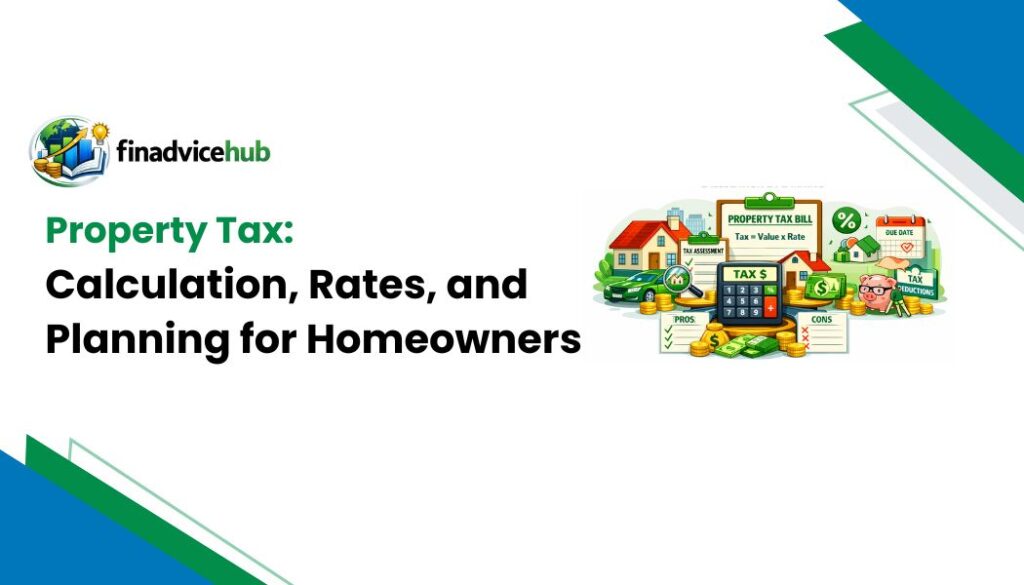
At its core, the property tax calculation formula looks like this:
Assessed Property Value × Local Tax Rate = Annual Property Tax
Example:
- Assessed home value: $400,000
- Local effective tax rate: 1.25%
Calculation:
$400,000 × 0.0125 = $5,000 annually
Monthly escrow impact:
$5,000 ÷ 12 = about $417 per month
Suddenly, the “affordable” mortgage payment doesn’t look quite so affordable.
Using Assessment Value
Many counties assess homes at a percentage of market value.
For example:
| Market Value | Assessment Ratio | Assessed Value |
| $500,000 | 80% | $400,000 |
Then the local tax rate applies to the assessed amount, not the full market value.
This is why homeowners comparing tax bills online often get confused if they don’t understand local assessment ratios.
Including Exemptions and Deductions
Many states offer property tax exemptions that reduce taxable value.
Common examples include:
- Homestead exemptions
- Senior citizen exemptions
- Veteran exemptions
- Disability exemptions
- Agricultural exemptions
Example:
| Item | Amount |
| Assessed Value | $350,000 |
| Homestead Exemption | -$50,000 |
| Taxable Value | $300,000 |
That exemption alone could save hundreds or even thousands annually.
There are also federal tax deductions for homeowners through the SALT deduction (State and Local Tax deduction), though federal deduction caps currently limit benefits for many households.
Real-Life Calculation Examples
Example 1: First-Time Homebuyer in Texas
- Home value: $425,000
- Effective tax rate: 1.8%
- Homestead exemption: $40,000
Estimated taxable value:
$385,000
Annual property tax:
$6,930
Monthly escrow addition:
About $578
This is one reason many buyers relocating to Texas from lower-tax states experience sticker shock despite no state income tax.
Example 2: Florida Retiree
- Condo assessed value: $300,000
- Effective tax rate: 0.98%
- Senior exemption applied
Estimated annual property tax:
Around $2,400–$2,700
Lower taxes become part of retirement planning strategy in states with homestead protections.
Online Calculators and AI Tools
Digital property tax calculators have become much more accurate in recent years.
Modern AI property tax estimation tools can now:
- Predict reassessment increases
- Compare county-level effective rates
- Forecast escrow shortages
- Analyze historical valuation trends
Still, calculators are estimates, not guarantees.
County reassessments, school levies, and voter-approved measures can change tax obligations quickly.
Property Tax Rates
Variation by State and City
Property tax rates by state vary enormously.
Here’s a simplified comparison of effective rates:
| State | Approx. Effective Rate |
| New Jersey | 2.2%+ |
| Illinois | 2.0%+ |
| Texas | 1.6%–1.9% |
| California | ~0.7% |
| Hawaii | ~0.3% |
A lower tax rate doesn’t always equal lower taxes overall because property values matter too.
A 0.7% tax on a $1.5 million California home can still exceed taxes on a cheaper Midwestern property with a higher rate.
Residential vs. Commercial Property
Commercial real estate tax structures often differ from residential taxation.
Commercial properties may face:
- Higher assessment ratios
- Different exemptions
- Additional municipal fees
- Business improvement district charges
Residential homeowners usually receive more protections and exemptions.
Historical Trends
Property taxes have generally increased over time due to:
- Rising home values
- School funding demands
- Infrastructure expansion
- Inflationary municipal costs
One trend worth watching: rapidly growing suburban counties are seeing sharper reassessment spikes than slower-growth rural areas.
That creates affordability pressure for long-term homeowners.
Comparing Effective Tax Rates
The effective tax rate tells you what percentage of your home’s market value you actually pay annually.
Formula:
Annual Property Tax ÷ Market Value × 100
Example:
- Tax bill: $7,200
- Home value: $450,000
Effective rate:
1.6%
This metric helps compare areas more accurately than advertised mileage rates alone.
Example Scenarios
| Scenario | Home Value | Effective Rate | Annual Tax |
| Urban Northeast | $650,000 | 2.1% | $13,650 |
| Texas Suburb | $450,000 | 1.8% | $8,100 |
| Florida Retirement Area | $375,000 | 0.9% | $3,375 |
| Midwest Small Town | $250,000 | 1.4% | $3,500 |
The differences are substantial.
Over a 30-year mortgage, property taxes can total hundreds of thousands of dollars.
Most buyers underestimate that reality.
Planning and Management
Budgeting for Property Taxes
One of the smartest financial habits homeowners can develop is treating annual property tax like a fluctuating expense, not a fixed one.
A good rule:
Expect taxes to rise 2%–5% annually in many growing areas.
Build that assumption into long-term housing affordability calculations.
Tax Payment Schedules
Property tax payment schedules differ by jurisdiction.
Common structures include:
- Annual payment
- Semiannual installments
- Quarterly payments
- Mortgage escrow collection
Missing deadlines can trigger:
- Penalties
- Interest charges
- Tax liens
In extreme cases, unpaid taxes can eventually lead to foreclosure proceedings.
Reducing Property Tax Liability
Legally reducing property taxes often comes down to preparation.
Strategies include:
Apply for Every Eligible Exemption
Many homeowners miss savings simply because they never file paperwork.
Review Your Assessment Carefully
Errors happen more often than people think.
I’ve seen assessments include:
- Incorrect square footage
- Finished basements that don’t exist
- Wrong lot dimensions
- Duplicate improvements
Even small inaccuracies can raise taxes substantially.
Monitor Comparable Sales
If neighboring homes with similar features are assessed lower, you may have grounds for appeal.
Tax Appeals Process
The property tax appeals process sounds intimidating, but it’s often straightforward.
Typical steps:
- Review assessment notice
- Gather evidence
- Compare nearby properties
- Submit appeal before the deadline
- Attend the hearing if necessary
Helpful evidence may include:
- Independent appraisals
- Comparable sales
- Photos of structural issues
- Repair estimates
Some homeowners save thousands annually after successful appeals.
Best Practices for Homeowners
Keep Property Records Organized
Store:
- Tax bills
- Assessment notices
- Exemption approvals
- Renovation permits
Understand Improvement Impact
Major upgrades can increase assessed value significantly.
Adding:
- Pools
- Finished basements
- Large additions
- Detached structures
May increase future property tax obligations.
Challenges and Considerations
Hidden Costs and Fees
Many homeowners focus only on the tax rate while ignoring extra assessments.
Common hidden charges include:
- Stormwater fees
- Garbage collection assessments
- School bonds
- Sidewalk improvement levies
- Fire district taxes
Always review the full tax breakdown before buying property.
Impact on Home Affordability
The impact of property taxes on home affordability is enormous.
A buyer approved for a $2,500 monthly payment may only qualify for:
- A $500,000 home in one county
- A $390,000 home in another
…simply because taxes differ.
This is why experienced buyers compare total monthly ownership cost, not just home price.
Escrow and Mortgage Implications
Mortgage escrow shortages are common after reassessment.
Here’s what happens:
- Taxes rise unexpectedly
- Escrow account becomes underfunded
- Lender increases the monthly payment
- Homeowner experiences payment shock
That increase can feel sudden and stressful.
Especially for first-time homeowners.
Property Value Changes
Property appreciation often creates a double-edged sword.
Your equity rises. So can your taxes.
Fast-growing housing markets tend to produce:
- Larger reassessments
- Higher annual tax bills
- Increased affordability pressure
Some longtime homeowners in appreciating neighborhoods struggle with rising tax burdens despite owning homes outright.
Future Tax Rate Projections
Several trends may shape future home property tax rates:
- Infrastructure spending
- Population growth
- Climate adaptation costs
- School funding needs
- Municipal pension obligations
AI-driven predictive real estate tax modeling is also becoming more common among local governments to estimate future revenue needs.
That could make reassessment systems more data-driven, but also more aggressive.
Common Property Tax Mistakes
Assuming Online Estimates Are Exact
Real estate websites often display outdated tax data.
Always verify directly with county records.
Ignoring Reassessment Notices
Deadlines matter.
Missing an appeal window can lock in higher taxes for years.
Forgetting Exemptions
This happens constantly with:
- Seniors
- Veterans
- First-time homeowners
A missed exemption can mean overpaying indefinitely.
Underestimating Escrow Increases
Homebuyers frequently budget only for current taxes instead of projected reassessed taxes after purchase.
That’s risky.
Expert Tips for Homeowners
1: Compare Effective Rates Before Buying
Two homes with identical prices may have wildly different long-term ownership costs.
Always compare:
- Effective tax rates
- Historical increases
- Local assessment frequency
2: Review Tax Records Annually
Don’t assume county data is correct forever.
Clerical errors happen.
3: Understand Local School Funding
In many areas, school district taxes represent the largest portion of property tax bills.
Researching district funding trends can help predict future increases.
4: Factor Taxes Into Retirement Planning
Retirees often focus on mortgage payoff but overlook rising real estate tax obligations.
Property taxes remain even after the mortgage disappears.
FAQs
What is property tax, and how is it calculated?
Property tax is a local tax charged on real estate based on assessed property value and local tax rates. The standard formula is:
Assessed Value × Tax Rate = Annual Property Tax
How do property taxes vary by state?
Property taxes differ based on:
- Local government budgets
- School funding systems
- Assessment rules
- Home values
States like New Jersey generally have higher effective rates, while Hawaii tends to have lower rates.
Are there exemptions or deductions available?
Yes. Common property tax exemptions include:
- Homestead exemptions
- Veteran exemptions
- Senior citizen exemptions
- Disability exemptions
Federal SALT deductions may also apply.
How does property tax affect mortgage payments?
If taxes are paid through escrow, rising taxes increase monthly mortgage payments because lenders collect additional funds to cover future tax bills.
Can I appeal my property tax assessment?
Yes. Homeowners can appeal assessments if they believe property value estimates are inaccurate or unfair compared to similar properties.
How often are property taxes reassessed?
It depends on the state and county. Some reassess annually, while others reassess every few years.
Are there online property tax calculators?
Yes. Many counties and financial websites provide digital property tax calculators and AI-powered estimation tools for forecasting taxes.
Conclusion
Property tax is one of the most overlooked and underestimated costs of homeownership in America.
It affects:
- Monthly affordability
- Mortgage qualification
- Long-term investment returns
- Retirement planning
- Relocation decisions
And unlike many expenses, it rarely stays flat.
The homeowners who manage property taxes best usually do three things consistently:
- They understand how assessments work
- They review tax records regularly
- They plan proactively instead of reacting to surprises
That approach can save thousands over the life of a home.
If you’re buying, refinancing, or reassessing your long-term housing budget, now’s the time to evaluate your property tax strategy carefully before the next assessment notice arrives.