
Buying a house in America today can feel like running a financial obstacle course.
Interest rates shift constantly. Home prices remain stubbornly high in many cities. And then there’s the question almost every buyer asks at some point:
“How much down payment do I actually need?”
It sounds simple. But it rarely is.
I’ve watched first-time buyers delay homeownership for years because they believed they needed 20% down, even when they qualified for far less. I’ve also seen buyers put nearly all their savings into a home purchase, only to panic later when an emergency repair showed up three months after closing.
The truth sits somewhere in the middle.
A down payment affects far more than just the upfront cost of buying a home. It impacts:
- Your mortgage approval
- Your monthly payment
- Your interest costs
- Your loan options
- Your financial stress level after closing
And in some cases, it determines whether buying a home is realistic at all.
This guide breaks down exactly how down payments work in the United States, how lenders evaluate them, what first-time buyers should know, and how to build a smart strategy without draining your finances.
Because a bigger down payment isn’t always the best move.
Understanding Down Payment
Definition and Purpose
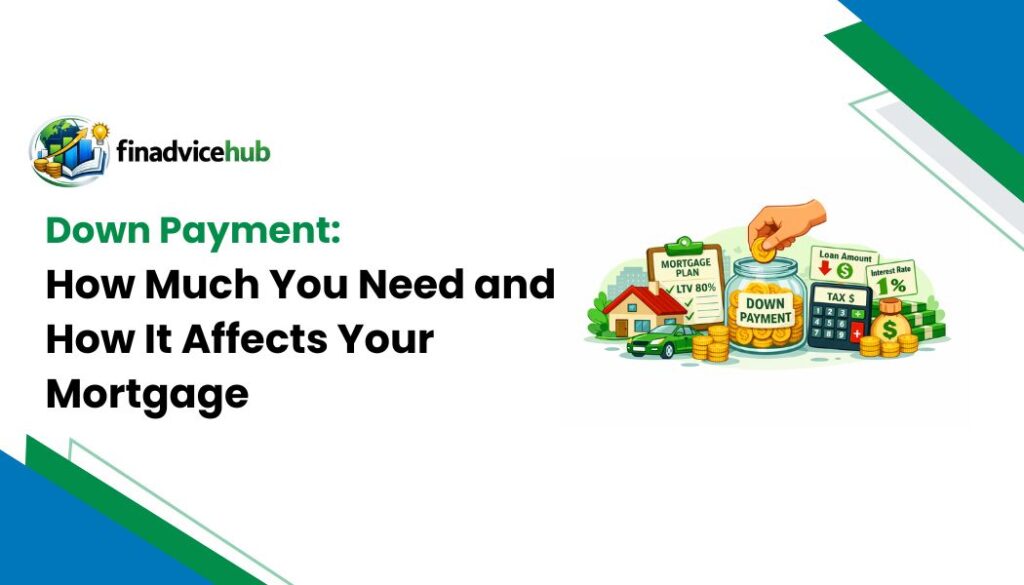
A down payment is the upfront cash you pay toward the purchase price of a home.
The remaining balance gets financed through a mortgage loan.
Example:
| Home Price | Down Payment | Mortgage Loan |
| $400,000 | $40,000 | $360,000 |
Your down payment represents your initial ownership stake in the property.
Lenders care about this because buyers with more equity upfront are generally considered lower-risk borrowers.
Minimum vs. Recommended Down Payment
One of the biggest myths in home financing is that every buyer needs 20% down.
That’s simply not true.
Here’s what many U.S. mortgage programs allow:
| Loan Type | Typical Minimum Down Payment |
| Conventional Loan | 3%–5% |
| FHA Loan | 3.5% |
| VA Loan | 0% |
| USDA Loan | 0% |
Still, there’s a reason the 20% benchmark gets repeated so often.
Putting down 20% often helps buyers:
- Avoid private mortgage insurance (PMI)
- Lower monthly payments
- Reduce long-term interest costs
- Improve loan approval odds
But there’s a trade-off.
A larger down payment can leave buyers cash-poor after closing.
And honestly, that’s more common than many real estate agents admit.
Impact on Loan Approval
Your down payment percentage directly affects lender risk calculations.
A higher down payment can:
- Improve debt-to-income flexibility
- Increase approval odds
- Lower interest rates
- Offset weaker credit in some cases
On the other hand, low-down-payment loans may require:
- Higher credit scores
- Mortgage insurance
- Stronger income verification
- Additional cash reserves
Lenders evaluate the entire borrower profile, not just the down payment alone.
First-Time Homebuyer Considerations
First-time buyers often focus entirely on “getting into a house” while underestimating post-purchase costs.
That’s dangerous.
Closing costs, moving expenses, utility deposits, furniture, repairs, and emergency maintenance can drain savings fast.
I’ve seen buyers celebrate closing day only to face:
- A broken HVAC system
- Roof leaks
- Plumbing issues
- Escrow shortages
This is why many financial advisors recommend keeping an emergency fund even after making a down payment.
A slightly smaller down payment with stronger reserves is often the healthier financial choice.
Relationship to Mortgage Interest
The size of your home down payment affects both:
- Your loan balance
- Your mortgage interest costs
Example:
| Scenario | Down Payment | Loan Amount |
| Buyer A | $20,000 | $380,000 |
| Buyer B | $80,000 | $320,000 |
Buyer B borrows less money, which means:
- Lower monthly payments
- Less total interest paid
- Faster equity growth
Over a 30-year mortgage, the savings difference can become enormous.
Calculating Down Payment
Percentage vs. Fixed Amount
Most lenders discuss down payments as percentages.
Formula:
Home Price × Down Payment Percentage = Down Payment Amount
Example:
- Home price: $500,000
- Down payment: 10%
Calculation:
$500,000 × 0.10 = $50,000
Simple math. Bigger consequences.
Loan-to-Value Ratio (LTV)
The loan-to-value ratio is one of the most important mortgage concepts that buyers rarely understand fully.
Formula:
Mortgage Loan ÷ Property Value = LTV Ratio
Example:
| Home Price | Down Payment | Loan Amount | LTV |
| $400,000 | $40,000 | $360,000 | 90% |
Lower LTV ratios usually mean:
- Better loan terms
- Lower lender risk
- Reduced mortgage insurance costs
High LTV loans may still work well for buyers with strong income stability.
Step-by-Step Calculation
Let’s walk through a realistic down payment calculation example.
Example Home Purchase
| Item | Amount |
| Home Price | $450,000 |
| Down Payment (5%) | $22,500 |
| Estimated Closing Costs | $11,000 |
| Cash Needed at Closing | ~$33,500 |
This is where many buyers get surprised.
The down payment isn’t the only upfront cost.
Closing expenses typically include:
- Loan origination fees
- Appraisal fees
- Title insurance
- Escrow setup
- Prepaid taxes and insurance
That extra layer catches many buyers off guard.
Real-Life Examples
Example 1: First-Time Buyer in Texas
- Home price: $350,000
- FHA down payment: 3.5%
- Down payment amount: $12,250
Advantages:
- Faster path to ownership
- Lower upfront cash needs
Trade-offs:
- FHA mortgage insurance
- Higher monthly payment
Example 2: Conventional Buyer in Colorado
- Home price: $600,000
- Down payment: 20%
- Down payment amount: $120,000
Advantages:
- No PMI
- Lower monthly payment
- Better interest rate options
Trade-off:
- Significant cash tied up in home equity
Online Down Payment Calculators
Modern digital mortgage affordability tools are surprisingly advanced.
Many AI down payment calculators now estimate:
- PMI costs
- Interest savings
- Loan scenarios
- Affordability projections
- Debt-to-income impact
Still, calculators are estimates, not underwriting approvals.
Local taxes, insurance rates, HOA dues, and lender overlays can dramatically change affordability.
Saving for a Down Payment
Budgeting Strategies
Saving for a down payment often requires behavioral change more than mathematical genius.
The buyers who succeed usually:
- Automate savings
- Reduce discretionary spending
- Increase income temporarily
- Set realistic timelines
One effective strategy is creating a separate “house fund” account isolated from daily spending.
Out of sight helps reduce temptation.
Savings Accounts and Investment Options
Where should you keep down payment money?
That depends largely on timing.
| Timeline | Better Option |
| Less than 2 years | High-yield savings account |
| 3–5 years | Conservative investment mix |
| 5+ years | Broader investment strategy |
Money needed soon generally shouldn’t sit in volatile investments.
A stock market dip right before closing can derail an entire purchase plan.
Assistance Programs for Buyers
Many buyers don’t realize that down payment assistance programs exist.
Common programs include:
- State housing grants
- Employer assistance
- FHA assistance programs
- Local municipal grants
- Forgivable second mortgages
Eligibility often depends on:
- Income
- Location
- Occupancy status
- First-time buyer qualification
Some programs can cover thousands in upfront costs.
Yet many eligible buyers never apply.
Tips to Reduce the Required Down Payment
There are legitimate ways to minimize the down payment burden without making reckless decisions.
Consider Lower-Down-Payment Loan Programs
Conventional 3% programs may work for qualified buyers.
Negotiate Seller Credits
In some markets, sellers contribute toward closing costs.
Improve Credit Before Applying
Higher credit scores can unlock more favorable loan structures.
Explore Multi-Generational Buying
Shared ownership arrangements sometimes help families enter expensive housing markets.
Not every strategy fits every buyer. But flexibility matters.
Timeline Planning
Most successful buyers don’t “accidentally” save for a home.
They build a timeline.
Example:
| Goal Timeline | Monthly Savings Needed |
| $30,000 in 5 years | ~$500/month |
| $50,000 in 4 years | ~$1,040/month |
| $75,000 in 6 years | ~$1,040/month |
Seeing the monthly target makes the goal feel more tangible.
Challenges and Considerations
High Down Payment Barriers
Housing affordability remains one of the biggest financial challenges in the U.S.
In high-cost cities, even a modest down payment can equal:
- Several years of savings
- Student loan balances
- Entire retirement contributions
This creates difficult trade-offs for younger buyers, especially.
Impact on Monthly Mortgage
Larger down payments usually reduce:
- Principal balance
- Monthly payment
- Interest expense
- PMI requirements
But buyers shouldn’t stretch so far that they lose financial flexibility.
A lower payment means little if you can’t handle emergencies afterward.
Tax Implications
Your down payment itself is generally not tax-deductible.
However:
- Mortgage interest may be deductible
- Property taxes may qualify for deductions
- Mortgage insurance deductibility rules can change periodically
Buyers should consult a qualified tax professional for state-specific implications.
Balancing Down Payment With Emergency Funds
This matters more than many online calculators admit.
Homeownership comes with surprise costs.
Sometimes immediately.
A healthy post-closing emergency reserve can prevent:
- Credit card debt
- Personal loans
- Financial stress
- Deferred maintenance
Many financial planners recommend maintaining at least 3–6 months of expenses after closing.
Avoiding Common Mistakes
Mistake #1: Emptying Savings Completely
This is probably the most dangerous mistake first-time buyers make.
Mistake #2: Ignoring Total Monthly Cost
Mortgage principal is only part of the equation.
Also consider:
- Taxes
- Insurance
- HOA dues
- Utilities
- Maintenance
Mistake #3: Chasing the Maximum Approval Amount
Just because a lender approves a number doesn’t mean it’s comfortable financially.
There’s a difference between “qualified” and “affordable.”
Mistake #4: Waiting Forever for 20%
In some markets, rising home prices outpace savings growth.
Waiting can sometimes increase the challenge rather than solve it.
Best Practices
Choosing the Optimal Down Payment Amount
The “best” down payment depends on:
- Income stability
- Emergency savings
- Interest rates
- Housing market conditions
- Long-term financial goals
For many buyers, the optimal number isn’t the maximum possible amount.
It’s the amount that balances affordability with financial safety.
Planning Early
Buyers who start planning 2–5 years ahead usually have:
- Better credit
- Stronger savings habits
- More lender options
- Less financial stress
Time creates flexibility.
Comparing Lender Options
Different lenders offer very different:
- PMI pricing
- Minimum down payment rules
- Interest rates
- Assistance programs
Shopping around matters more than many buyers realize.
Even a small rate difference can cost tens of thousands over time.
Using Calculators for Accuracy
Digital mortgage calculators can help buyers model:
- Affordability
- Monthly payments
- PMI costs
- Interest scenarios
- Cash-to-close requirements
They’re useful planning tools, not guarantees.
Monitoring Home Affordability
Home affordability changes constantly based on:
- Interest rates
- Property taxes
- Insurance costs
- Local inventory
- Wage growth
Smart buyers monitor the entire market picture instead of focusing only on home prices.
Expert Tips for Buyers
Pro Tip #1: Focus on Monthly Sustainability
A manageable payment matters more than winning a bidding war.
Pro Tip #2: Protect Your Cash Reserves
Homes are expensive to maintain. Unexpected repairs aren’t rare; they’re normal.
Pro Tip #3: Improve Credit Before Increasing Down Payment
Sometimes raising your credit score saves more than increasing your down payment.
Pro Tip #4: Understand PMI Removal Rules
Some conventional loans allow PMI removal after reaching certain equity thresholds.
That can reduce future monthly costs substantially.
Conclusion
A down payment is more than a number on a mortgage application.
It’s a balancing act between:
- Affordability
- Financial flexibility
- Long-term stability
- Risk management
The right strategy isn’t always the biggest possible down payment.
Sometimes the smartest move is preserving cash reserves, using assistance programs, improving credit first, or choosing a lower-risk monthly payment structure.
The buyers who navigate this process best usually think beyond closing day.
They plan for life after the keys are handed over.
And that mindset often matters more than the exact percentage they put down.
FAQs
How much down payment is needed in the USA?
Minimum down payment requirements vary by loan type. Some conventional loans require as little as 3%, while FHA loans typically require 3.5%. VA and USDA loans may allow qualified buyers to purchase with 0% down.
Does a bigger down payment lower monthly mortgage payments?
Yes. A larger down payment reduces the loan amount, which usually lowers monthly mortgage payments and long-term interest costs.
Is 20% down required to buy a home?
No. Many buyers purchase homes with less than 20% down. However, putting down less than 20% often requires mortgage insurance.
What is the loan-to-value ratio?
The loan-to-value ratio (LTV) compares the mortgage loan amount to the property value. Lower LTV ratios generally improve loan terms and reduce lender risk.
Are there down payment assistance programs in the U.S.?
Yes. Many states, cities, and housing agencies offer grants, forgivable loans, and buyer assistance programs for eligible homebuyers.
Should I use all my savings for a down payment?
Usually no. Maintaining emergency savings after closing is important because homeownership often comes with unexpected repair and maintenance expenses.
How do online down payment calculators work?
Digital mortgage calculators estimate down payments, monthly payments, PMI costs, and affordability based on home price, loan terms, taxes, and interest rates.